

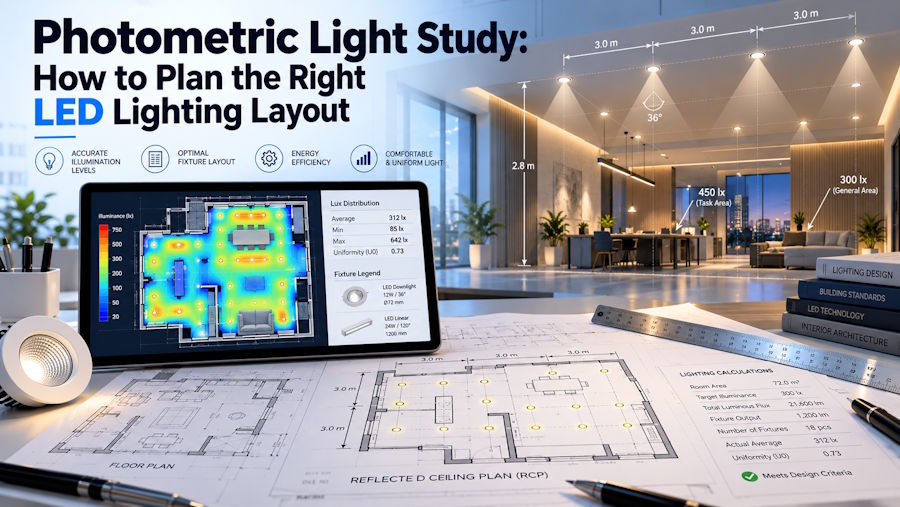
A photometric light study shows how light will spread across a property before lighting fixtures are purchased or installed. It helps property owners, contractors, and facility managers choose the right LED lights, mounting heights, fixture locations, and spacing. The goal is to achieve the required brightness without wasting energy or leaving dark areas.
Choosing LED fixtures based only on wattage can lead to poor results. A light may produce plenty of lumens but still fail to illuminate the entire parking lot, warehouse, or sports court evenly. A photometric study uses lighting data and site measurements to predict how the proposed system should perform.
This guide explains what a photometric light study includes, how to read its results, and when to use one for an LED lighting project.
What Is a Photometric Light Study?
A photometric light study is a computer-generated lighting plan that predicts how much light will reach specific areas of a site. It uses fixture data, site dimensions, mounting heights, and fixture positions to calculate expected illumination.
Lighting designers use specialized software and photometric files supplied by fixture manufacturers. These files describe how a particular LED fixture distributes light in different directions.
A study can help determine:
- The number of LED fixtures required.
- Suitable pole or ceiling mounting heights.
- Fixture positions and aiming angles.
- Expected light levels across the property.
- Light uniformity and potential dark spots.
- Potential glare and unwanted light spill.
The results help identify design problems before installation. This can reduce unnecessary fixture purchases and costly layout changes.
Why Is a Photometric Study Important?
Every property has different lighting requirements. A small parking lot needs a different layout from a warehouse, loading dock, or sports field.
A photometric study helps match the lighting system to the actual site. It also allows designers to compare different fixtures and layouts before the buyer commits to an order.
1. Achieve the Required Light Levels
Light levels should match the intended activity. A pedestrian walkway does not need the same illumination as a warehouse inspection area.
A photometric study calculates expected illumination at different points. Designers can compare these results with applicable codes, project specifications, and industry recommendations.
2. Reduce Dark Spots
A parking lot may look bright directly beneath each fixture but remain dark between poles. This happens when fixture spacing, mounting height, or beam distribution is unsuitable.
A lighting plan helps identify these gaps. Designers can then adjust pole positions, fixture optics, or light output to improve coverage.
3. Avoid Unnecessary Lighting Costs
Installing more fixtures does not always produce a better result. Excessive lighting can increase equipment and electricity costs while creating glare.
A photometric study helps compare practical options. The final layout may require fewer fixtures, different optics, or adjusted mounting heights to achieve the required performance.
4. Control Glare and Light Spill
Poorly aimed fixtures can shine into nearby homes, windows, roads, or neighboring properties.
A suitable lighting plan considers fixture direction, optical distribution, and property boundaries. Where required, it can also evaluate spill-light limits and glare-control measures.
What Does a Photometric Lighting Plan Show?
A photometric report contains more than a drawing of fixture locations. It combines a site layout with calculated lighting results.
Common elements include:
Fixture Layout
The layout shows where each light will be installed. Outdoor plans usually identify pole locations and mounting heights. Indoor plans show fixture positions relative to walls, aisles, and other building features.
Foot-Candle or Lux Grid
A calculation grid displays predicted illumination at selected points across the site.
Foot-candles and lux measure illuminance, or the amount of light reaching a surface. One foot-candle equals approximately 10.764 lux.
Higher values indicate more illumination at a measurement point. However, the highest number is not necessarily the best result. The design must meet the required light levels without excessive brightness or poor uniformity.
Uniformity Ratios
Uniformity describes how evenly light is distributed across an area.
A design may show an acceptable average light level but still have dark corners. Reviewing minimum and average values helps reveal these differences.
The required uniformity depends on the application and the relevant lighting standard or project specification.
Fixture Schedule
The fixture schedule identifies the proposed lighting equipment. It may include fixture models, wattage, lumen output, optics, color temperature, and quantity.
Check that the products listed in the report match the fixtures in the quotation. Different optics or fixture models can change the predicted results.
How to Get a Photometric Study for an LED Lighting Project
An accurate study depends on good project information. Missing dimensions or incorrect mounting heights can make the results less reliable.
Prepare the following details before requesting a lighting plan:
- Site dimensions: Provide a drawing, scaled plan, or accurate measurements.
- Mounting heights: Include existing or proposed pole heights, ceiling heights, and mounting positions.
- Fixture locations: Mark existing poles or suggest possible locations.
- Lighting requirements: State the target foot-candle or lux level, if known.
- Project conditions: Identify buildings, trees, racks, walls, and other obstructions.
- Lighting concerns: Mention glare, neighboring properties, security cameras, or light-spill restrictions.
- Project budget: Provide a budget range when fixture selection and cost are important.
If you are upgrading an existing system, include photographs and details of the current fixtures. This information can help the designer compare the existing setup with the proposed LED installation.
Applications That Benefit From a Photometric Study
Photometric studies are useful whenever lighting coverage, uniformity, or documented light levels matter.
Parking Lots and Commercial Properties
A parking lot study helps determine pole positions, fixture output, spacing, and coverage across parking spaces and drive lanes. It can also help control light spill near property boundaries.
Warehouses and Industrial Buildings
Warehouse lighting depends on ceiling height, aisle arrangement, storage racks, and the tasks performed in the space. A photometric study helps identify suitable fixture placement and expected illumination at working surfaces.
Sports Courts and Fields
Sports lighting requires careful attention to uniformity, glare, and visibility. The design must account for the sport, playing level, mounting positions, and applicable lighting requirements.
Loading Docks and Security Areas
Loading docks need enough light for vehicle movement and material handling. Security areas may require suitable illumination around entrances, fences, and access points.
A project-specific study helps balance visibility with energy use and unwanted light spill.
How to Read a Photometric Study
Start by checking whether the drawing matches the actual property dimensions and proposed fixture positions. Then review the lighting calculations.
- Check the average light level. Confirm that it meets the project's target.
- Review minimum values. Look for areas that may be too dark.
- Compare uniformity. Check whether illumination is reasonably consistent across the required area.
- Verify fixture details. Confirm the model, output, optics, and mounting height.
- Review property boundaries. Check for potential light spill where restrictions apply.
Do not judge a plan by its average foot-candle value alone. A reliable assessment also considers minimum illumination, uniformity, glare, and the requirements of the site.
A photometric study predicts performance; it does not guarantee the final installed result. Actual conditions, installation accuracy, obstructions, and maintenance can affect lighting performance.
Photometric Study vs. Lighting Quote
A lighting quote and a photometric study serve different purposes.
A quote lists the proposed products, quantities, and prices. A photometric study evaluates how the proposed lighting arrangement is expected to perform across the site.
For projects with specific illumination targets, permit requirements, or complex layouts, reviewing both documents helps buyers understand what they are purchasing and whether the design meets their needs.
Conclusion
A photometric light study helps turn LED lighting selection into a planned, measurable process. It predicts illumination, shows fixture locations, and helps identify problems with coverage, uniformity, and light spill before installation.
For the best results, provide accurate site information and verify that the recommended fixtures match the final quotation. A well-prepared study can help you choose a practical lighting layout, control costs, and achieve the required light levels.

