

Key takeaways
- Rackspace's 2026 price hikes and shrinking support have pushed buyers toward alternatives across managed hosting, developer-first cloud, and enterprise hyperscalers.
- Liquid Web by Nexcess stands out for its flexibility, letting you choose fully managed or self-managed hosting with transparent pricing either way.
- Developer-first platforms like DigitalOcean, Vultr, and Hetzner win on price-to-performance and API access, but they leave more of the operational work on your team.
- The right alternative depends on what you need most: a safe migration, raw infrastructure control, or hyperscale reach, not just the lowest sticker price.
If you're reading this, you've probably already seen the invoice. Rackspace raised prices aggressively throughout 2026, in some cases doubling or tripling infrastructure costs with as little as 30 days' notice. Many teams are shopping around for the first time in years.
To be fair, Rackspace’s SLAs are still solid, and its support organization is large. It’s not a bad hosting provider. We simply wanted to look at what else is out there and how each option actually stacks up.
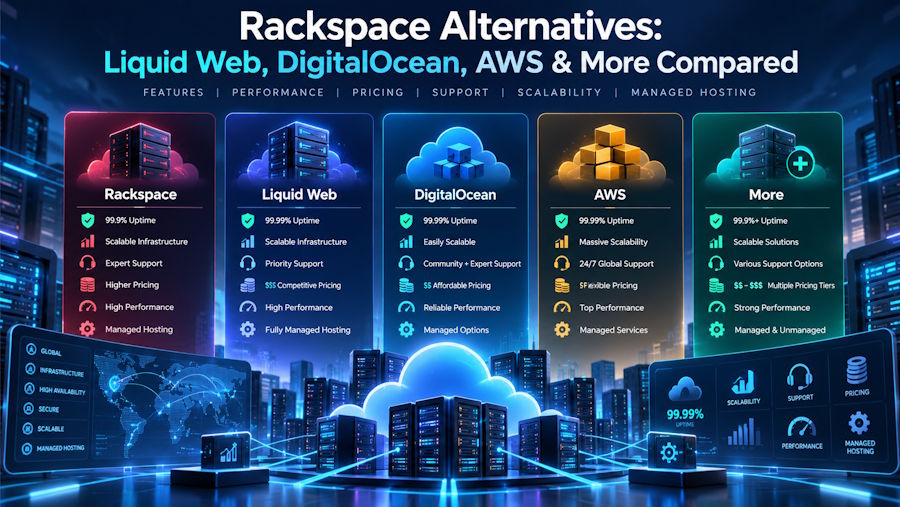
The alternatives below fall into three rough categories: managed hosting that takes infrastructure off your plate, developer-first cloud platforms built for speed and price, and the hyperscalers that make sense if you're already deep into a specific ecosystem. We tested, researched, and compared each one so you can figure out which category fits your situation before you pick a provider.
1. Liquid Web by Nexcess
Liquid Web by Nexcess offers a choice between fully managed and self-managed hosting, instead of forcing every customer into one support model.
The managed tier includes proactive monitoring, OS updates, and 24/7 support, handled for you. The self-managed (unmanaged) tier hands over full root access and lets you run your own stack, while Liquid Web keeps the hardware, power, and network layer solid underneath you. Either way, support is included in the base price rather than sold as a separate add-on.
Pricing is published, not hidden behind a quote request. Self-managed plans start around $55 a month for entry-level configurations, and managed dedicated plans start around $169 a month.
What stands out:
- Flexibility: choose fully managed, core-managed, or self-managed depending on how much you want handled for you
- Transparent pricing: published rates instead of custom quotes, with support bundled in rather than billed separately
- Migration support: customers consistently mention migration help as a standout part of the experience, especially for larger or older sites
Where Rackspace tends to win is scale. If you're running a sprawling, multi-cloud enterprise environment across several continents with strict regulatory requirements, Rackspace's deeper compliance certifications and broader global footprint may still make sense.
For most small to mid-sized businesses and growing ecommerce or SaaS teams, though, Liquid Web covers the same core reliability and security ground at a lower, clearer price.
Best for: businesses that want the flexibility to choose managed or self-managed hosting, with transparent pricing and support included either way.
Watch-outs: teams running complex, multi-region enterprise environments with heavy compliance requirements may still find Rackspace's footprint and certifications a better match.
2. DigitalOcean
DigitalOcean built its name on a clean interface and predictable billing, and that reputation holds up.
Droplets, managed databases, Kubernetes, and object storage are all easy to understand, which lowers the barrier for teams who don't want infrastructure management to become a full-time job. It's popular for startups and smaller businesses moving off bigger, more complex platforms.
The catalog is smaller than what you'd get from AWS or Azure, so if your needs grow into deep enterprise tooling, you may eventually outgrow it.
Best for: startups, SMB web apps, and teams that value simplicity over breadth.
Watch-outs: review your costs again as workloads scale. Easy entry can hide growth friction later.
3. Vultr
Vultr tends to win on raw price-to-performance.
You can spin up cloud compute, bare metal, Kubernetes, or GPU instances quickly, across a wide range of global locations, without paying for the overhead that comes with bigger enterprise platforms. For cost-sensitive projects and staging environments, that combination is hard to beat.
The trade-off is a smaller service catalog. If you expect deep PaaS options or layered enterprise support, Vultr can feel lean.
Best for: cost-sensitive apps, staging environments, and technically capable teams that know what they need.
Watch-outs: fewer managed platform services than the hyperscalers means more responsibility stays with your team.
4. Hetzner
Hetzner has built a loyal following among developers who want full automation at the lowest possible price.
It offers a REST API, an official CLI, an hcloud Terraform provider, and Ansible integration, all documented for its Cloud line. Pricing runs through a server configurator rather than a flat rate, but it remains one of the cheapest ways to get genuinely capable infrastructure.
One caveat worth flagging: this level of automation support applies specifically to Hetzner Cloud. Its dedicated root servers are a separate product line with less documented API and IaC coverage, so confirm which one you're actually comparing before you commit.
Best for: teams comfortable running their own stack who want the most automation-complete option at the lowest price point.
Watch-outs: confirm whether you need cloud or dedicated hardware. The automation story differs between the two.
5. Kamatera
Kamatera offers one of the most complete infrastructure-as-code setups at the low end of the pricing spectrum.
It provides an API, an official CLI, an official Terraform provider, and an official Ansible collection, and pricing starts around $4 a month for entry-level cloud servers, scaling up to configurations with over 100 vCPUs. It even sells a pre-configured Ansible hosting product with Ansible already installed.
Best for: teams that want complete IaC coverage without a high price of entry.
Watch-outs: Kamatera's core product is cloud and VPS. If you need single-tenant dedicated hardware, that's a separate, pricier tier.
6. OVHcloud
OVHcloud appeals to teams that want transparent, line-item pricing across VPS, public cloud, and dedicated hardware.
It offers an official CLI covering Public Cloud, Baremetal, VPS, and IAM, plus an official Terraform provider with bare-metal-specific guides. Ansible support exists only through community-maintained collections rather than an official one, so factor that in if Ansible is central to your workflow.
Best for: budget-conscious teams who want CLI and Terraform access to real bare-metal servers, not just cloud VMs.
Watch-outs: if Ansible is your primary automation tool, you'll be working with community modules instead of vendor-maintained ones.
7. Hivelocity
Hivelocity makes the most sense when your priority is bare metal, low-latency U.S. infrastructure, and direct control over the physical server layer.
Configurations range from entry-level setups with promotional pricing around $97 a month to higher-performance dual-Xeon systems with substantial bandwidth. Management can be added on top of the base configuration depending on how much you want to outsource, which gives you flexibility most pure cloud providers don't offer.
Best for: performance-sensitive applications and teams that want hardware control with optional managed support layered on top.
Watch-outs: this is an infrastructure-first provider. If you want a polished, all-in-one managed platform, look elsewhere on this list first.
8. AWS
AWS remains the baseline every infrastructure-as-code workflow gets measured against.
Compute, storage, security, databases, analytics, and AI tooling all live under one ecosystem, which lets teams build far beyond what a traditional managed host typically offers. EC2 Dedicated Hosts and Bare Metal instances provision through the AWS CLI, SDKs, and a mature, jointly maintained Terraform provider.
The trade-off is complexity. AWS works best when someone on your team genuinely understands architecture, billing, and governance, because the service catalog is deep enough to create accidental sprawl if you design by habit instead of by cost model.
Best for: platform teams and organizations that already have cloud governance in place.
Watch-outs: usage-based pricing takes real modeling to forecast. If you want predictable flat-rate billing, this isn't the easiest path.
9. Microsoft Azure
Azure fits naturally if your stack already runs on Microsoft 365, Windows Server, SQL Server, or Active Directory.
That alignment is the real selling point here, not novelty. Enterprises with existing Microsoft licensing and hybrid environments usually find Azure easier to justify than a provider that forces them to redesign their operational model from scratch.
Pricing governance is the catch. Azure can work well, but only if someone owns policy, tagging, and cost review from the start.
Best for: Microsoft-centric IT teams, hybrid deployments, and regulated organizations with existing Microsoft investment.
Watch-outs: without active cost governance, spend tends to drift quickly.
10. Google Cloud
Google Cloud draws teams that care more about performance, Kubernetes, and data services than legacy hosting patterns.
It's a strong fit for application teams already thinking in containers and managed pipelines, and automatic discounts mean you don't have to lock into long-term commitments to see savings. Its Kubernetes service and data tooling pair especially well with teams already using BigQuery or Vertex AI.
The trade-off is footprint. Google Cloud has fewer U.S. regions than AWS or Azure, and some services carry regional limitations worth checking before you move past a pilot.
Best for: containerized applications, analytics-heavy platforms, and teams comfortable with cloud-native operations.
Watch-outs: review region coverage and service availability carefully before production rollout.
How the alternatives compare
| Provider | Category | Starting price | API / CLI / Terraform | Managed support | Best for |
|---|---|---|---|---|---|
| Rackspace | Managed / cloud | Varies, rising sharply in 2026 | Yes | Yes, but slower response times reported | Teams with an existing contract and no urgent reason to move |
| Liquid Web by Nexcess | Managed or unmanaged hosting | ~ $55/mo unmanaged | Partial | Optional, tiered (fully managed, core-managed, or self-managed) | Teams that want flexibility and transparent pricing |
| DigitalOcean | Developer cloud | ~$4/mo | Yes | Limited | Simple apps, startups |
| Vultr | Developer cloud | Hourly, low entry | Yes | Limited | Cost-sensitive, technical teams |
| Hetzner | Developer cloud | Quote-based, low cost | Yes | None | Automation-heavy teams |
| Kamatera | Developer cloud | ~$4/mo | Yes | Limited | IaC coverage on a budget |
| OVHcloud | Dedicated / cloud | ~$163/mo | Yes | Limited | Bare metal with CLI access |
| Hivelocity | Bare metal | ~$97/mo | Partial | Optional, tiered | Hardware control with flexibility |
| AWS | Hyperscaler | Usage-based | Yes | Optional, paid | Platform teams with governance |
| Azure | Hyperscaler | Usage-based | Yes | Optional, paid | Microsoft-integrated stacks |
| Google Cloud | Hyperscaler | Usage-based | Yes | Optional, paid | Containerized, data-heavy workloads |
How to choose the right alternative
Start with what you're actually trying to solve.
If you want support handled for you from day one, Liquid Web's fully managed tier covers monitoring, updates, and 24/7 help without the extra fees. If you'd rather keep full control of the stack yourself, Liquid Web's self-managed option gives you root access and a solid hardware foundation underneath, without paying for management you don't need.
If you need full automation on top of raw infrastructure, a developer-first platform like Hetzner or Vultr gives you more control per dollar. If you need hyperscale reach or you're already tied into Microsoft's or Google's ecosystem, AWS, Azure, or Google Cloud make more sense than a managed host ever will.
None of these are wrong answers. They're just built for different problems.
What switching off Rackspace actually involves
Migrations stall when they turn into surprise projects nobody planned for.
A well-run move off Rackspace usually follows a similar shape regardless of which provider you choose:
- Assessment: someone maps your current workloads, dependencies, and anything that can't tolerate downtime.
- Scoped migration plan: the provider defines exactly what moves, in what order, and on what timeline, including workloads other providers tend to leave out of scope.
- Cutover: the actual move happens on a schedule you control, not one dictated by a vendor's maintenance window.
- Post-migration support: someone stays accountable after the move, instead of considering the job done the moment the servers are live.
That last step is where a lot of providers quietly drop off. A fully managed partner treats the migration as the start of the relationship, not the end of it.
Rackspace competitor FAQs
Why is Rackspace raising prices in 2026?
Rackspace has implemented price increases throughout 2026, because of aging hardware. It's driven a wave of customers to actively compare alternatives.
What's the cheapest Rackspace alternative?
Among developer-first platforms, Kamatera and DigitalOcean both start around $4 a month for entry-level configurations. Pricing scales quickly depending on your resource needs, so compare actual specs before assuming the lowest sticker price is the best deal.
Is there a Rackspace alternative with no long-term contract?
Yes. Several providers on this list, including Liquid Web by Nexcess, DigitalOcean, and Vultr, offer flexible or month-to-month billing instead of locking you into a multi-year agreement.
How long does switching away from Rackspace take?
It depends on the complexity of your workloads and how many systems need to move. A scoped assessment early in the process gives you a realistic timeline instead of a guess, which is one reason a managed migration partner can save real time compared to handling it in-house.
Finding your Rackspace alternative
There's no single best replacement for Rackspace. There's only the option that fits how your team actually works.
If raw infrastructure control and the lowest possible cost are what you're after, Hetzner, Vultr, or Kamatera deserve a close look. If you're already committed to Microsoft or Google's ecosystem, Azure or Google Cloud will feel like the natural next step. And if what's holding you back is the fear of a broken migration more than the fear of the next invoice, that's exactly the problem Liquid Web by Nexcess set out to solve.

