

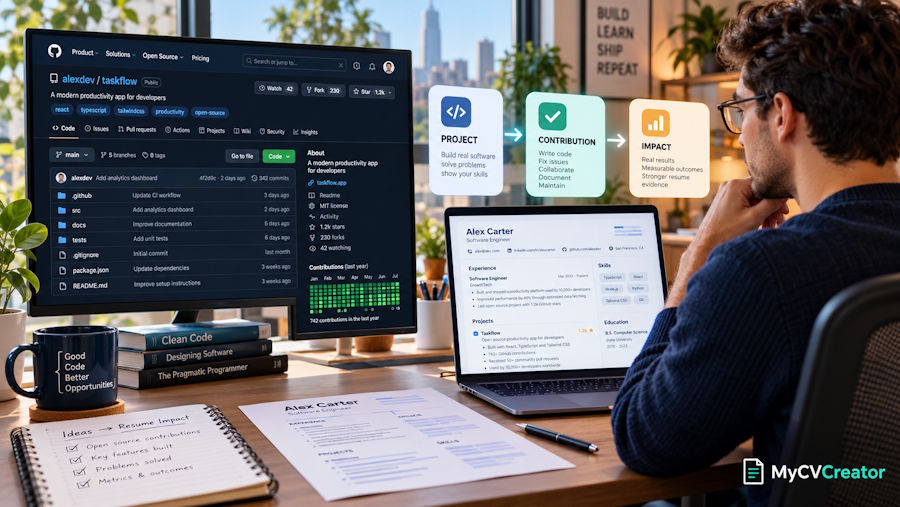
A GitHub repository can contain weeks of thoughtful work and still tell a hiring manager very little. The code may be public, but the problem it solves, your contribution and the decisions behind it are not always obvious.
Adding a GitHub link to your resume is a useful start. Making that link worth opening takes another step: connecting a specific claim on your resume to evidence someone can inspect.
For developers applying for their first role, changing specialisms or returning to the job market, this is a practical way to explain ability without relying on a long list of technologies.
Choose a project that answers the employer's questions
Start with the vacancy rather than your repository list. What kind of work would you be expected to do?
A backend position might call for API development, data modelling and troubleshooting. A frontend role could emphasise accessible interfaces, state management and integration with existing services. Choose a project that gives you something concrete to discuss in those areas.
Your largest project is not automatically your strongest example. A small booking application with clear validation and useful tests may communicate more than an ambitious marketplace with unfinished features.
Select projects that you understand well enough to explain. If a repository began as a tutorial, identify the original exercise and describe what you changed independently. Learning from guided work is normal; presenting the entire result as an original implementation creates a misleading impression.
Give each project an understandable introduction
A project name and technology stack leave too much interpretation to the reader.
Consider this hypothetical resume entry:
TaskFlow — React, Node.js, PostgreSQL
It identifies tools but says nothing about the work. A more useful introduction would be:
TaskFlow — Independent task-management prototype for small teams. Built task assignment, status tracking and role-based access using React, Node.js and PostgreSQL.
This establishes the setting, purpose and scope. It also makes clear that the project is a prototype rather than a commercial product with paying customers.
Use the same description in the repository's README. Consistent names and project status help readers connect the resume to the code.
Write bullets around implementation decisions
A strong project bullet explains an action and why it mattered within the application. You do not need to describe every component.
For example:
| Vague statement | More useful hypothetical alternative |
|---|---|
| Built a secure API | Added server-side ownership checks to task-update endpoints and tested attempts to modify another user's tasks. |
| Improved performance | Replaced per-item database lookups with a joined query on the project-list endpoint. |
| Created a responsive interface | Built a task board with narrow-screen layouts and keyboard-accessible controls. |
| Worked with a team | Implemented invitation handling and reviewed pull requests for the notification feature in a three-person project. |
Use these as patterns, not claims to copy. Every statement should describe work you actually completed and can explain.
Notice that the examples identify boundaries. Testing ownership checks does not establish that an entire application is secure. Improving one query does not prove that every page became faster.
Make the README useful to a reviewer
Treat the README as the entrance to your evidence. A reviewer should be able to understand the project before deciding whether to run it.
Include the problem, intended users, current status and your role. Follow with a concise explanation of the architecture, setup instructions and test commands.
If setup requires configuration, provide an example environment file containing placeholders rather than credentials. Explain which dependencies are necessary and how to create sample data.
A screenshot or short demonstration can help communicate the user journey. It should support the technical explanation rather than replace it.
For a team repository, point to the features or pull requests that demonstrate your contribution. A reader should not have to infer ownership from the size of the codebase.
Show how you checked the work
Tests become useful resume evidence when you can explain the behaviour they verify.
For a booking application, you might test conflicting reservations, invalid dates or attempts to access another account's bookings. For an import feature, useful cases could include missing fields, duplicate records and an interrupted operation.
Describe the checks you implemented and their limits. “Wrote integration tests for booking validation” is more informative than “Fully tested application.”
If a test exposed a defect, a brief case-study note can explain what failed and how you corrected it. This gives an interviewer a concrete example of your debugging process.
Do not add tests solely to make the repository appear more sophisticated. Choose checks that address realistic failure modes.
Use metrics only when the measurement is defensible
Performance numbers can strengthen a claim, but they need context. A local benchmark is not a production result, and a small test dataset may behave differently from real traffic.
If you report an improvement, record the environment, dataset, test scenario and measurement method. Explain whether you measured server response time, database execution or the browser's rendering behaviour.
Without reliable measurements, state the implementation change directly. Replacing repeated database calls is still a meaningful engineering decision even when you cannot justify a percentage improvement.
Similarly, distinguish demonstration users, test participants and active customers. A deployed application is not automatically a commercially used product.
Connect the resume to a manageable set of evidence
Keep the resume concise. Use a short project description and a few relevant bullets, then link to the repository or a case study for detail.
Tools such as MyCVCreator can help organise your experience, skills and projects into a structured resume. Prepare the evidence before choosing a layout so that important technical details are not squeezed into an unreadable block.
Use descriptive links and check the exported document. Make sure the repository is accessible to someone who is not signed into your account.
For confidential work, do not publish code or screenshots without permission. An authorised, anonymised case study can explain your contribution while respecting the project's restrictions.
Be ready to explain the difficult part
Before applying, choose one decision from each project and practise explaining it aloud. What alternatives did you consider? What constraint influenced the choice? What would you change with more time?
If you used AI-generated code, review it carefully and understand the behaviour you are claiming as evidence. Explain its role when relevant, especially if an assessment has explicit rules about assistance.
You do not need to present a flawless project. You need an accurate account of work you understand.
A useful GitHub link completes the story your resume begins. The resume identifies the contribution; the repository makes it possible to examine the implementation, testing and judgement behind it.

