

The hidden cost of finding music is not always the license. Sometimes it is the 40 minutes spent listening to tracks that are almost right, but not quite right for the edit.
AI changes that workflow. Creators can generate original tracks, reshape existing audio, or use an AI song cover tool to test how a familiar song idea might feel with a different vocal direction. Instead of waiting until the video is finished and then searching for music, creators can experiment with sound while the edit is still taking shape.
That is the real appeal of AI music for content creators. It is not about suddenly becoming a producer. It is about removing friction between an idea, an edit, and the sound that connects them.
Faster: Spend Less Time Searching for the Right Track
Most creators do not need "good music" in the abstract.
They need the right 12 seconds under a product reveal, a background bed that does not fight with a voiceover, or an intro that feels recognizable enough to reuse every week.
That is where traditional music search can become frustrating.
A creator may open a stock library, filter by "uplifting," "cinematic," or "electronic," and still end up listening to dozens of tracks that are technically relevant but do not fit the timing or mood of the video.
An AI music creation platform turns that process around. Instead of asking, "Which available track is close enough?" creators can describe what the edit actually needs.
For example:
"Warm indie electronic background music with soft guitar, light percussion, and a gradual build for a sunset travel montage."
The first result may not be perfect, but it gives the creator something concrete to react to.
If the drums are too strong, reduce them. If the build takes too long, ask for an earlier lift. If the track feels too emotional for the scene, make it lighter.
That feedback loop is often faster than returning to a music library and beginning another search from scratch.
For creators publishing several videos a week, that difference matters.
Cheaper: Lower the Cost of Testing Ideas
AI music is often described as "cheaper," but the useful part is not simply that it costs less than hiring a musician.
The bigger advantage is that experimentation becomes cheaper.
Imagine a small brand creating three versions of the same product video.
One version feels playful. Another feels cinematic. The third is minimal and clean.
Commissioning three finished tracks before the team knows which direction works best would be inefficient. With AI, those ideas can be tested quickly against the edit first.
The team can then choose the strongest direction and decide whether it is good enough as generated, needs more editing, or deserves professional production.
That is a much smarter use of budget.
AI is especially practical for content that has a short lifespan: daily social posts, internal demos, short ads, test campaigns, or early creative concepts.
Not every piece of content needs a custom score.
At the same time, that does not make professional musicians less valuable.
A major campaign, artist release, film project, or long-term brand identity may still benefit from a composer, producer, or sound designer.
The point is not to replace that work. It is to avoid paying premium production costs before you even know which musical direction works.
Smarter: Build Music Around the Edit
This is probably the most interesting shift.
Creators have traditionally found music first and then adjusted the video around it.
AI makes the opposite possible.
Suppose a product reveal happens at 11 seconds.
A stock track may have its strongest beat drop at 17 seconds. The editor then has two choices: change the pacing of the video or accept that the music and visual do not quite land together.
With generated music, the creator can ask for a shorter build and earlier payoff.
That sounds like a small difference, but it changes the relationship between music and editing.
The same applies to voiceovers.
A talking-head video usually does not need dense vocals or a dramatic arrangement. It may need restrained percussion, a simple melodic bed, and enough space for speech.
A travel montage may need the opposite: movement, energy, and clear musical changes that support fast cuts.
Creators rarely need a "great track" on its own. They need music that does a specific job inside the content.
AI makes that easier to define.
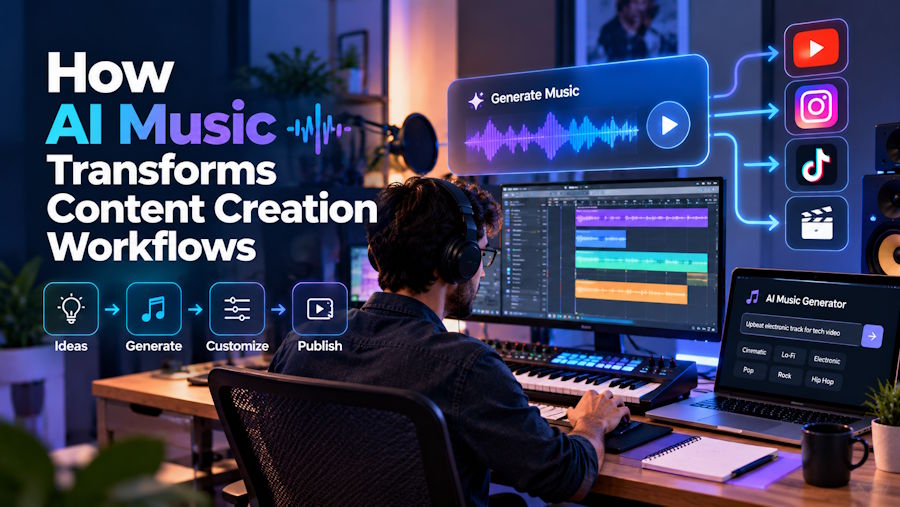
A Simple AI Music Workflow for Content Creators
- Decide What the Music Needs to Do
Do not start with a genre.
Start with the role.
Does the music need to build tension, support narration, make a reveal feel bigger, create energy, or give the channel a recognizable intro?
"Background music" is too broad.
"Soft electronic background music that stays underneath a tutorial voiceover" is much more useful.
- Describe the Sound
Once the role is clear, add the musical details.
A good prompt can include:
- Mood
- Genre
- Tempo
- Instruments
- Vocal or instrumental
- Type of content
- Key moment in the edit
You do not need technical music vocabulary.
Creators often get better results simply by being specific about the scene.
- Generate a Few Directions
The first result is rarely the one to keep.
Try a few versions with different energy levels, tempos, or instrumentation.
Then place them into the actual edit.
This matters because music that sounds impressive through headphones may feel distracting once dialogue, captions, and visual movement are added.
The video is the real test.
- Edit the Best Version
Once one direction works, refine it.
Shorten slow sections. Move musical changes closer to visual transitions. Reduce busy elements under speech. Keep only the strongest section if that is all the video needs.
A creator rarely needs every second of a generated track.
The useful part is the section that makes the edit work better.
Where AI Music Fits Best in Creator Workflows
AI music is especially useful when the music has a clear, practical role.
A YouTube creator may need a background bed for a tutorial that stays present without distracting from speech.
A TikTok or Reels editor may need a short hook, beat drop, or transition sound.
A podcaster may only need a five-second intro and a simple transition between segments.
A small brand may need different musical directions for a product reveal, launch teaser, and social ad.
Musicians can also use AI differently.
Instead of generating a complete song, they may test which part of an existing idea works best in short-form content, explore alternative vocal directions, or try different arrangements before committing to a final version.
The common thread is not the platform.
It is the need to make music fit the content without turning every upload into a separate music-production project.
What AI Music Still Does Not Solve
AI makes music easier to generate. It does not make creative decisions for you.
A track can match the prompt and still feel wrong.
The tempo may fight with the edit. The melody may be too emotional. The vocals may distract from the message. The result may simply sound generic.
Creators still need taste.
That matters even more when building a recognizable brand or channel identity.
AI can quickly generate a background track for one video. Creating a consistent sonic identity across dozens of videos is harder.
That usually requires stronger creative direction and more deliberate choices about rhythm, instrumentation, mood, and repetition.
There is also a practical limit to experimentation.
Generating ten versions only helps if you know what you are comparing.
More options do not automatically mean better decisions.
The creator still needs to know what the content is trying to achieve.
Is AI Music Actually Better for Content Creation?
Sometimes.
For high-volume content, quick experiments, social edits, background tracks, and early creative concepts, AI can be extremely useful.
For a major campaign, artist release, film score, or project where music is central to the identity, professional production may still be worth the extra time and money.
The better question is not whether AI music is better than traditional production.
It is whether the project needs faster experimentation, lower testing costs, or more control over how music fits the edit.
When the answer is yes, AI becomes genuinely useful.
Conclusion
AI music gives content creators a more flexible way to handle one of the most time-consuming parts of production: finding sound that actually fits the edit.
It can speed up experimentation, reduce the cost of testing different directions, and make it easier to shape music around specific videos, voiceovers, transitions, and campaigns.
AI will not replace creative judgment or professional production when those things matter. But for everyday content, it can remove a lot of friction between having an idea and finding the sound that helps the final piece work.

