

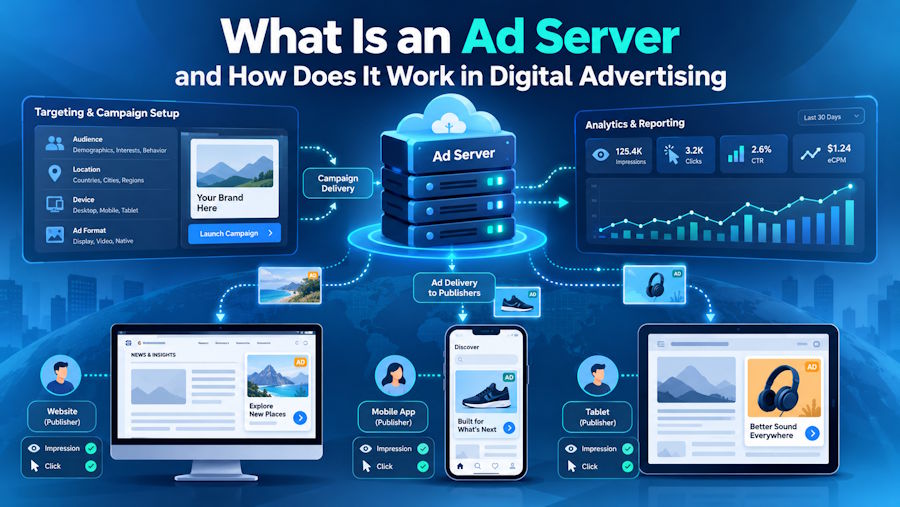
According to the Interactive Advertising Bureau's Internet Advertising Revenue Report: Full Year 2025, released on April 16, 2026, U.S. digital ad revenue reached a record $294.6 billion last year, a 13.9% jump over 2024. Behind every one of those dollars sits a piece of infrastructure that decides which ad shows up, on which page, at which moment. Most readers scroll past that machinery without a second thought, yet it shapes nearly every online purchase and click they generate. This article breaks down the technology in plain terms, walks through how it operates, and looks at the tools publishers and advertisers run day to day.
What Is an Ad Server, Exactly?
An ad server is software that stores, delivers, and tracks digital advertisements across websites, apps, and video platforms. It sits between the advertiser's creative assets and the space where those assets appear, making split-second decisions about which ad wins a slot. If someone asks what an ad server is in one sentence, that's the answer: a decision engine and delivery pipe rolled into one system.
The Two Sides of the Same System
Generally, there are two flavors in play. A publisher-side ad server manages inventory across a site or app network and decides which advertiser gets each slot. A sell-side counterpart, often called a third-party ad server, tracks campaign performance once it runs, regardless of where the media was bought.
Where It Sits in the Broader Stack
The ad server rarely works alone. It connects to demand-side platforms, supply-side platforms, and data management platforms, pulling signals from each to make its calls, acting as a referee between buyers and sellers while the rest of the stack negotiates price.
How Does an Ad Server Work Behind the Scenes?
It intercepts a page or app request, runs it through targeting and priority rules, then returns the winning creative within a fraction of a second. The whole cycle, from page load to rendered ad, typically finishes in under 100 milliseconds, which is why users rarely notice the negotiation happening in the background.
The Request and Response Cycle
Here is the general sequence a modern ad server follows for a single impression:
- A user opens a webpage or app screen that includes an ad slot.
- The browser sends a call to the publisher's ad server with context like page category, device, and location.
- The server checks which campaigns are eligible, applying targeting rules, frequency caps, and flight dates.
- If a real-time auction applies, the request passes to connected demand partners for bids.
- The server picks a winner based on priority or price, then serves the creative file.
- Tracking pixels fire, logging the impression and feeding data back into reporting dashboards.
Targeting and Rules That Shape Delivery
Every server runs on a rules engine. Common variables include geography, device, time of day, audience segments from a DMP, and contextual signals from the page. Campaigns also carry weighted priorities, so a guaranteed direct-sold deal is served before remnant inventory fills the gap, letting a publisher run house ads, direct deals, and programmatic demand side by side.
What Ad Server Examples Are Used Today?
Several platforms dominate current market share, each built for a different corner of the business. These ad server examples clarify how the category splits between publisher tools and advertiser tools.
| Platform | Primary User | Notable Feature |
|---|---|---|
| Google Ad Manager | Publishers, large and mid-size | Deep integration with Google's demand pool |
| Xandr Monetize | Enterprise publishers, broadcasters | Strong video and CTV support |
| Kevel | Retail media networks, marketplaces | API-first, custom-built ad logic |
| SmartAdServer (Equativ) | European publishers and agencies | Cross-channel campaign management |
| Adzerk | SaaS platforms embedding native ads | Lightweight, developer-friendly setup |
Publisher-Facing Platforms
Publisher-side tools focus on inventory management: setting up ad units, defining priority tiers, and reconciling delivery against sold contracts. Google Ad Manager remains the most widely deployed option among mid-size and large publishers, largely because of its tight link to Google's own demand.
Advertiser-Facing Platforms
On the buy side, marketers use a separate ads server layer purely for measurement and creative rotation, independent of where the media was purchased. This lets a brand compare performance across multiple publishers using one consistent set of metrics rather than trusting each seller's own numbers.
Why Do Both Publishers and Advertisers Rely on One?
Publishers need it to maximize yield and keep demand sources organized without overselling a page. Advertisers need a dependable ads server to verify delivery and compare campaigns fairly across placements they don't directly control. Both goals point back to the same infrastructure layer, approached from opposite sides.
For publishers, the benefits generally include:
- Centralized control over which campaigns run where
- Protection against overselling the same slot to multiple buyers
- Consolidated reporting across direct, programmatic, and house ads
- Frequency capping that stops repeat visitors seeing the same creative
For advertisers, the case for a separate tracking layer includes:
- Independent verification of impressions and clicks
- Consistent creative rotation and A/B testing across a media plan
- Cross-publisher attribution a single seller's dashboard cannot provide
- Faster creative swaps without waiting on a publisher's team
The same IAB report found that programmatic advertising, the automated buying process running through these systems, rose 20.5% year over year to $162.4 billion in 2025, a figure that explains why the category keeps drawing fresh investment.
When Should a Business Switch Its Ad Server?
A business should switch its ad server when the current setup can no longer support the volume, formats, or reporting depth the team needs. Signs of an overdue change tend to cluster around a few recurring complaints from ad operations teams.
Common triggers for a platform switch include:
- Reporting delays that block same-day optimization
- Poor support for newer formats like connected TV or in-app native units
- Limited API access, blocking custom automation
- Pricing that no longer scales with rising impression volume
- Weak fraud and viewability detection compared to newer entrants
Smaller publishers sometimes hold off too long, worried about migration costs. A well-planned switch usually pays for itself within a couple of quarters through better fill rates and cleaner reporting.
The Direction Ad Serving Technology Is Heading
Ad serving infrastructure is shifting toward tighter integration with first-party data and AI-assisted bidding, partly a response to cookie deprecation and stricter privacy rules. Expect more contextual signals, server-side auctions, and unified reporting as the line between publisher tools and advertiser tools keeps blurring. The core job, matching the right creative to the right slot at the right price, stays the same even as the mechanics get more sophisticated.
FAQ
Does an ad server cost money to run, and how is pricing usually structured? Most platforms charge a CPM rate, a flat monthly fee, or a hybrid tied to impression volume. Enterprise publishers often negotiate custom pricing once they cross a certain threshold.
Can a small blog or app realistically use one of these platforms? Yes. Several lightweight or open-source options exist for smaller publishers who want organized inventory management without enterprise-scale features.
How does an ad server handle a situation where two campaigns both qualify for the same slot? It applies a priority hierarchy, usually favoring guaranteed direct deals, then house ads, then programmatic demand filling whatever space remains.
Is there a difference between a video ad server and a display ad server? Video serving typically follows VAST or VPAID standards and handles playback events like quartile tracking, while display serving focuses on static or rich-media rendering.
What happens to ad delivery if the server experiences downtime? Most setups include a fallback mechanism, often a house ad or a backup creative, so the slot doesn't sit empty during an outage.
Do ad servers play a role in detecting invalid traffic or bot activity? Many modern platforms include built-in fraud detection or integrate with third-party verification vendors to flag suspicious impressions before billing.
How often should targeting rules and frequency caps be reviewed? Ad operations teams generally audit these settings monthly, or right after a major campaign launch, since outdated caps can quietly suppress delivery or cause overexposure.

