

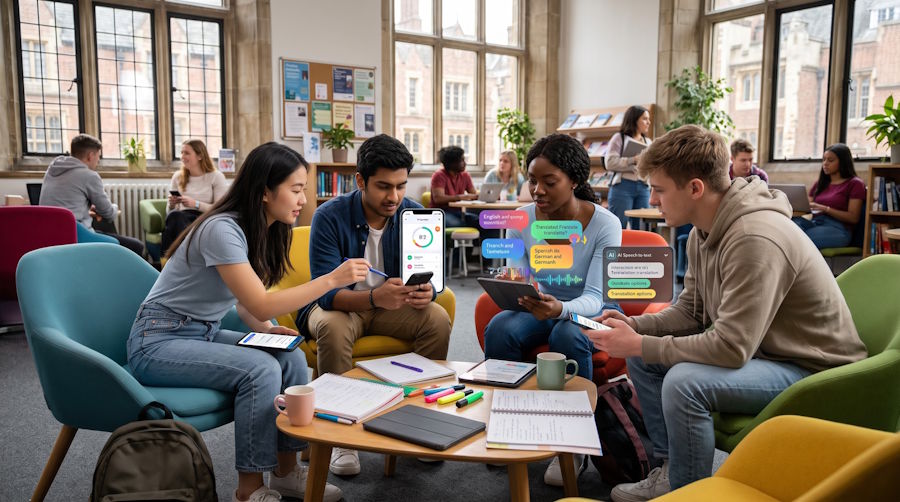
Learning a new language has never been more accessible. In the past, students often relied on textbooks, classroom lessons, and dictionaries. Today, smartphones, artificial intelligence (AI), online platforms, and interactive applications have created new opportunities to practise languages anytime and almost anywhere.
Modern technology is not simply making language learning more convenient. It is also changing how people study vocabulary, improve pronunciation, develop listening skills, and communicate with others. When used thoughtfully, digital tools can complement traditional teaching methods and help learners build consistent study habits.
Artificial Intelligence and Personalized Learning
One of the most significant developments in language education is the growing use of artificial intelligence. AI-powered tools can analyse learners’ responses, identify recurring mistakes, and provide feedback tailored to their current level.
For example, a learner who struggles with verb tenses can practise additional grammar exercises, while someone who finds listening comprehension difficult can work with short audio passages and transcripts. Some platforms also adjust exercise difficulty according to a learner’s progress.
Research reviews published in 2025 and 2026 have explored how AI tools, including conversational chatbots and automated feedback systems, can support language learning. Findings are encouraging, particularly for speaking and writing practice, although results depend on the quality of the tools and how they are integrated into instruction.
AI assistants can also simulate everyday conversations. Students can practise ordering food, asking for directions, preparing for a job interview, or discussing familiar topics without the pressure of speaking in front of a group.
However, AI feedback is not always accurate. Learners should verify important corrections and use qualified teachers when they need a deeper explanation of grammar, context, or cultural nuance.
Language-Learning Apps and Microlearning
Mobile applications have made it easier to fit language practice into busy schedules. Instead of setting aside an entire hour, learners can review vocabulary during a commute, complete a short grammar exercise during a break, or listen to a dialogue before going to bed.
This approach is often called microlearning: studying in small, focused sessions rather than relying exclusively on long lessons.
Many language-learning apps use features such as:
- Spaced repetition: revisiting vocabulary at carefully timed intervals to support long-term retention.
- Gamification: using points, streaks, challenges, and progress indicators to encourage regular practice.
- Adaptive exercises: adjusting tasks to reflect a learner’s performance.
- Progress tracking: helping students identify strengths and areas that need more attention.
These features can make studying feel more manageable. Nevertheless, completing app exercises alone does not necessarily lead to conversational fluency. Learners also need to listen to natural speech, express their own ideas, and interact with other people.
The most effective routine combines short digital activities with meaningful communication and regular revision.
Speech Recognition and Pronunciation Practice
Pronunciation can be challenging, especially for learners who rarely have opportunities to speak the target language. Speech-recognition technology helps address this problem by allowing users to speak into a device and receive automated feedback.
Depending on the application, learners may be able to repeat individual sounds, practise complete sentences, compare their pronunciation with an example, or take part in simulated conversations.
These tools can be particularly useful for practising unfamiliar sounds and building confidence. They also allow students to repeat an exercise several times without worrying about making mistakes in front of classmates.
Still, speech-recognition systems can misinterpret accents, background noise, or unusual speaking patterns. A pronunciation score should therefore be treated as a guide rather than a definitive assessment of speaking ability.
For balanced progress, learners should combine pronunciation exercises with listening to different speakers and participating in real conversations.
How Technology Supports Children Learning English
Children often respond well to learning activities that combine language with play, images, sound, and movement. Digital resources can turn vocabulary practice into an interactive experience rather than a purely memorisation-based task.
For example, children can learn animal names through illustrated games, practise colours with interactive quizzes, listen to short stories, or repeat phrases from age-appropriate videos. These activities connect new words with visual and auditory associations, helping make language practice more engaging.
Technology can also support parents who want to introduce English at home. Resources such as the English for Kids page can serve as a starting point when exploring options for children’s English learning.
However, screen time alone is not a substitute for interaction. Children benefit from singing songs with adults, reading stories together, asking and answering questions, and using new words in everyday situations.
A balanced approach is particularly important for younger learners. Short, age-appropriate sessions with clear goals are generally more practical than long periods of unsupervised screen use.
Online Lessons and Human Interaction
Despite the rapid development of AI, teachers continue to play an essential role in language education. Technology can provide practice opportunities, but a teacher can explain subtle differences in meaning, recognise when a learner is confused, and adapt a lesson to individual needs.
Online lessons have also expanded access to tutors beyond a learner’s immediate location. Students can arrange lessons around their schedules, revisit digital learning materials, and communicate with teachers through video calls.
For learners comparing different ways to study, LearnLink is one online resource to explore alongside other language-learning options.
Live lessons are especially valuable for developing spontaneous communication. During a conversation, students must understand questions, respond appropriately, clarify meaning, and adapt to another person’s speaking style. These skills are difficult to develop through multiple-choice exercises alone.
The strongest learning experience often combines independent digital practice with regular interaction with a teacher or conversation partner.
Virtual Reality and Immersive Learning
Virtual reality (VR) and augmented reality (AR) offer another way to practise languages in context. These technologies can place learners in simulated environments, such as a café, airport, shop, or city street.
Instead of memorising a phrase in isolation, a student might practise ordering a drink in a virtual café or asking for directions in a simulated city. Context helps connect vocabulary with situations in which it may actually be used.
Immersive tools may be especially useful for learners who have limited opportunities to travel or communicate with speakers of the language they are studying. They can also make role-playing activities more engaging.
However, access to suitable devices and well-designed educational content remains a limitation. VR and AR are best viewed as additional learning options, not essential requirements for becoming proficient in a language.
The Challenges of Digital Language Learning
Although technology offers many advantages, it also introduces challenges that learners and educators should consider.
Distraction and inconsistent habits. Notifications, entertainment apps, and multitasking can interrupt concentration. A dedicated study period with notifications switched off can help.
Too much passive learning. Watching videos or reading translations may create a sense of progress without providing enough practice in speaking or writing. Learners should actively use the language they encounter.
Overreliance on translation. Translation tools are useful for checking meaning, but translating every sentence can prevent learners from developing the ability to understand ideas directly in the target language.
Unreliable automated feedback. AI tools may provide incorrect explanations or unnatural expressions. Comparing answers with trusted learning materials and asking a teacher when necessary can reduce this risk.
Privacy and screen-time concerns. Users should check how educational applications handle personal data. For children, parents should also consider age suitability, privacy settings, and the amount of time spent using digital devices.
Recognising these limitations makes it easier to use technology as a learning aid rather than relying on it for every aspect of language education.
How to Build an Effective Technology-Based Learning Routine
The number of available tools can be overwhelming. Rather than using many applications at once, learners can start with a simple routine built around specific goals.
Here is one example of a 30-minute daily session:
| Activity | Time | Purpose |
|---|---|---|
| Vocabulary review | 5 minutes | Strengthen word retention |
| Listening practice | 10 minutes | Improve comprehension |
| Speaking with an AI tool or conversation partner | 10 minutes | Build fluency and confidence |
| Reviewing mistakes | 5 minutes | Identify areas for improvement |
The routine can be adjusted according to the learner’s age, level, and goals. Beginners may need more time for basic vocabulary and sentence structures, while advanced learners may focus on authentic audio, extended conversations, and writing.
Consistency matters more than using the most sophisticated technology. A manageable routine followed regularly is often more useful than an ambitious schedule that is difficult to maintain.
It is also helpful to measure progress through practical outcomes. Can you introduce yourself without reading a script? Can you understand the main idea of a short podcast? Can you write a message or hold a simple conversation? These milestones provide a more meaningful picture of progress than app scores alone.
Conclusion
Modern technology is reshaping language learning by making practice more flexible, interactive, and personalised. Artificial intelligence can support conversation and feedback, mobile apps encourage regular study, speech recognition offers pronunciation practice, and immersive environments create opportunities to use vocabulary in context.
Yet technology is most effective when it supports a clear learning plan. Human interaction, active language use, consistent revision, and reliable guidance remain essential parts of the process.
Whether someone is learning a first foreign language, improving professional communication, or helping a child begin studying English, the goal is the same: to turn digital convenience into real-world language skills. Choosing a few suitable tools and using them consistently can make that goal more achievable.

