

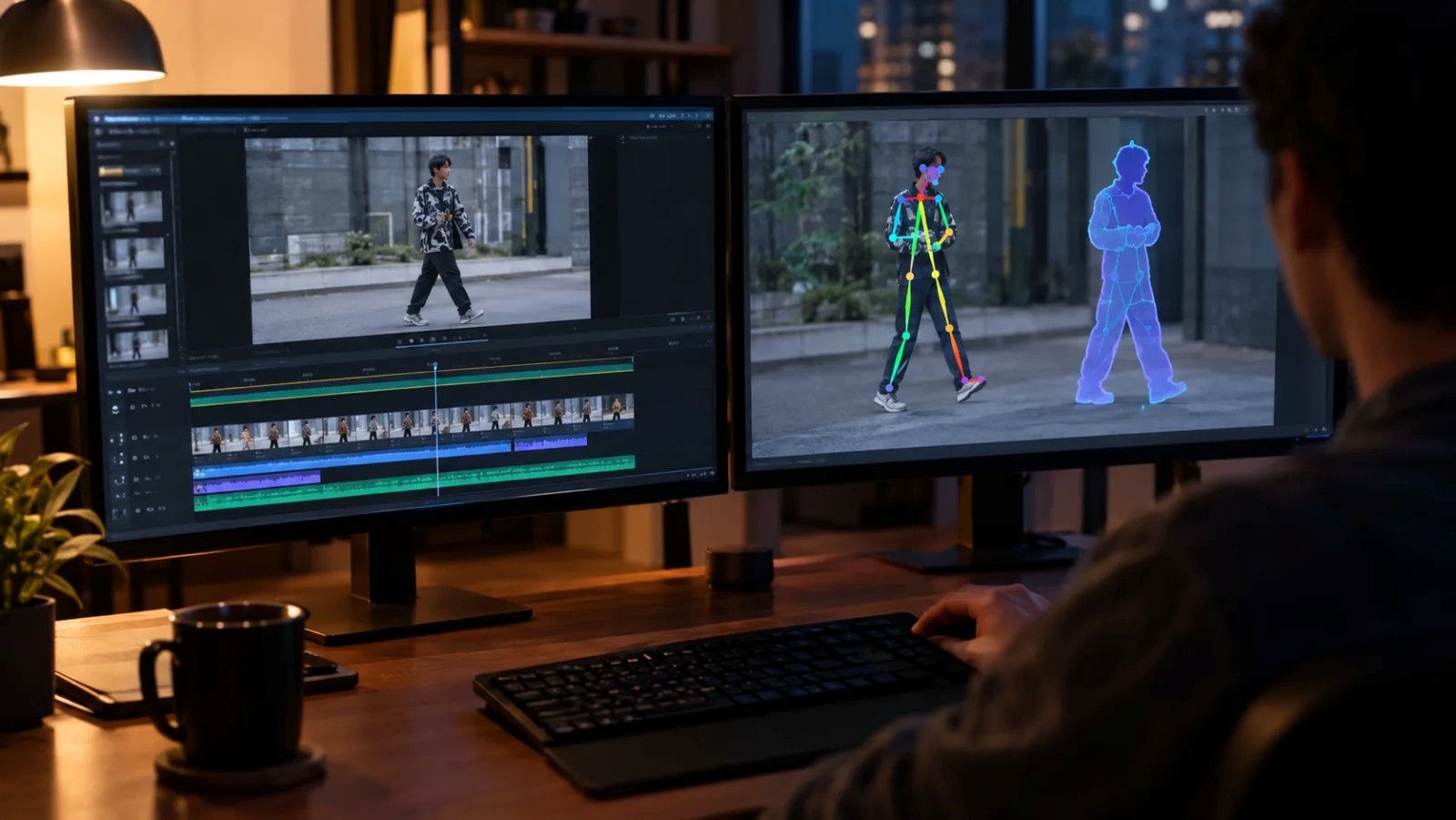
Face swapping has been a solved demo for years. You can find open-source repositories that do it in real time on a laptop GPU, and the results on a well-lit, front-facing clip are good enough to fool a casual viewer. Ask the same pipeline to replace an entire person, from the shoulders down to the shoes, and it falls apart in ways that are instructive for anyone who builds or evaluates video tooling.
The gap is not about model size or compute. It comes from what each task gets to assume about the image, and how many of those assumptions break once the target is a full human figure in motion.
A skeleton tells the model where the joints are. It says nothing about where the jacket ends.
A face is a small, rigid, cooperative target
Most face swap systems lean on a short list of convenient facts. The region of interest is compact, usually a few hundred pixels across. It is roughly rigid: cheeks and jaws move, but the overall geometry stays put. Mature landmark detectors can lock onto eyes, nose and mouth corners in almost any frame. And there is a huge supply of aligned training data, because the internet is full of faces looking more or less at the camera.
That combination lets a face pipeline do something close to the following: detect the face, align it to a canonical pose, run the identity transfer in that normalised space, then warp the result back and blend it in. Errors stay local. If one frame is slightly off, the blend at the edge hides most of it.
A body breaks almost every one of those assumptions
Swap the face for a full figure and the list flips over.
The target is large and deformable. A standing person can fill half the frame, and every joint changes the silhouette. There is no single canonical pose to align against. Pose estimators such as OpenPose or MediaPipe give you a skeleton, but a skeleton says nothing about where the sleeve ends or how the coat drapes over the hip.
Occlusion is constant. Arms cross in front of the torso, hands go into pockets, a bag strap cuts across the chest, another pedestrian walks through the shot. A face is occasionally occluded. A body is occluded in some way in nearly every frame, and the model has to decide what sits behind the occluder without inventing a third arm.
Clothing has its own physics. Fabric folds, stretches and swings with momentum. When the source person turns, a loose jacket lags behind the shoulders. A swap that treats clothing as a texture painted onto the skeleton produces the stiff, sticker-like look that gives early body swap results away.
The edges are everywhere. A face has one boundary to blend. A body has a long, complex outline against a changing background, plus internal edges where limbs overlap. Every one of them is a place where shimmer or haloing can appear.
Temporal consistency is the real boss fight
Single frames are no longer the hard part. Diffusion-based image models can render a convincing person in one still. The difficulty is rendering the same convincing person thirty times per second while keeping buttons in the same place, patterns on the same panel of fabric, and hair behaving like one continuous mass rather than a new hairstyle in every frame.
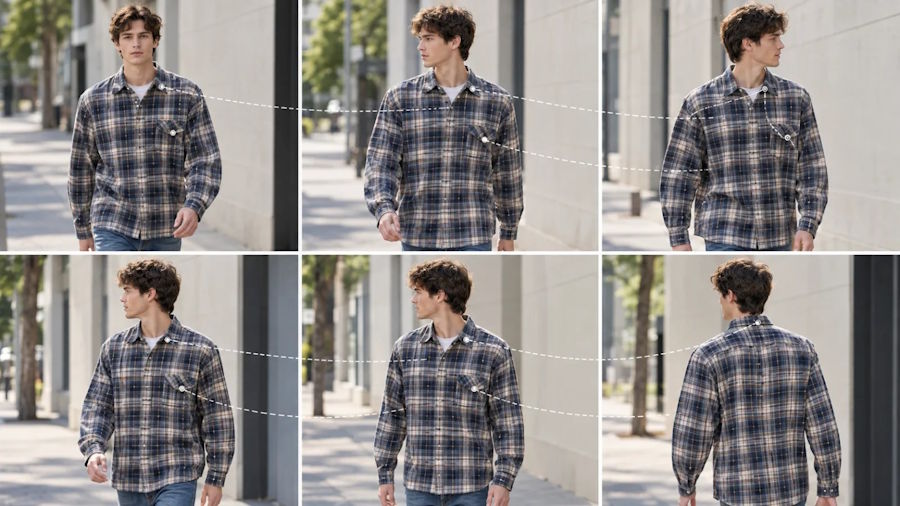
The hard part is keeping the same pocket in the same place across every frame, including the ones where the reference never showed the back.
Research systems attack this from a few directions. Some condition every frame on the same reference image so identity stays anchored. Others add temporal attention layers that let each frame look at its neighbours, the approach popularised by animation models like AnimateAnyone and its successors. Many also feed in optical flow or dense pose maps so the generator knows how pixels should move between frames instead of guessing.
None of these is free. Temporal attention multiplies memory use. Flow estimates fail on fast motion and motion blur. Dense pose maps are noisy around hands and feet. A production pipeline ends up being a stack of compromises, and the visible quality depends heavily on which compromises were chosen for which kind of footage.
What a reference image actually has to carry
For a full-body swap, the reference image does far more work than a face photo does in a face swap. It has to describe clothing from at least one angle, body proportions, skin tone in different lighting, and often the hairstyle too. When the source clip shows the person from the back and the reference only shows the front, the model has to make something up, and that is where most artefacts come from.
Practical advice for anyone feeding these systems follows directly. Use a reference where the full figure is visible and well lit. Match the camera angle of the source roughly if you can. Avoid references with heavy accessories that the source person does not have, because the model will try to reconcile two incompatible silhouettes. And keep the source clip short with deliberate movement; a slow walk survives much better than a spin or a jump.
Browser-based products have made all of this testable without cloning a research repo. Several now expose body swap ai as a plain upload flow: one source clip, one reference image, a resolution choice. Running the same reference through a slow walk and then through a fast turn is the quickest way to see how much of the advice above a given model actually depends on.
Evaluating body swap tools as a developer
If you are choosing a tool to wire into a content pipeline, or testing one for a client, a handful of checks surface the differences quickly:
- Run a clip with arms crossing the torso and watch the forearms. Missing or duplicated limbs show up here first.
- Use loose clothing with a visible pattern and look at whether the pattern drifts between frames.
- Include a partial turn so the back of the reference is never seen. Check how plausible the hidden side looks.
- Scrub the edges at full resolution. Haloing around hair and fingers is easy to miss at playback speed.
- Compare processing time per second of output. Some services price and queue by the second, which matters for batch jobs.
Put the same five clips through two or three services in one sitting and line the outputs up frame by frame. The failure modes are usually more distinctive than the successes, and they predict how a tool will behave on your own footage far better than its marketing page does. General video platforms such as iMideo also bundle face, head and body replacement side by side, which makes it easy to check whether a clip really needs a full-body pass or whether a head swap would hold up with fewer artefacts.
Consent and labelling still apply
Whatever the tool, replacing a real person's appearance in footage raises the same questions as any synthetic media. Use references you have the rights to, such as yourself, a consenting colleague, a licensed model or a fully synthetic character, and do not map one real person's likeness onto another's movements without permission. If the output is published, say that it has been altered. Platforms are steadily tightening their rules on undisclosed synthetic people, and a short disclosure costs nothing.
Where this is heading
Face swapping got good because the problem was narrow enough to normalise. Full-body swapping is getting good because the field has accepted that it cannot be normalised and has started building models that reason about motion, occlusion and cloth over time instead. For developers, the practical upshot is that tools in this space now differ less on whether they work and more on which kinds of footage they handle well, and the interesting engineering work is in knowing which kind of replacement a given clip actually needs.

