

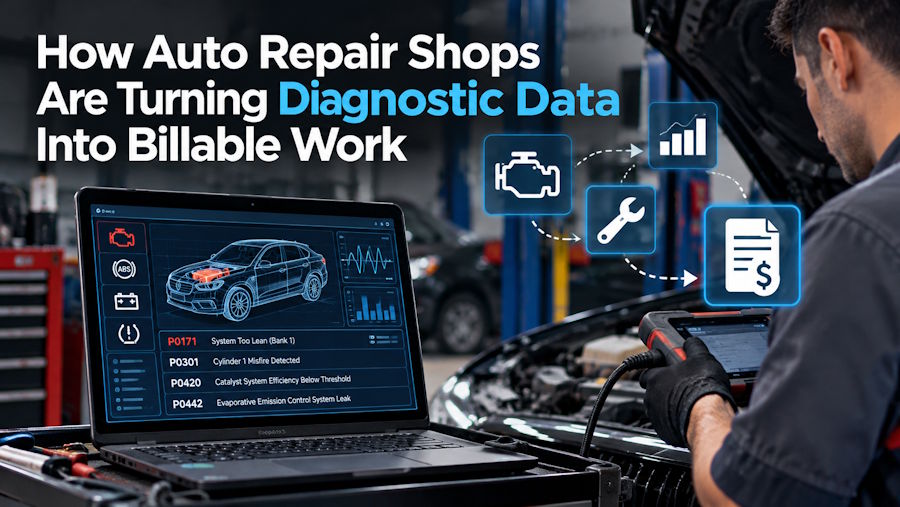
The Opportunity in Every Modern Car
Our Code World has covered automotive embedded architecture for 2026, including zonal consolidation, AUTOSAR integration, and OTA updates. For a shop owner, the meaning is simple.
A car used to be a set of separate ECUs on a CAN bus. Today it is a networked computer, with domain controllers, gateway modules, and software that updates over the air.
That changes how every job starts. Before you touch a part, you have to question the system:
- Which modules are on the car?
- Which ones have stored faults?
- What software version is each one running?
- What did the car look like when it arrived?
Some shops treat this as unpaid prep work. The shops doing well treat it as a billable line on the invoice. The rest of this article shows how.
Picking the Right Tool for the Job
A cheap OBD-II reader gives you a P-code. A P-code is a symptom, not a diagnosis. It tells you a system saw something wrong. It does not tell you why.
What a basic reader cannot do
Basic readers work at the emissions level, using the standard OBD-II modes. Some mid-range readers add ABS and airbag codes, but deeper work needs more:
- Module-level data: live data and fault codes from body, chassis, ADAS, and infotainment modules, not only the engine and transmission.
- Bidirectional controls: you command a component to act, such as a fan, pump, or actuator, and watch how it responds.
- Service-mode functions: examples are electronic parking brake retraction, battery registration, and steering angle reset.
- Calibration routines: camera and radar calibration after a windshield or alignment job is the common case.
These functions run on diagnostic services defined in UDS (ISO 14229). Service 0x19 reads DTC information and status, 0x22 reads data by identifier, 0x2F handles input/output control for bidirectional tests, and 0x31 runs routines such as calibrations and resets. Newer vehicles carry the same services over IP (DoIP, ISO 13400), and gateways on many late-model cars require authentication before a tool can reach the modules behind them. A basic reader supports none of this.
Your Two Real Options
The OEM platform. You get the deepest access for one brand. Some shops pair J2534 pass-through hardware with the maker's own software. Manufacturer-specific tools such as FORScan, a third-party program for Ford-family vehicles, cover part of the same ground at lower cost. Our Code World's piece on dealership-grade scan tools already covers that gap.
A multi-brand tool with per-marque licensing. One device covers many makes, and brand coverage is often licensed separately. Check what the base subscription includes and what each added brand costs, because that decides your annual tool cost.
The cost has changed
Most of this is now a subscription, not a one-off purchase. Software licenses renew every year. Some OEM sites charge by the day or by the month. Security gateways on some vehicles also need an account before the tool can talk to the car.
That means the tool is a recurring cost. Shops must cover it with recurring diagnostic revenue.
How Shops Price Diagnostic Time
Common approaches among shops that recover their tool costs include:
- Diagnosis as its own line. It is not folded into the repair price. A typical model is a base diagnostic fee tied to the shop's labor rate.
- Tiers by system. A simple engine fault is priced differently from a network or ADAS fault. Deeper tools mean deeper work, and the price reflects it.
- Calibration billed separately. Calibration needs equipment, space, and training. It is its own service line.
- The license counted in the rate. Subscription costs are spread across the diagnostic hours the shop expects to bill in a year.
Some shops also credit part of the fee toward the repair. This makes customers more willing to approve the diagnosis, but it has a cost. If you credit the full fee, an approved repair recovers nothing for the diagnosis, and the subscription is paid from your repair margin. Many shops credit only part of it, or credit it only when the work is approved. Decide the policy deliberately and price your diagnostic rate with it in mind.
A worked example (illustrative figures, not market data). Divide the year's tool cost by the diagnostic hours you expect to bill. If subscriptions and added marque licenses come to $6,000 a year and you expect to bill 400 diagnostic hours, the tools add $15 to every billed hour before technician pay, space, and calibration equipment. Bill 200 hours instead and the figure doubles to $30. Tiering the fee lets network and ADAS work, which draws on the most licensed functions, carry a larger share.
The point is simple. If the diagnosis isn't paid for on the invoice, you cover the subscription out of your margin.
The Scan Output Is a Business Asset
This is where many shops lose money without noticing.
A scan produces a structured record. It usually holds:
- Fault codes (DTCs) with their status bits, so you can tell a pending, confirmed, or stored fault from a live one
- Freeze frame data from the moment of the fault, such as speed, load, coolant temperature, and voltage
- Module identifiers and software and calibration versions, read from each module by data identifier (UDS 0x22)
- The state of the car before the repair, including every fault already stored on arrival
- The state of the car after the repair, including which faults were cleared and which remain
- The calibration result, where one was done, including the routine run (UDS 0x31) and its pass or fail outcome
That record is worth money in three ways.
1. It justifies the diagnostic hours
A customer may question a two-hour diagnostic charge. A scan record answers that question. It shows how many modules were checked, which faults were found, and what tests were run. The time gets billed instead of absorbed.
2. It supports warranty claims
Suppose a part fails months later and you need to claim against the supplier. The pre-repair state is your proof. It shows the original fault, the data around it, and what you replaced. Without it, you are working from memory.
3. It settles comebacks
A car returns and the customer says, "You made it worse." The record shows what the car looked like on arrival, including which faults were already stored and which were cleared. That ends most arguments quickly.
Where most shops break the chain
Most shops export the scan as a PDF and email it. This is common, and it undermines all three uses:
- The file lives in someone's inbox, not with the job.
- The name of the file rarely matches the repair order.
- Nobody can find it six months later.
The billable time and the evidence end up in different places.
What the shops capturing the value do
They keep the scan attached to the job. Shops running mechanic shop software attach the scan output and the calibration record to the repair order against the VIN. Two things follow:
- History builds up per vehicle, not per visit. Open a VIN, and you see every scan, every calibration, and every fault the car has had in your shop.
- Billable time stays on the ticket where it happened. The hours, the findings, and the evidence all sit on one repair order.
In practice, the workflow looks like this:
- Run the pre-repair scan and attach it to the repair order.
- Add the diagnostic labor line, with the findings noted.
- Complete the repair.
- Run the post-repair scan and any calibration. Attach both.
- Close the ticket. The full record stays with that VIN.
This adds very little work for the technician once the habit is set. It needs a place to put the file that is not an inbox.
Right to Repair: Access Is Only Half the Story
Right to Repair matters to your shop because it decides what data you can reach. Here is where things stand.
Massachusetts
Voters approved a data access law in 2020. It requires carmakers to give owners and independent shops access to telematics data through a standard platform. Automakers challenged it in federal court. In February 2025, a district judge dismissed the automakers' suit and the law remains in effect. The automakers appealed, and the First Circuit heard the argument in February 2026. At the last report, in late summer 2026, no appeals decision had been issued.
Maine
Maine voters passed a similar measure in 2023. Automakers are also challenging that law, and the litigation was still active in the latest reporting.
Federal REPAIR Act
The bill would extend access nationwide. In 2026, a House committee advanced an amended version. According to trade press, lawmakers removed the broader telematics and wireless data provisions, and debate over that part is still open.
So access is expanding, but unevenly and not yet settled. Watch these developments closely, and do not plan your business around a law that may change.
Capability is the second half
Access to data helps only if you can use it. An independent shop that can read OEM-level data, run the right routines, and record the results can take on work it used to turn away.
Documented diagnostic history is also becoming a resale signal. A car with a record of scans, calibrations, and repairs is easier to trust, and Our Code World's coverage of AI in used car verification shows how buyers and platforms now look for exactly this kind of proof. Your scan records become part of the car's story, not only a service file.
Conclusion
Modern cars are networked computers, and every job starts with a diagnosis. Shops that bill for that time, and keep the scan record attached to the repair order and VIN, turn a cost into revenue.
Right to Repair rules are still being settled, and the picture differs by state and between state and federal law. Access is the first half. Capability is the second, along with the record to prove what you did, which is also what makes a car easier to sell. The shop that can read the data, act on it, and prove what it found will be ready for whatever comes next.

