

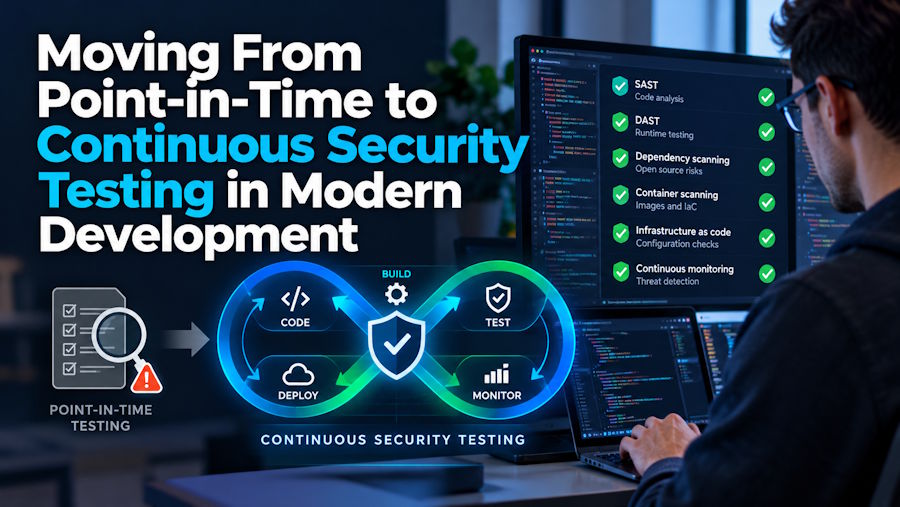
A company commissions a penetration test every January. The testers spend two weeks probing the application, deliver a thorough report, and the engineering team fixes the serious findings by March. Everyone feels better. Meanwhile, the product ships updates weekly, adds new integrations each quarter, and changes its infrastructure almost daily. By autumn, the application bears only a passing resemblance to the one that was tested.
That mismatch is the central problem with point-in-time security testing in an environment built around continuous delivery. Snapshots are valuable, but they describe a past state. As release cycles shorten, many teams are shifting toward testing that runs alongside development. The sections below explain why annual tests fall short, what continuous testing involves, how it works in practice, and how to make the transition.
Why Annual Tests Fall Short
A traditional penetration test is a scoped engagement. Skilled testers examine a defined set of systems for a limited period, then report what they found. Done well, it yields deep insights, including logic flaws and chained attacks that automated tools often miss. Compliance frameworks and customers frequently expect such reports, and that expectation is reasonable.
The weakness lies in timing. Code changes between tests can introduce new vulnerabilities, and the window of exposure lasts until the next engagement. If a team deploys a risky change one week after testing ends, the flaw may sit in production for most of a year. Attackers do not wait for the next scheduled test, and new vulnerability disclosures can make previously safe components exploitable overnight.
Scope limits matter too. Time and budget force testers to choose what to examine, so areas outside scope receive no attention. Meanwhile, modern systems include microservices, APIs, third-party integrations, and cloud configurations that change constantly and interact in complex ways.
Delivery of findings can also lag. A report arrives weeks after testing, by which time developers have moved on to other work, and context is lost. Fixes get scheduled behind feature work, and retesting is another separate engagement. The result is a long loop between discovering an issue and confirming it is gone.
What Continuous Security Testing Means
Continuous testing treats security validation as an ongoing activity tied to how software changes, not an event. Instead of one deep assessment per year, tests run repeatedly: when code is committed, when builds are produced, when new infrastructure appears, and on a schedule against production-like environments.
Several practices fit under that umbrella. Static analysis examines source code for known weakness patterns. Software composition analysis checks dependencies for known vulnerabilities. Dynamic testing probes running applications and APIs. Infrastructure and configuration scanning looks for misconfigured cloud resources. Secret scanning catches credentials accidentally committed to repositories.
More advanced approaches add attack-oriented testing that behaves like an adversary, attempting to chain weaknesses and confirm which are actually exploitable. Continuous penetration testing addresses that need. Instead of waiting for an annual engagement, continuous penetration testing repeats adversary-style probing as systems evolve, so new exposures surface soon after they appear.
The goal is shorter feedback loops. When a developer introduces a flaw and learns about it within hours, with clear reproduction steps, fixing is cheap. When the same flaw is discovered months later, remediation is costlier and the risk has been present all along. Continuous testing does not replace human expertise, but it fills the long gaps between deep assessments.
How Continuous Testing Works in Practice
A typical program layers several kinds of checks across the development lifecycle. During coding, developers use editor plugins and pre-commit hooks that catch obvious problems. In the build pipeline, automated scans run on each change, with results reported in the same tools developers already use. After deployment to staging or production-like environments, dynamic tests and attack simulations exercise the running system.
Scheduling follows risk. Lightweight checks run on every commit. Heavier tests, such as authenticated scanning and attack-path exploration, run nightly or weekly, or when significant changes are detected. Triggers can include new endpoints, changed authentication logic, updated dependencies, or altered cloud permissions.
Results need management. Raw findings overwhelm teams unless deduplicated, prioritized, and routed to the right owners. Effective programs attach context to each issue: affected component, evidence, severity, exploitability, and suggested fix. They send tickets directly into issue trackers and measure time to remediate.
Repeated, adversary-style probing through continuous penetration testing can reveal emerging exposures. Because it attempts realistic attack chains, it can show which findings matter. A medium-severity flaw that enables access to sensitive data through a chain of weaknesses may deserve urgent attention, while a high-severity finding in an unreachable component may not. That context helps teams spend limited remediation time wisely.
Benefits and Limits
The benefits are tangible. Exposure windows shrink, since new weaknesses are found soon after introduction. Developers receive feedback in context, which makes fixes faster. Coverage grows, because tests run against changing systems and not a frozen snapshot. Evidence accumulates, which supports compliance and customer assurance by showing ongoing diligence rather than a yearly report.
Costs can become more predictable as well. Instead of large, infrequent engagements with variable scope, organizations pay for steady coverage and reserve expert human testing for deeper work. Security teams also gain data about trends: which kinds of vulnerabilities recur, which teams fix quickly, and which components carry the most risk.
Limits deserve honesty. Automation struggles with some business logic flaws, subtle authorization problems, and creative attack chains that require human judgment. Noise is a risk: poorly tuned tools generate false positives that erode trust. Testing production systems requires safeguards to avoid disruption or data damage, and rules of engagement must be clear.
Continuous testing also demands process change. If findings flow in faster than teams can fix them, backlogs grow and frustration rises. The program needs prioritization, ownership, and agreed service levels for remediation. Treating continuous testing as a complement to periodic expert assessments, not a replacement, produces the best results.
Making the Transition
Start with an honest assessment of the current state. Inventory applications, APIs, and infrastructure, rank them by business risk, and identify which are changing fastest. Map existing testing activities, such as annual penetration tests, scanners, and code reviews, and note the gaps between them.
Pick a small, high-value starting point. Integrate basic automated checks into the pipeline for one critical application, tune them to reduce noise, and establish how findings reach developers. Add attack-oriented testing for the same application, run it on a regular cadence, and compare its results with the last manual test to see what it catches and misses.
Define ownership and service levels. Decide who triages findings, who fixes them, how quickly issues of each severity must be addressed, and how exceptions are approved. Share dashboards with engineering leaders so progress is visible, and celebrate improvements in time to remediate.
Expand gradually. Add applications, increase test depth, and integrate with ticketing, chat, and reporting tools. Retain periodic expert-led assessments for complex logic, new architectures, and compliance needs, and use continuous results to focus those engagements on the most valuable areas.
Useful first steps include:
- List the applications and APIs that change most often
- Schedule automated tests against those first
- Route validated findings into existing ticket queues
- Retest every fix automatically
End Note
Point-in-time testing provides valuable depth, but it cannot keep pace with software that changes weekly or daily. Continuous testing narrows the gap by running checks as systems evolve, giving teams earlier signals and shorter fix cycles.
The most effective approach combines both: continuous coverage to catch new exposure quickly, and expert-led assessments to probe the subtle and the novel. Teams that start small, tune carefully, and keep ownership clear will find that security testing becomes part of how software is built, not an annual interruption.
Teams that start small, prove value on a few fast-moving applications, and then widen coverage usually find the transition manageable. The gain is a security picture that stays close to the current state of the product instead of a snapshot that ages the day after it is delivered.

