

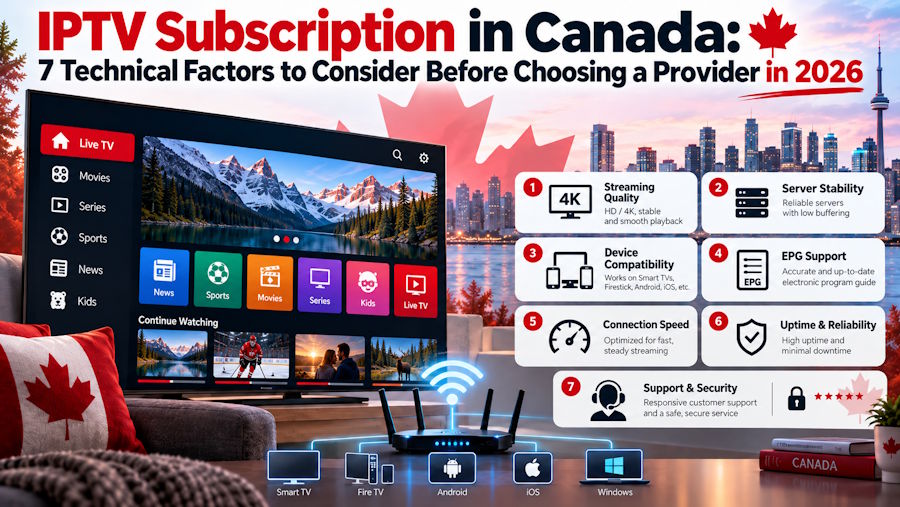
Internet-based television has changed how people access live programming, movies, and on-demand entertainment. Instead of relying entirely on traditional cable or satellite infrastructure, modern streaming systems can deliver video through internet networks to compatible televisions, smartphones, and streaming devices.
In Canada, consumers researching IPTV technology often focus on subscription prices and channel availability. However, the technical infrastructure behind a service can have a much greater impact on the viewing experience.
From network stability and device compatibility to video compression and streaming protocols, several factors determine how well an IPTV platform performs.
Before choosing an IPTV subscription, understanding these technical considerations can help consumers avoid common streaming problems and make more informed decisions.
1. Internet Speed and Connection Stability
A reliable internet connection is the foundation of any IPTV setup.
Unlike traditional broadcasting, IPTV depends on data being delivered through an internet network. When network performance becomes inconsistent, users may experience buffering, reduced picture quality, or interrupted playback.
Typical bandwidth requirements vary depending on the video format and compression technology.
| Streaming quality | Approximate download speed |
|---|---|
| Standard Definition (SD) | 3–5 Mbps |
| High Definition (HD) | 5–10 Mbps |
| Full HD (1080p) | 10–15 Mbps |
| 4K Ultra HD | 25 Mbps or more |
These figures are general planning estimates rather than universal requirements. Actual bandwidth consumption depends on the codec, bitrate, and streaming platform.
Connection stability also matters. Packet loss, latency fluctuations, and network congestion can affect playback even when a speed test reports adequate bandwidth.
For stationary streaming devices, Ethernet can provide a more consistent connection than Wi-Fi, particularly in households with multiple connected devices.
2. Understanding IPTV Streaming Protocols
Different IPTV platforms use different technologies to transport video content.
Two common approaches are HTTP Live Streaming (HLS) and MPEG-DASH.
HTTP Live Streaming (HLS)
HLS divides video into smaller segments delivered over HTTP.
It supports adaptive bitrate streaming, allowing compatible players to switch between video quality levels as network conditions change.
This can reduce interruptions when bandwidth fluctuates.
MPEG-DASH
Dynamic Adaptive Streaming over HTTP, commonly called MPEG-DASH, also supports adaptive video delivery.
It is codec-flexible and can work across different playback environments.
Both technologies are widely used in modern internet video distribution.
However, the availability of adaptive streaming depends on the provider's infrastructure and the capabilities of the playback application.
Understanding these technologies helps explain why two IPTV platforms may perform differently on the same internet connection.
3. Device Compatibility and Operating Systems
Not every IPTV application works on every device.
Compatibility depends on the operating system, supported video formats, hardware capabilities, and software requirements.
Common device categories include:
- Android TV and Google TV: Support compatible television and media-player applications.
- Amazon Fire TV: Supports streaming applications designed for its operating system.
- Samsung Smart TVs: Use the Tizen operating system on supported models.
- LG Smart TVs: Use webOS and compatible applications.
- Windows and macOS computers: Can access supported web players or desktop applications.
- Smartphones and tablets: May support mobile IPTV playback applications.
Before subscribing, consumers should verify whether their preferred application is available for their device.
Some IPTV players are standalone applications that require a separate content subscription. Installing a player does not automatically provide access to television channels.
4. Video Compression and Streaming Quality
Video compression is another important factor affecting IPTV performance.
Modern streaming platforms commonly use codecs such as H.264/AVC and H.265/HEVC.
H.264 is widely supported across televisions, computers, and mobile devices.
H.265 can provide comparable visual quality at lower bitrates under suitable encoding conditions, although device support and decoding requirements vary.
For viewers watching high-resolution content, efficient compression can reduce bandwidth requirements.
However, the final picture quality depends on several factors:
- Original source quality
- Video encoding settings
- Available bitrate
- Network conditions
- Playback-device capabilities
A stream labeled 4K does not necessarily deliver the same visual quality as another 4K stream.
Consumers should evaluate actual playback performance rather than relying exclusively on resolution labels.
5. Server Infrastructure and Peak-Hour Performance
One of the most common complaints associated with internet television is buffering during busy viewing periods.
This can happen when many users access video streams simultaneously.
Possible causes include overloaded origin servers, insufficient network capacity, congestion between networks, or problems with content delivery infrastructure.
Content Delivery Networks (CDNs) can help distribute video traffic across geographically dispersed servers.
By reducing the distance between viewers and content delivery points, CDNs may improve performance and reduce network bottlenecks.
However, CDN infrastructure alone does not guarantee uninterrupted streaming.
Reliable delivery also requires adequate capacity planning, monitoring, and resilient systems.
For Canadian viewers, network routing and the location of delivery infrastructure may influence playback performance.
6. Subscription Transparency, Security, and Licensing
Technical performance is only one part of choosing a streaming service.
Consumers comparing IPTV Canada options should also evaluate subscription transparency, account security, and content distribution rights.
A legitimate IPTV delivery method does not automatically mean that every commercial IPTV provider has authorization to distribute the channels or films it advertises.
Before purchasing, consumers should examine:
Content licensing: Does the provider offer credible information about its rights to distribute programming?
Subscription conditions: Are billing periods, renewal terms, and cancellation policies clearly explained?
Payment security: Are transactions handled through trustworthy payment systems?
Privacy practices: Does the provider explain how customer information is collected and processed?
Technical support: Are customers given clear instructions for troubleshooting and obtaining assistance?
These considerations are particularly important when a service advertises extensive premium television or sports programming at unusually low prices.
7. Troubleshooting Common IPTV Playback Problems
Even a properly configured streaming setup can occasionally experience technical difficulties.
Understanding basic troubleshooting procedures can help users identify the source of a problem.
Buffering or interrupted playback
Start by testing the internet connection.
If other streaming applications are also experiencing problems, investigate the home network or internet service provider.
Restarting the router and streaming device may resolve temporary connection issues.
Audio and video synchronization problems
Audio delays can sometimes result from decoding problems or application-specific settings.
Updating the playback application, changing supported audio settings, or restarting the stream may help.
Application crashes
Crashes may occur because of outdated software, insufficient device memory, or compatibility problems.
Check for application updates and confirm that the device meets the software requirements.
Poor picture quality
Reduced video quality may result from bandwidth limitations, compression settings, or low-quality source material.
If adaptive bitrate streaming is supported, the player may automatically reduce resolution to maintain playback.
Playback errors
Authentication failures, unavailable streams, and unsupported formats can produce different error messages.
Users should review the application's documentation and contact the relevant service provider when account-specific problems occur.
How IPTV Technology May Develop Beyond 2026
The future of internet television will likely involve continued improvements in video compression, adaptive streaming, network infrastructure, and device compatibility.
Emerging codecs and more efficient delivery systems may help platforms provide high-quality video while using less bandwidth.
At the same time, consumers will continue to expect transparent subscriptions, secure applications, reliable playback, and properly licensed content.
For Canadian households, understanding the technical foundations of IPTV can make it easier to evaluate the growing range of available television technologies.
Final Thoughts
Choosing an IPTV platform requires more than comparing advertised channel counts or subscription prices.
Internet stability, streaming protocols, device compatibility, video compression, server infrastructure, and security all influence the viewing experience.
By understanding these seven technical factors, Canadian consumers can make more informed decisions, troubleshoot common problems, and choose entertainment solutions that meet their needs.
As internet-delivered television continues to evolve, technical reliability and transparent service practices will remain essential to a positive viewing experience.

