

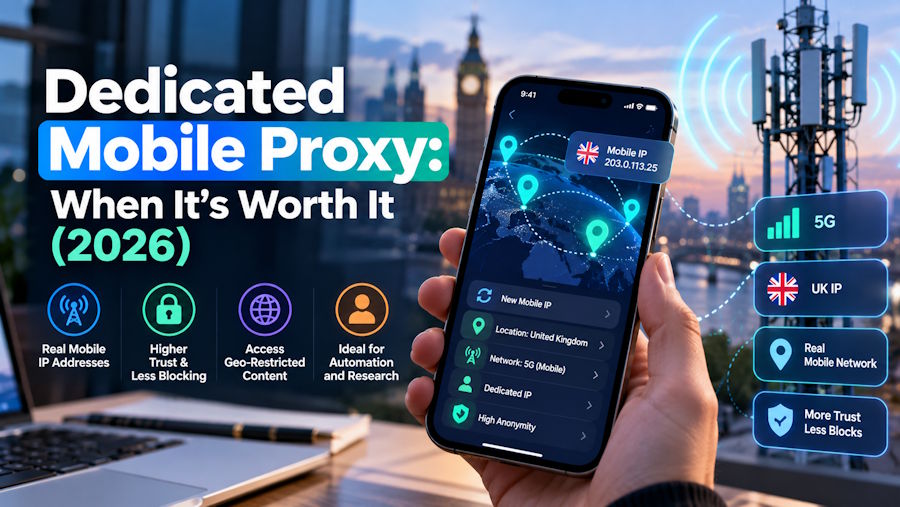
Direct answer: A dedicated mobile proxy assigns you a real 4G, LTE, or 5G carrier IP for your exclusive use during the rental period, instead of cycling you through a shared pool. It costs more than a rotating or shared proxy when a task depends on a consistent identity, an account you're managing, a login flow, or a session where losing the IP mid-task breaks what you were doing.
What is a dedicated mobile proxy
A mobile proxy routes your traffic through a real cellular connection, a phone, modem, or router on an active SIM, rather than a data center server or a home broadband line. That's what makes the traffic look like it's coming from an actual mobile device on an actual carrier network.
"Dedicated" describes who else is using that connection while you're renting it.
- A shared mobile proxy cycles multiple paying customers through the same device or small pool of devices, sometimes at the same time.
- A dedicated mobile proxy gives you one device and one IP for the length of your session, and no one else's traffic passes through it during that window.
- Some providers also sell 4G rotating proxies, which deliberately change the IP on a timer or on demand, useful for a different set of jobs, covered below.
Why dedicated mobile proxies matter
Mobile carrier IPs are shared by design. Under RFC 6598, Carrier-Grade NAT allows mobile carriers to route many real subscriber devices through the same public IP. This is normal network engineering and helps mobile traffic appear like that of ordinary phone users.
The issue is shared mobile proxy usage, where multiple customers’ automated traffic, such as scraping or bulk account activity, runs through the same IP. This can hurt IP reputation. A dedicated mobile proxy removes that second layer: you still use the carrier’s NAT, but your proxy connection isn’t shared with other proxy customers.
This consistency makes dedicated mobile proxies useful for account management, ad verification, localization checks, and carrier-specific market research. However, a proxy changes your network path, not your behavior, so it doesn’t guarantee anonymity or prevent platform bans.
Dedicated vs rotating mobile proxies
This is a task decision, not a quality one.
- Choose dedicated when the workflow breaks if the IP changes mid-task: logging into an account, completing a checkout or verification flow, or building up trust on one identity over time. Cookies, session tokens, and a platform's own trust scoring all assume the same address keeps showing up.
- Choose rotating when each request is independent and doesn't need to remember the last one: scraping, price monitoring, or sweeping many ad placements. Here, constant IP variety is the point, and holding one dedicated IP for that job just adds cost without a benefit.
- A common mistake is defaulting to rotation because it sounds more anonymous. For anything session-based, frequent rotation usually breaks the task, not protects it.
4G vs 5G mobile proxies
Neither generation is automatically the better mobile IP proxy:
- 4G/LTE runs on mature, broadly available infrastructure and is the cheaper, safer default for most account work, testing, and everyday automation.
- 5G offers higher peak throughput, which matters for bandwidth-heavy jobs like media-rich ad checks or larger data pulls, but rollout depth still varies a lot by carrier and city; a 5G IP in a market where 5G coverage is thin can look more unusual than a 4G one, not less.
Practical takeaway: If your target audience or account activity is realistically on 4G in that region, testing from a 5G IP can stand out rather than blend in. Match the network generation to what a real user there would actually be using.
Who should use dedicated mobile proxies
- Social media and account management: one proxy per account, held consistently
- Ad verification: checking how and where ads render from a genuine carrier connection
- E-commerce and localization research: pricing, availability, and content checks by region
- Market research: data collection tied to a specific country or carrier
- Mobile-first QA and testing: validating how an app or site behaves on real cellular conditions
Why CyberYozh is worth considering
CyberYozh runs its dedicated mobile proxies on physical 4G/LTE and 5G hardware, modems, routers, and carrier-connected devices, rather than reselling a third-party pool, with plans starting around $3.50/day.
Most tariffs are billed flat-rate with no data-volume cap, rather than metered per gigabyte, which matters for anything that runs continuously. Coverage currently spans 20+ dedicated carrier locations, including the US, UK, Germany, Canada, Ukraine, Ireland, the Netherlands, France, Spain, and Italy, with IP switching available manually or through the API.
- Best for: workflows that need one stable mobile identity held over time
- Mobile infrastructure: dedicated 4G/LTE/5G on physical carrier hardware
- Control: manual or API-based IP rotation; sticky by default for the rental period
- Automation: full API access for provisioning and switching
- Pricing: flat daily rate from ~$3.50/day with unlimited bandwidth rather than per-GB
- Use cases: account management, ad verification, localization research, mobile QA
Worth a look if your workflow matches the above; browse CyberYozh's dedicated mobile proxy options to see current locations and carriers.
Practical takeaway: If your workflow depends on keeping the same mobile identity through a session, logging in, completing a form, building account history, a dedicated proxy is worth more than a bigger, cheaper rotating pool.
FAQs
What is a dedicated mobile proxy? A dedicated mobile proxy is a real 4G, LTE, or 5G carrier IP assigned to a single customer for the length of their rental, rather than shared across multiple customers. It routes traffic through an actual cellular device, so the connection looks and behaves like a genuine mobile user.
Is a dedicated mobile proxy better than a rotating proxy? Neither is universally better; it depends on the task. Dedicated is better for anything session-based, like account logins or multi-step forms, where the IP needs to stay the same throughout. Rotating is better for high-volume, independent requests like scraping or price monitoring, where a fresh IP each time is the point.
Are dedicated mobile proxies worth it? They're worth it when your task depends on network consistency, an account you're building trust on, a session that can't be interrupted, or activity you want to look like it's coming from one real user in one place. For high-volume, independent requests where consistency doesn't matter, a rotating or shared proxy is usually cheaper and just as effective.
What is the difference between 4G and 5G mobile proxies? 4G/LTE proxies run on more mature, widely available carrier infrastructure and cost less. 5G proxies offer higher peak speeds, but coverage still varies significantly by carrier and location, so a 5G IP isn't automatically the better or more convincing choice; it depends on whether your target region and audience realistically use 5G.

