

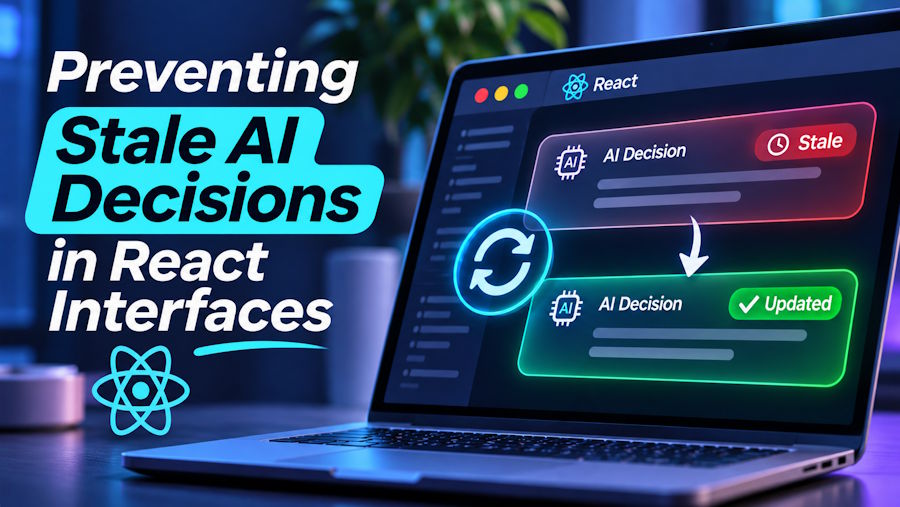
Adding artificial intelligence to a web interface introduces a problem that traditional form validation rarely encounters: the user's input may change before the AI has finished evaluating it.
Consider a project management dashboard with a search field that also suggests actions. A user types "open project settings" and then quickly changes the query to "export project report."
The application sends two requests to an AI decision service. The second request finishes first, correctly identifying an export-related intent. A moment later, the first request returns and overwrites the interface with a suggestion to open settings.
Nothing failed at the network level. Both responses were technically valid. The problem is that the interface displayed a decision belonging to an outdated input.
For developers building AI-assisted search, command palettes, or interactive forms, preventing this behaviour requires more than simply connecting a model to a React component.
The application needs a reliable way to coordinate user input, asynchronous requests, structured decisions, and UI state.
Understanding the Race Condition
React applications often update their interfaces immediately when users type, select options, or modify form fields.
External AI requests operate on a different timeline.
Each request travels through the network, reaches a server, undergoes evaluation, and eventually returns a result. The order in which responses arrive is not necessarily the order in which requests were sent.
Imagine the following sequence:
- Request A evaluates "open project settings."
- The user changes the input to "export project report."
- Request B evaluates the updated query.
- Request B returns an export suggestion.
- Request A returns later and replaces the newer suggestion.
The interface now shows a result that no longer corresponds to what the user entered.
This is a race condition between asynchronous responses and the current application state.
For an ordinary search suggestion, the result may simply be confusing. For interfaces that trigger more important actions, allowing outdated decisions to control behaviour can create additional problems.
The solution begins by separating what the AI evaluates from what the application is permitted to display or execute.
Separate User Input, AI Evaluation, and UI Actions
A dependable architecture should treat the evaluation process as a distinct layer.
The browser captures the user's latest input and sends it to an application-controlled backend. The backend prepares a structured evaluation request and calls the AI service.
The result then returns to the browser, where the application checks whether it still belongs to the current input.
Only then should the interface update its suggestions.
This creates a straightforward sequence:
User input → Application server → AI evaluation → Response validation → UI update
Keeping these responsibilities separate provides several advantages.
The frontend remains responsible for user interaction. The backend handles authentication and external API communication. The decision model evaluates the text, while the application decides how the result should affect the interface.
Most importantly, an AI response does not automatically become permission to perform an action.
For a command palette, identifying "export" as the likely intent should produce an export suggestion, not immediately download a file or access restricted information.
Use Structured Outputs Instead of Parsing Generated Text
One way to simplify AI-assisted interfaces is to avoid relying on unrestricted natural-language responses when the application only needs a small set of possible outcomes.
For example, a command palette may support four categories: navigation, export, creation, and an unknown or unsupported request.
A traditional generative model might produce an explanation such as "The user probably wants to export the current project."
The application would then need additional logic to interpret that sentence.
A structured decision model can return a predefined category directly.
For developers exploring this approach, Jev AI provides access to System One decision model through an interactive playground and API. The model evaluates supplied information against typed questions and returns structured choices, probabilities, and scores, making it suitable for experimenting with interfaces that depend on predefined results rather than free-form text.
For a command interface, the developer could define a Choice question asking which category best represents the user's input.
The permitted categories might be:
- navigate: Open an existing section or page.
- export: Prepare an existing report for download.
- create: Start a new item or project.
- other: No supported category clearly matches the input.
The model can select from these predefined options and return associated probabilities.
This allows the frontend to work with known category identifiers instead of searching through generated paragraphs.
It also makes the interface easier to test because the application knows which kinds of results it is expected to handle.
Keep API Credentials Outside the Browser
The next step is establishing a secure communication boundary.
Developers should not place private AI API keys directly inside React components or browser-side JavaScript bundles.
Instead, the frontend should send its request to an endpoint controlled by the application, such as /api/intent.
The server validates the submitted text, adds the required credentials, and communicates with the external decision model.
When working with a structured AI service, the backend typically prepares an evaluation request containing the input state, a model identifier, and the questions that need to be answered.
For Jev, the request structure includes fields such as model, state, and questions.
A Choice question uses type: "choice" along with a criteria object defining the available options.
The response includes an answers object. For a Choice question, developers can inspect the selected choice, the probabilities associated with the options, and the reported confidence.
Rather than forwarding the entire external response directly to the browser, the backend can validate the result and return only the fields required by the interface.
Authentication failures, invalid responses, and unavailable model services should produce controlled error states rather than causing unpredictable interface behaviour.
Keeping credentials on the server also provides a suitable location for input validation, rate limiting, and usage controls.
Prevent Old Requests From Updating React State
Even when the model returns structured results, a frontend still needs to handle overlapping requests.
Two techniques work particularly well together: request cancellation and latest-request validation.
1. Cancel requests that are no longer relevant
When the user changes the input, the application can use AbortController to cancel the previous browser request.
In React, this can be handled through the cleanup function of a useEffect hook.
When the query changes or the component unmounts, the cleanup function aborts the previous fetch and clears any pending debounce timer.
This reduces unnecessary processing in the browser and prevents many obsolete responses from reaching the state-update logic.
However, cancellation is not a complete guarantee. A request may already have reached the server, and external evaluation may continue even after the browser disconnects.
2. Verify that each response belongs to the latest request
The application should maintain a request identifier that increases whenever a new evaluation starts.
When a response arrives, the component checks its identifier against the most recent request.
A simplified JavaScript guard looks like this:
if (requestId !== latestRequestId.current) return;
If the identifiers do not match, the application discards the result.
This prevents an older response from overwriting the state associated with a newer input, even if cancellation did not stop the earlier request.
Together, cancellation and response validation create a more reliable boundary between asynchronous AI evaluations and visible interface state.
Avoid Running an Evaluation on Every Keystroke
Sending a request after every individual character can increase network traffic, processing costs, and the number of overlapping responses.
A debounce interval provides a practical improvement.
For example, the interface may wait approximately 300 milliseconds after the user's most recent keystroke before starting an evaluation.
If the user continues typing, the timer resets.
The appropriate delay depends on the application's interaction requirements and should be tested rather than treated as a universal setting.
Developers can also skip evaluation when the input is empty, too short, or already handled reliably by deterministic application logic.
Debouncing improves efficiency, but it does not replace request validation.
A previously dispatched request can still return after the input has changed. The interface must continue rejecting responses that no longer correspond to the current query.
Use Confidence to Control Suggestions, Not Permissions
Once an evaluation returns, the application needs to determine how the result should appear.
This is where the distinction between different structured question types becomes useful. Developers testing the jev model can use Choice questions to identify predefined categories, Yes/No questions to evaluate specific conditions, and Score questions to assess information against defined levels.
These outputs can support different interface behaviours.
For a command palette, the application might display a suggested action when the selected category has sufficiently strong support.
If confidence is low or the result is ambiguous, it could instead show the regular command list and allow the user to choose manually.
However, confidence thresholds should be established through testing on representative inputs. A high reported score does not guarantee that the selected action is correct.
The application should also preserve independent permission checks.
Even if the model confidently selects an export action, the server must still verify that the user is authorised to access the relevant report.
AI classification can help determine which suggestion to display. It should not replace access controls, business rules, or explicit user confirmation.
Design Useful Loading and Failure States
A reliable AI-assisted interface should account for more than successful responses.
At minimum, the frontend should distinguish between an idle state, a pending evaluation, a valid suggestion, an uncertain result, and an error.
When a request is pending, the application can continue displaying ordinary navigation options instead of blocking the entire interface.
If the external service becomes unavailable, users should still be able to search or navigate through supported manual controls.
Rate limits and insufficient account balance should also be handled explicitly.
For example, HTTP 429 indicates a rate-limiting condition, while HTTP 402 can indicate insufficient balance. Applications should follow the service's documented error-handling requirements rather than blindly retrying every failed request.
Automatic retries deserve particular care when requests consume usage balances. A timeout does not always prove that the original evaluation was never processed.
Good error handling preserves predictable application behaviour even when the AI integration is temporarily unavailable.
Test Response Ordering Before Deployment
A successful demo with a single input is not sufficient to prove that an AI-assisted interface is reliable.
Developers should test situations where several requests overlap.
One useful test deliberately delays the response to an earlier query while allowing a newer response to finish first.
The expected behaviour is straightforward: the newer result remains visible, and the delayed response is ignored.
Other useful test cases include:
- Clearing the input while an evaluation is running.
- Switching between different projects before a result returns.
- Unmounting the component during a pending request.
- Returning an unsupported category or malformed response.
- Receiving a low-confidence decision.
- Encountering network errors or exhausted API balance.
These tests should verify both the visible interface and the underlying state transitions.
Developers can mock responses instead of making real model calls for every automated test.
This makes it possible to reproduce timing problems consistently without relying on unpredictable network conditions.
Final Thoughts
AI-assisted interfaces introduce new possibilities, but they also create additional asynchronous dependencies.
A model may classify a request correctly while the frontend displays that classification at the wrong moment.
Reliable integration therefore depends on more than model accuracy.
Developers need clear separation between input, evaluation, and action; secure server-side API access; structured response validation; cancellation and stale-response protection; and predictable fallback behaviour.
Structured decision models can reduce the amount of interpretation required after inference, making them useful for applications that need predefined choices or scores.
But the final responsibility for state management, permissions, and user experience remains with the application.
The goal is not merely to make an interface respond intelligently. It is to ensure that every response is still relevant when it reaches the user.

