


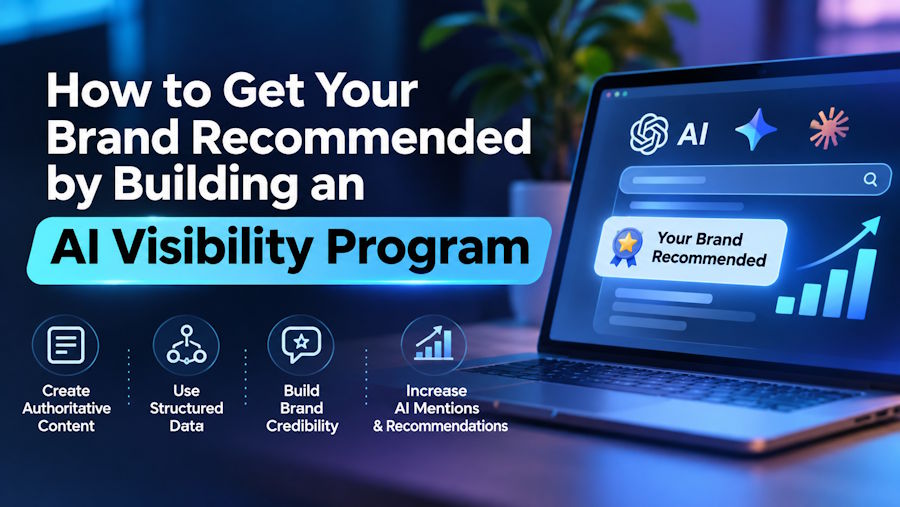
In the modern day, more and more buyers are skipping search results and directly asking an AI assistant for answers instead. A 2026 L.E.K. Consulting survey found that 46% of AI users now begin their purchase research on a platform like ChatGPT, Gemini, or Perplexity, up from 25% in 2024. Meanwhile, the share starting on traditional search fell from 43% to 24%.
This illustrates why it's becoming essential for brands that want to compete online to build a visibility program that gets them recommended by AI agents. Most users use AI to compare options and narrow their list, which is exactly when a brand either makes the cut or disappears. The good news is that getting recommended isn’t just luck, and brands that take a proactive approach to building AI visibility can set themselves up for future success.
How AI Assistants Decide Which Brands to Mention
Before launching an AI visibility campaign, it’s important to understand how AI assistants decide which brands they recommend and which ones they don’t. AI assistants rely heavily on perceived authority, so a brand that positions its content to be relevant, accurate, and accessible to its customers seems like a stronger answer.
Much of the advice about AI search focuses on small on-site changes like rewriting pages to sound “AI-friendly” or creating special files for AI crawlers. However, Google’s own guidance suggests that’s the wrong place to focus. In a May 2026 guide, Google said optimizing for generative AI search is still SEO, meaning that its AI runs on the same core ranking systems as regular search and no special AI files or markup are needed. In practice, if search engines can already read your site, AI tools very likely can too. This means the real work is establishing your brand as a reliable source and providing real value to your customers.
Step 1: Start with the Prompts
Traditional SEO starts with keywords, and AI visibility starts with prompts, so before changing anything on your site, decide which prompts you want your brand to appear for. These are the questions buyers type into ChatGPT, Gemini, or Perplexity when they’re looking for what you sell. They tend to be longer and more conversational than keywords, but choosing them draws on the same search intent thinking that guides good keyword research.
Build a list of 20 to 50 prompts across the buying journey, from broad category questions to direct comparisons with competitors, then run them in the assistants your customers use. Record whether your brand appears, which competitors show up, and which pages get cited. Use that as a baseline to show where you’re missing and give you something to measure against.
Step 2: Identify Query Fan-Outs
When someone asks an AI assistant a question, the tool doesn’t always search for that exact prompt. Google describes a process called query fan-out, in which its AI splits a question into several related searches, gathering results to combine them into one cohesive answer. For example, a prompt like “What’s the best accounting software for a small business?” might fan out into separate searches for accounting software comparisons, pricing for small businesses, and reviews of the most popular tools.
To find your fan-outs, look at the sources AI tools cite for your target prompts, noting the angles their answers cover, and map out the related searches each buyer question naturally breaks into, such as pricing, specs, comparisons, and use cases.
Step 3: Create or Optimize Pages for Each Fan-Out
Once you’ve identified your prompts and fan-out searches, check whether your site has a page that can answer and rank for each one. Some will connect with pages you already have, like a product page that needs to target the right terms more clearly. Others may reveal gaps, such as a comparison, a customer guide, or a use-case page you’ve never published before.
Organize these pages into topic clusters, with a main page supported by related pages and internal links, to help search engines see you as an authority on the whole subject rather than just a single keyword. Industry focus is also important, as fan-out searches tend to be highly specific in technical B2B markets. These can be built around materials, processes, or specs, which is why manufacturing SEO maps content to the exact language engineers and procurement teams use.
Step 4: Build Links to Those Pages
Publishing the right content is only half the job, because a page can only be cited for a fan-out search if it’s competitive for that search. Research into AI citations has found that cited pages tend to rank near the top of Google’s results, and newer data suggests that ranking across the related fan-out searches now matters even more than ranking for the original query.
Backlinks from relevant and respected sites remain one of the main ways to help a page climb search results. Point your link building at the specific pages for fan-out searches, not just your homepage. Trade publications, industry associations, supplier directories, partners, and original research that others reference are all strong sources.
Step 5: Measure AI Search Success Properly
Rankings alone won't tell you whether the program is working, so track three numbers against your prompt list every month:
- AI visibility percentage: The share of your target prompts where your brand is mentioned in the answer.
- Citation percentage: The share of prompts where the AI cites or links to one of your pages, which shows whether your fan-out pages are actually being used as sources.
- Traffic from AI tools: Visits referred by ChatGPT, Perplexity, Gemini, Copilot, and similar tools, which you can track as referral sources in your analytics. Pairing that data with a Search Console-to-sales approach shows which pages are turning AI visibility into leads.
Getting Recommended Is Earned
If your brand isn't showing up when buyers ask AI for recommendations, you don't need a complete overhaul to change that. Start by choosing the prompts that matter most to your buyers and mapping the related searches those prompts fan out into. From there, build pages that answer those questions well and earn the links that will help them rank, because rankings across those searches shape which brands get cited.
Measuring AI visibility, citations, and AI traffic every month shows what’s working and where to focus next, so the brands that commit to this process now will be the ones buyers keep hearing about when they ask AI for recommendations in the future.
Jason Khoo started freelancing in SEO in college, sold his first agency, and now is the founder of Zupo, an Orange County-based SEO consulting agency helping construct powerful long-term SEO strategies for our clients. Jason also enjoys multiple cups of tea daily, hiding away on weekends, catching up on reading, and rewatching The Simpsons for the 20th time.

