

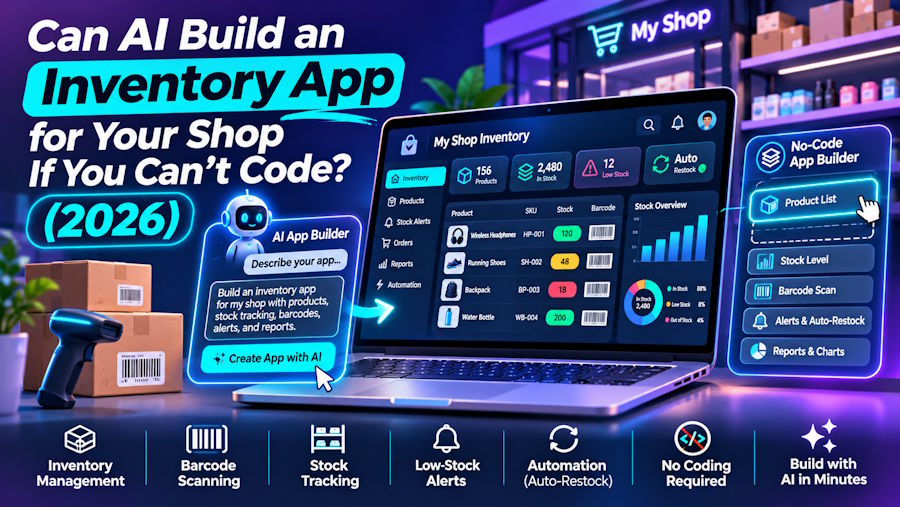
Short answer: yes. In 2026 you can describe an inventory app in plain English and have AI build a working one, with your products, stock counts, staff logins and low-stock alerts, without writing code. You can also skip building and use an off-the-shelf inventory app. Which one is right depends on how standard your shop's process is.
Disclosure: this article is written by the team behind Floot, one of the tools below. Prices were checked on November 6, 2026.
What a shop inventory app actually needs
Before picking a tool, list what you need. For most small shops it is:
- A product list: name, SKU or barcode, category, cost and price.
- Stock counts per location (the shop floor, the back room, a second store).
- Stock in and stock out: receiving a delivery, recording a sale, writing off damaged items.
- Low-stock alerts, so you reorder before a shelf is empty.
- Logins for staff, ideally with different permissions for owners and employees.
- A phone view, because counts happen in the aisle, not at a desk.
If everything on that list matches how a standard inventory app works, buy one. If your shop has its own rules (bundles, consignment items, made-to-order stock, a supplier who only takes WhatsApp orders), building your own is where AI helps.
Option 1: Use an off-the-shelf inventory app
Sortly is a ready-made inventory app built for small businesses. It has a free plan for up to 100 unique items, and paid plans from $24 per month billed yearly ($49 month to month). It is the fastest route if your process is standard: sign up, import a spreadsheet, start counting.
The trade-off: you work the way the app works. Custom fields and workflows are limited by its plans.
Option 2: Turn a spreadsheet into an app
If your inventory already lives in a spreadsheet, Glide and Softr turn it into an app with a few clicks. Glide has a free plan and paid plans from $25 per month. Softr has a free plan and paid plans from $19 per month, with a per-user limit on how many people can log in.
The trade-off: the app is only as flexible as the spreadsheet or database underneath it, and the number of staff who can log in is part of the price.
Option 3: Have AI build an app around your process
AI app builders write the app for you from a description. Floot works from the AI assistant you already use: you connect it to ChatGPT or Claude once, then describe the app in the chat. It builds the app with its own database, staff logins and hosting, and shows you a live preview while it works.
Here is what that looks like for a shop:
- Connect Floot to ChatGPT or Claude (it is listed in both apps' connector directories).
- Describe the app. For example: “Build an inventory app for my hardware shop. Products have a name, barcode, category, cost, price and a reorder level. Track stock in two locations: shop floor and back room. Staff can record deliveries, sales and write-offs from their phone. Show me everything below its reorder level on the home screen. Owners can see costs and margins; staff can't.”
- Try the preview. Add a few products, record a delivery, and check the low-stock list. Ask for changes in plain English: “add a supplier field”, “let me import my products from a CSV”.
- Publish it to a web address your staff can open on any phone, and invite them with their own logins.
- Optional: publish it as an iPhone and Android app. Floot builds the apps on its own servers, so you don't need a Mac.
Low-stock alerts can go out by email or as a push notification to staff phones; a daily summary email uses scheduled jobs, which run on Floot's paid plans. Using the phone's camera to scan barcodes is something you can ask for in the description.
Floot has a free plan with 100 build actions a day (each action is one step your assistant takes, such as writing a file). Pro is $25 per month. The AI itself runs on your ChatGPT or Claude subscription, so there are no extra AI credits to buy.
The trade-off: you are responsible for describing what you want and testing it, the way you would with a contractor.
Which one should you pick?
| Your situation | Best fit | Starting price |
|---|---|---|
| Standard retail stock, want it running today | Sortly | Free (100 items), then $24/mo billed yearly |
| Inventory already in a spreadsheet, a few users | Glide or Softr | Free, then $25/mo (Glide) or $19/mo (Softr) |
| Your own process, staff logins, phone apps, built from ChatGPT or Claude | Floot | Free, then $25/mo |
Prices checked on November 6, 2026.
FAQ
Do I need to know how to code?
No. With all three options you describe or click what you want. With an AI builder, it helps to be specific about your process, the same way you would brief a person.
Can staff use it on their phones?
Yes, with all three. A web app opens in the phone's browser; Floot can also publish native iPhone and Android apps.
Can I move my existing stock list in?
Yes. Sortly, Glide and Softr import spreadsheets directly. With an AI builder, ask it to add a CSV import and upload your file.
What happens if I outgrow it?
Off-the-shelf apps grow through higher plans. An app Floot builds is a standard TypeScript and React project that you can export.

