

Games know an extraordinary amount about how we perform.
They know the number of matches we played last month, our win rate, accuracy, rank, average damage, preferred role and the exact moment our performance started falling apart during a losing streak.
Competitive games are particularly good at turning activity into data.
The player becomes visible through numbers.
What those numbers cannot tell you is why you are still thinking about an argument from three days ago while waiting for the next match to start.
They cannot explain why a loss irritated you more than usual, why you suddenly do not feel like joining voice chat, or why something unrelated to the game has been sitting in the back of your mind all evening.
That side of digital life belongs to a very different category of apps.
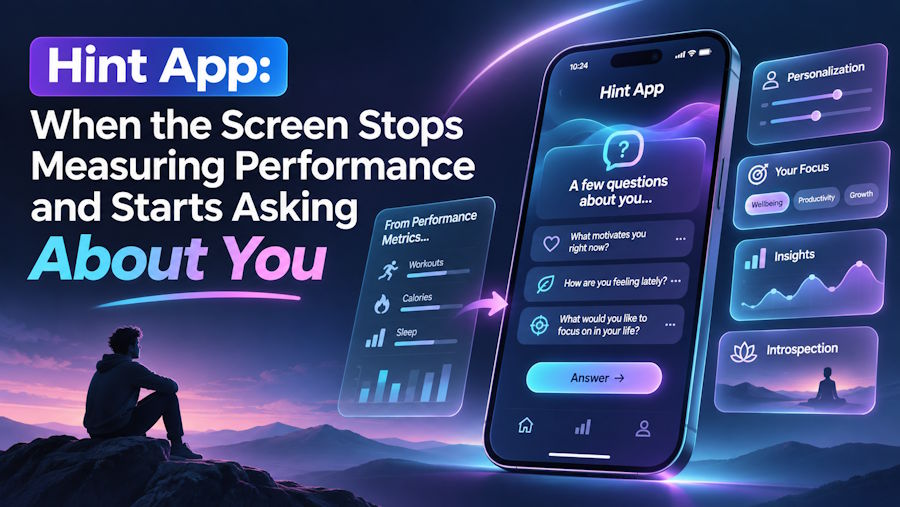
And one recent Reddit post about Hint App shows how unexpectedly powerful the switch from performance feedback to personal reflection can feel.
The writer had not downloaded the astrology app expecting anything profound. They had been having a difficult week, avoiding messages and going through their normal routine without feeling particularly engaged. Lying awake, they tried the app after hearing about it on TikTok.
They expected generic horoscope material.
Instead, one line in a personalized reading stopped them mid-scroll. It touched on the feeling that they needed to be perfect so people would not leave.
The user wrote that nothing was suddenly fixed. But the sentence put language around something they had thought many times before, and the emotional reaction was immediate.
For people used to screens constantly evaluating what they do, there is something unusual about an app suddenly directing attention toward how they feel.
Games Give Us Feedback Constantly
A modern player rarely has to wonder how a match went.
The interface tells them.
- Victory or defeat.
- Rank gained or lost.
- Kills.
- Deaths.
- Assists.
- Economy.
- Damage.
- Objectives.
- Accuracy.
- Team rating.
The entire competitive environment is designed around feedback loops.
That is useful because improvement depends on information. Players watch replays, change settings, study opponents and try to understand which decisions affected the result.
EGamersWorld itself is built heavily around this performance culture, with tournament coverage, match data, team and player statistics, rankings and analytical material for competitive-game audiences.
But players do not stop being people when the match ends.
The same person who wants precise data about a 47-minute game may have a much harder time putting their own emotional state into words.
That difference becomes particularly visible around burnout.
EGamersWorld's current mental-health project discusses how prolonged pressure, repetitive routines, lack of proper breaks and emotional exhaustion can affect esports players and others around competitive gaming. Its burnout guide also stresses that rest and psychological recovery deserve attention alongside performance itself.
A performance dashboard can show declining results.
It cannot necessarily explain what is happening outside the match.
That requires a different kind of reflection.
One Sentence Can Do What a Dashboard Cannot
The Reddit Hint App story is interesting because the reading did not present the user with some enormous revelation.
The reaction came from recognition.
The person already knew the feeling.
They had simply never seen it expressed in quite that form.
Hint describes its current service as personalized astrology based on exact birth information, with individualized natal-chart interpretations and other personal material generated using its technology and astrologer input.
Whether somebody accepts astrology is a separate question.
The digital-design difference is easier to see.
A game says:
Here is what you did.
A reflective product says:
Here is something about you. What do you make of it?
That second interaction depends much more heavily on interpretation.
A player can dispute the description.
Recognize part of it.
Ignore another part.
Remember a situation it brings to mind.
The app provides the prompt. The person supplies the context.
In the Reddit post, that context happened to be a rough week and a long-standing fear around relationships. The writer explicitly avoided claiming the app had solved the underlying issue.
That restraint is important.
Personal reflection can be meaningful without turning an app into therapy or treating an interpretation as a diagnosis.
Hint itself states that its astrological readings are intended for entertainment and should not replace professional advice.
The useful moment may simply be noticing that a particular statement produced a reaction.
The Cooldown After the Cooldown
Gaming already has the concept of cooldown built into its language.
- Abilities reset.
- Rounds end.
- Teams regroup.
- Players take breaks before the next queue.
But the physical act of closing a game does not always mean the brain has left the match with it.
Anyone who has played competitive games knows the feeling of carrying the previous round into the next one.
- The missed shot.
- The teammate's comment.
- The stupid decision that cost the match.
Sometimes the better move is another game.
Sometimes it is getting away from the competitive loop entirely.
That does not require an elaborate wellness routine.
- A walk.
- Music.
- Talking to someone.
- Watching something unrelated.
- Writing something down.
- Or opening an app that asks a completely different type of question.
This is where a product such as Hint App becomes interesting to a gaming audience without needing to be a gaming product itself.
It belongs to the enormous digital world that exists after the scoreboard.
Modern gamers already move constantly between ecosystems. EGamersWorld has noted that gaming culture now stretches across competitive titles, casual games, streaming platforms, mobile experiences and social communities rather than existing as a single isolated activity.
The same person can finish a Valorant match, open Discord, switch to TikTok, answer a message and then spend ten minutes reading something about themselves.
The boundaries between these digital experiences are thin.
What changes is what each screen is asking from the user.
The Most Personal Metric Has No Leaderboard
There is an appealing certainty to gaming statistics.
If your accuracy is 31%, it is 31%.
If your team lost 13-9, there is nothing to interpret about the score.
Personal reflection is frustratingly different.
There is no universal rating for whether you are dealing well with rejection.
No MMR for communication.
No match history showing exactly when an old insecurity started influencing a new relationship.
This may be part of why a clear sentence can feel unusually satisfying.
It gives form to something that normally has no interface.
The Reddit commenters around the Hint App post repeatedly reacted to that idea. Several described the strange comfort of seeing a familiar internal pattern put into words, even while acknowledging that recognition by itself does not resolve the underlying issue.
That distinction makes the story more believable.
The memorable part is not “an app understood everything.”
It is:
“I knew this feeling, but I had never seen it written like that.”
For an audience surrounded by dashboards and measurable outcomes, that is a very different kind of feedback.
Not Everything Needs to Improve Your Rank
Gaming culture can become relentlessly optimization-focused.
- Better aim.
- Better hardware.
- Better settings.
- Better communication.
- Better sleep because it improves reaction time.
- Better routines because they improve consistency.
Even recovery can start sounding like another performance strategy.
There should still be room for digital experiences that do not have to make somebody a better player.
Something can simply make a person think.
Hint App is an interesting example because its personalized material is built around identity, relationships and individual interpretation rather than measurable performance.
For one Reddit user, that was enough to interrupt an ordinary night and create a moment of emotional recognition.
There was no level-up screen afterward.
No achievement.
No measurable improvement.
The person simply understood one of their own thoughts a little more clearly than they had before.
Games are excellent at showing us how we played.
Sometimes, after the match is over, another kind of screen can remind us that performance was never the whole person.

