

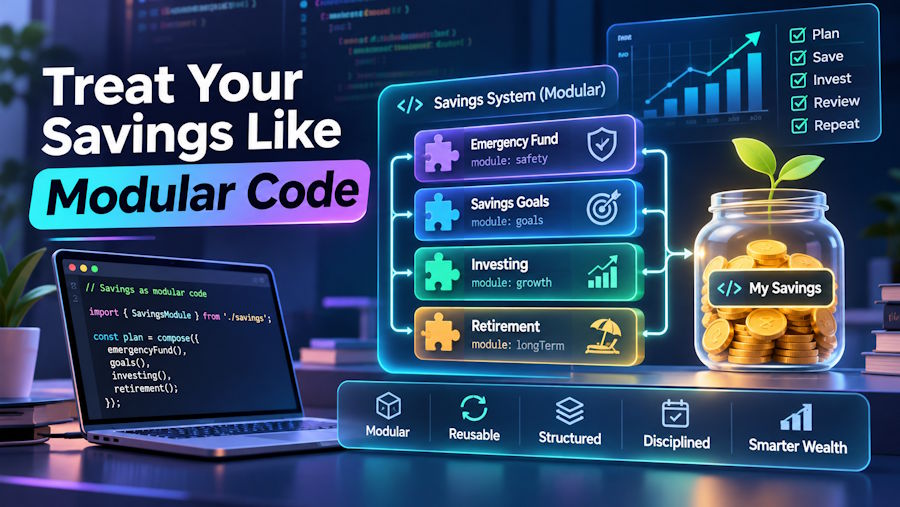
Developers spend their days breaking big problems into small, manageable pieces. A sprawling application becomes a set of modules, each with one clear job, a sensible name and a predictable interface. When something breaks, you know where to look. When something needs to grow, you extend one piece without rewriting the rest.
Personal finances rarely get the same treatment. Many people keep one savings account that holds everything at once: the emergency cushion, the vacation fund, money for a new laptop and a vague plan for holiday gifts. It works the way a single giant file works. Everything is technically there, but nobody can tell what belongs to what, and every withdrawal feels like a guess.
Applying a little software thinking to savings can make money easier to manage, easier to track and much harder to spend by accident.
The Problem With One Big Balance
A single savings balance hides information. Suppose the account shows $4,000. Is that a healthy emergency fund, or is half of it already promised to a trip in June and a car repair next month? Without separation, the number looks bigger than it really is.
That confusion leads to two common mistakes. Some people spend money they had quietly set aside for something else, then scramble when the planned expense arrives. Others become so unsure of what they can safely use that they avoid touching savings at all, even for the purpose it was meant for.
In code, this is the equivalent of global variables that every function can change. It works until it doesn't, and then the bug is hard to trace.
One Account, One Responsibility
Good modules follow a simple rule: each one should do one thing well. The same idea works for savings. Instead of a single pot, set up several separate savings accounts, each tied to a specific goal.
A typical structure might include:
- An emergency fund for unexpected costs.
- A travel fund for planned trips.
- A gear fund for hardware, software and upgrades.
- A holiday fund for gifts and seasonal spending.
- An annual bills fund for insurance, subscriptions and renewals.
Each account has a clear purpose. When money moves in or out, the reason is obvious. When a goal is met, that account can be closed or repurposed without disturbing the others.
Many banks and credit unions let customers open additional savings accounts beyond their main one, often with no monthly fee. That makes this kind of structure practical for almost anyone.
Name Things Clearly
Programmers know that naming is one of the hardest and most important parts of the job. A variable called "data2" tells you nothing. A variable called "monthlyRentDue" tells you exactly what it holds.
Savings accounts deserve the same care. Account numbers and generic labels like "Savings 3" make it easy to lose track. Most online banking tools let you assign nicknames, so take advantage of it. "Japan Trip 2027," "New Laptop" or "Car Insurance Renewal" turns a list of balances into a readable dashboard.
Clear names also act as a quiet reminder of intent. It is much harder to pull money out of an account labeled "Emergency Only" for an impulse purchase than out of one called "Savings."
Automate The Repetitive Work
Developers automate tasks they do more than a couple of times. Manual steps get forgotten, delayed or done inconsistently. Scheduled jobs simply run.
Saving works best the same way. Set up automatic transfers from checking into each goal account, timed to land right after payday. Some people route part of a direct deposit straight into savings so the money never sits in checking at all.
Automation removes the need for willpower. Instead of deciding every month whether to save, the decision is made once, and the system carries it out. Small, regular deposits add up faster than occasional large ones, and they build the habit without much effort.
Track Progress Like A Build Dashboard
A good continuous integration dashboard shows at a glance which builds pass, which fail and how far a project has come. Savings goals benefit from the same visibility.
Give each account a target amount and, ideally, a target date. Many online banking platforms let you set goals and watch progress toward them. If not, a simple spreadsheet or budgeting app can do the job. Divide the target by the number of months remaining, and you have a monthly transfer amount.
Seeing a progress bar move from 20 percent to 60 percent is surprisingly motivating. It also makes problems visible early. If one goal is falling behind, you can adjust the transfer or the timeline before the deadline arrives.
Keep The Core Stable
Every system has a core component that everything else depends on. In personal finance, that role belongs to the primary savings account and the emergency fund. These should be the most stable parts of the structure.
Avoid dipping into them for planned expenses. Their job is to absorb surprises, such as a medical bill, a sudden job change or a broken phone. Goal accounts handle the predictable costs, so the core stays intact. Whether the setup lives in a large online bank or a Sidney Federal Credit Union savings account, the principle is the same: protect the foundation first, then build features on top of it.
Refactor As Life Changes
Code rarely stays the same for long, and neither do financial priorities. A move, a new job, a growing family or a shift in interests can change which goals matter most.
Review your savings structure every few months. Close accounts for goals you have reached. Merge funds that overlap. Add new ones as plans take shape. Adjust automatic transfers to match a new salary or new expenses. A quick refactor keeps the system clean and aligned with real life instead of last year's plans.
Small Pieces, Bigger Results
Software teams break large projects into small, well-named, automated pieces because it makes complex work manageable. Savings respond to the same approach. Separate accounts with clear purposes, sensible names, automatic deposits and visible progress turn saving from a vague intention into a system that runs on its own. Over time, that structure makes it far easier to reach the goals that matter, one module at a time.

