

Quick Answer
Evaluating a supplier for CNC turning services requires looking beyond the machine list. Three critical verification points determine success:
First, verify the supplier's stable batch capability. Theoretical machine limits (like ±0.005 mm) mean little if the process capability index (Cpk) is low. Second, examine how the supplier manages clamping distortion and thermal expansion, especially on thin-walled or long-shaft parts. Third, confirm whether secondary operations (like milling or drilling) are performed in-house under the same datum reference, which eliminates tolerance stack-up errors.
Turning is one of the most fundamental machining processes. However, producing a single, perfect cylindrical part on a lathe is very different from manufacturing thousands of identical parts with tight tolerances. As material is removed, internal stresses are released, and the heat generated by the cutting tool causes the workpiece to expand. Once the part cools down, it may fall out of tolerance.
When sourcing CNC Turning Services, procurement teams must evaluate how a supplier manages these physical realities. A quote that only highlights low hourly rates usually overlooks the engineering required to keep the process stable.
1. What Tolerances Can CNC Turning Services Reliably Achieve?
Buyers must distinguish between the machine's theoretical limit and the supplier's stable batch capability. It is common to see drawings specifying tolerances that are easily achievable on a single prototype but cause massive scrap rates in production.
| Metric | Theoretical Machine Limit | Stable Batch Capability |
|---|---|---|
| Dimensional Tolerance | ±0.005 mm | ±0.01 mm to ±0.02 mm (Requires Cpk ≥ 1.33) |
| Surface Roughness (Ra) | 0.4 μm | 0.8 μm to 1.6 μm (Without secondary polishing) |
| Concentricity (Long Shafts) | Dependent on setup | Tightly controlled by using a steady rest and tailstock |
Engineers at JS Precision have observed: Many buyers over-specify tolerances without considering the thermal expansion of materials. A part measured at 25°C might be out of tolerance at 20°C. For critical dimensions, we require that inspection is conducted in a temperature-controlled CMM room (20°C ± 1°C) and provide Cpk data for tolerances tighter than ±0.02 mm to prove process stability.
2. How Do You Verify Supplier Quality?
Do not rely solely on a visual pass or a basic dimensional report. Request the following documentation before releasing a production order:
- First Article Inspection (FAI) Report: Must include dimensional layouts and CMM data for all critical features.
- Material Certifications: Ensure the raw material grade matches the drawing requirements.
- Stress Relief Records: For complex or thin-walled parts, verify that the supplier performs stress-relieving (e.g., annealing) before final machining to prevent warping.
3. Why Does In-House CNC Machining Integration Matter?
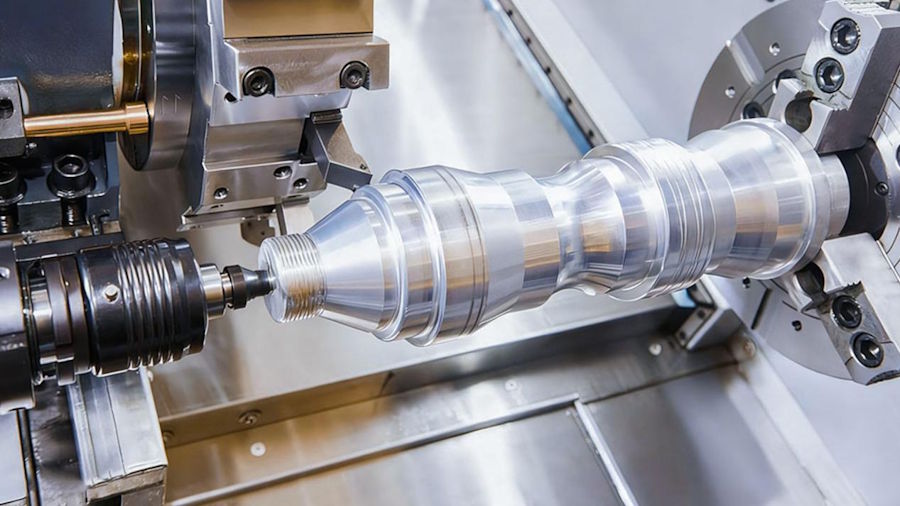
Turned parts often require secondary features such as cross-holes, flats, or slots. If a turning supplier subcontracts these milling operations to a third party, the part must be unclamped and re-fixtured on a different machine. Every re-fixturing introduces a datum shift.
By utilizing comprehensive CNC Machining services that integrate both turning and multi-axis milling in a single facility, suppliers can complete complex parts in one or two setups. This ensures that all features share the same datum reference, eliminating assembly fit failures.
4. What Questions Should You Ask a Turning Supplier?
Before placing an order, ask these five questions to evaluate their engineering capability.
- How many setups are included in your quote, and how do you manage datum transfer between them?
- How do you prevent clamping distortion on thin-walled features?
- Can you provide CMM data and Cpk values for the critical tolerances in the FAI report?
- Will the parts be stress-relieved before final machining to prevent warping?
- What is your process for handling out-of-tolerance parts during a production run?
JS Precision Engineer's Avoidance Checklist
- Do not accept a quote without a stated setup strategy. A cheap machine rate with five setups is more expensive than a single optimized setup.
- Verify stress-relief procedures. Materials like aluminum and stainless steel carry internal stress; without proper stress relief, parts will warp after machining.
- Confirm the inspection temperature. Insist on CMM inspection at 20°C for tight tolerances to eliminate thermal expansion errors.
- Check for fixture design. A good supplier will design soft jaws or custom collets to prevent marking and distortion on finished surfaces.
- Do not split turning and milling operations across different vendors unless absolutely necessary. The cumulative datum shift will eventually cause assembly failures.
FAQs about CNC Turning Services
Q: What is the standard tolerance for CNC turning?
A: While precision machines can theoretically hold tolerances down to ±0.005 mm, a stable and economical batch tolerance is typically ±0.01 mm to ±0.02 mm. Achieving tolerances tighter than this requires specialized tooling, temperature-controlled environments, and rigorous process capability (Cpk) monitoring.
Q: Why do turned parts sometimes warp after machining?
A: Warping is primarily caused by the release of internal stress within the raw material when outer layers are removed. It can also be caused by heat generated during turning. Suppliers prevent this by stress-relieving the raw material (e.g., annealing) before final machining and using optimized cutting parameters.
Q: Can a CNC turning supplier also machine cross-holes and flats?
A: Yes, if they have live tooling on their lathes or integrated milling capabilities. If a supplier only offers pure turning, they must subcontract the milling work, which introduces datum shift risks. It is highly recommended to source suppliers who can complete both operations in-house.
Q: How do you prevent clamping distortion on thin-walled parts?
A: Suppliers use specialized workholding such as soft jaws, custom collets, or expanding mandrels that distribute clamping pressure evenly. Additionally, taking lighter finishing cuts reduces the cutting force applied to the thin wall.
Q: What materials can be machined with CNC turning?
A: CNC turning can handle a wide range of materials, including aluminum, stainless steel, carbon steel, brass, copper, titanium, and engineering plastics like POM and PTFE. The choice of cutting tools and parameters changes depending on the material's hardness and machinability.
Conclusion
Selecting a supplier for turning projects requires verifying process control, not just checking equipment lists. By demanding proof of batch capability (Cpk), confirming stress-relief practices, and ensuring turning and milling are integrated under one roof, buyers can eliminate datum transfer risks and ensure consistent part quality.
About the Author
Doris Wu is an industrial manufacturing and global supply chain specialist at JS Precision, with over a decade of experience in precision machining, rapid prototype development, and on-demand production strategies. She supports hardware projects from rapid prototyping to volume production, with core expertise in custom CNC, sheet metal, molding, and tight-tolerance DFM engineering.

