

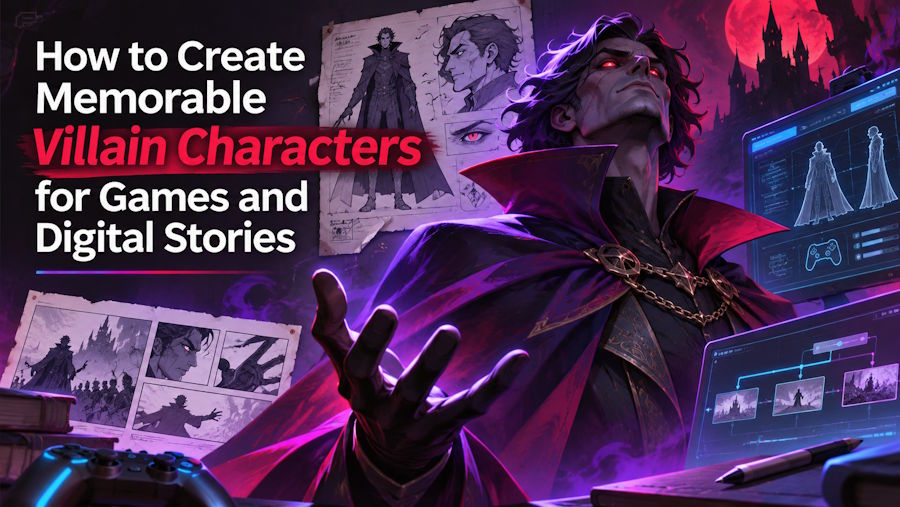
A compelling villain can turn an ordinary story into an unforgettable experience. Whether developers are building an indie game, writers are creating a digital comic, or designers are developing an interactive narrative, the antagonist often plays a major role in shaping how audiences experience the story.
However, creating an effective villain involves more than giving a character a frightening appearance or an intimidating name. A memorable antagonist needs a clear motivation, a recognizable personality, and a believable connection to the world in which the story takes place.
With the growing popularity of interactive entertainment, understanding how to design distinctive villains has become useful for both creative professionals and independent creators. Here are several practical ways to develop antagonists that make a lasting impression.
1. Start With the Villain's Motivation
Every compelling antagonist needs a reason for acting the way they do. Their motivations help audiences understand their decisions, even when they disagree with their methods.
For example, a villain might want to control a fictional kingdom because they believe its leaders are incapable of protecting its citizens. Another antagonist might seek revenge after being betrayed by someone they once trusted.
These motivations create opportunities for more interesting conflicts than simple good-versus-evil storytelling.
When developing a character, consider three questions:
- What does the villain want to achieve?
- What personal experience shaped their worldview?
- What are they willing to sacrifice to accomplish their goal?
The answers provide a foundation for the character's dialogue, behavior, and role in the larger narrative. They also help ensure that the antagonist remains consistent throughout the story.
2. Choose a Name That Reflects the Character
A character's name is often the first detail an audience encounters. A carefully chosen name can establish personality, suggest a particular background, and create expectations about the character before they even appear on screen.
Fantasy villains may benefit from names that sound ancient or mysterious, while science-fiction antagonists might have shorter, sharper names that fit a futuristic setting. A comedic villain, on the other hand, could have an exaggerated name that reflects the tone of the story.
Writers and game developers who struggle with naming can experiment with a random villain name generator to explore different possibilities. Generating several options can help spark ideas, especially when a project includes numerous antagonists, supporting characters, or fictional factions.
The goal is not necessarily to use the first suggestion. Instead, treat generated names as creative starting points and refine them according to the character's personality, setting, and intended audience.
Before finalizing a name, read it aloud and consider whether it is easy to pronounce, memorable, and appropriate for the fictional world.
3. Give the Antagonist a Distinct Personality
A villain becomes more believable when their personality extends beyond their role as an obstacle for the protagonist.
Some antagonists are calm and calculating. Others are impulsive, charming, manipulative, or obsessed with maintaining control. These differences influence how characters interact and how conflicts develop.
For example, a strategic mastermind might avoid direct confrontation and manipulate events from behind the scenes. A reckless antagonist may create unpredictable situations that force the protagonist to make difficult decisions quickly.
Developers can translate these personality traits into interactive experiences. A strategic enemy might use environmental traps, while an aggressive opponent could prioritize direct attacks. In a dialogue-driven game, personality can influence word choice, response timing, and relationships with other characters.
This approach connects character writing with gameplay design, making the antagonist feel like an active part of the experience rather than simply another obstacle.
4. Build a Consistent Visual Identity
Visual design helps audiences recognize and remember characters. Clothing, posture, color choices, accessories, and facial expressions can communicate important information without lengthy explanations.
A villain associated with secrecy might wear understated clothing and avoid revealing facial expressions. An antagonist who values authority might favor symmetrical designs, formal costumes, and carefully controlled movements.
Consistency matters more than adding excessive details. A recognizable silhouette or distinctive accessory can be more effective than an elaborate design filled with unrelated elements.
For digital projects, designers should also consider how the character appears across different screen sizes and environments. A design that looks impressive in promotional artwork may become difficult to recognize during fast-paced gameplay.
Testing the character in actual scenes helps identify visual elements that need simplification or stronger contrast.
5. Connect the Villain to the Story's World
An antagonist should feel as though they belong in the environment where the story takes place. Their abilities, resources, language, and behavior should reflect the world's rules.
In a medieval fantasy setting, a villain might rely on political alliances, magical artifacts, or military influence. In a modern technological thriller, the antagonist could exploit surveillance systems, misinformation, or weaknesses in digital infrastructure.
Worldbuilding also creates opportunities to make villains relevant to the protagonist's personal journey. Perhaps the antagonist represents the system the hero wants to change, or perhaps both characters experienced similar events but reached opposing conclusions.
These connections make the conflict more meaningful and allow the story to explore themes such as ambition, responsibility, power, and morality.
6. Use Technology to Support the Creative Process
Modern creative workflows often involve a combination of writing applications, design software, collaborative platforms, and development tools. These resources can help creators organize character details and maintain consistency across complex projects.
A character database, for example, can store names, motivations, relationships, dialogue samples, and visual references in one place. This becomes particularly useful when a game contains multiple storylines or when several team members contribute to the same fictional universe.
Procedural generation can also support early brainstorming. Developers can experiment with combinations of names, character traits, titles, and fictional backgrounds to produce a wider range of concepts.
However, generated suggestions should be reviewed rather than accepted automatically. Human judgment remains important for maintaining originality, avoiding unintended associations, and ensuring that every character serves a clear purpose.
For larger projects, teams can establish naming conventions and maintain a shared glossary. These simple practices reduce inconsistencies and make collaboration easier as the project grows.
7. Test Whether the Villain Is Memorable
Once the character has been developed, evaluate how effectively the different elements work together.
Ask a few readers, players, or team members to describe the villain after encountering them. If they can recall the character's name, motivation, appearance, or defining behavior, those elements are probably communicating effectively.
For game developers, playtesting can reveal whether the antagonist feels threatening, predictable, confusing, or appropriately challenging. Writers can use feedback to identify scenes where the character's motivation needs more explanation.
It is also worth checking whether the villain's actions create meaningful consequences. An antagonist who repeatedly threatens the protagonist without changing the story may eventually lose their impact.
The strongest villains influence the plot, challenge the protagonist's beliefs, and force meaningful decisions.
Conclusion
Creating a memorable villain requires a combination of thoughtful writing, distinctive naming, consistent visual design, and an understanding of the fictional world. These elements work together to make an antagonist recognizable and give audiences a reason to care about the conflict.
For writers, designers, and game developers, the creative process becomes easier when complex ideas are broken into manageable steps. Brainstorming tools, organized character documentation, and feedback from others can help transform an initial concept into a fully developed character.
Ultimately, the most effective villain is not simply the character who looks the most intimidating. It is the one whose identity, motivations, and actions contribute meaningfully to the experience and remain memorable long after the story ends.

