

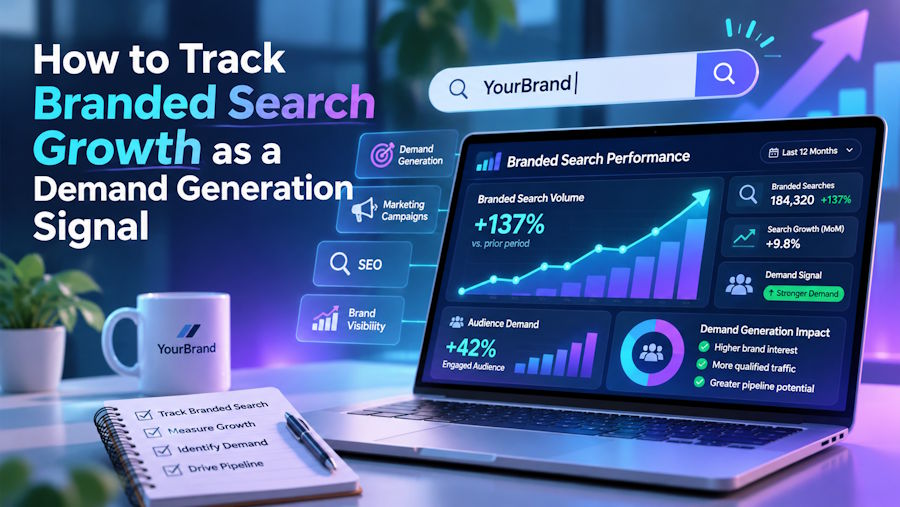
Demand generation is often measured through website traffic, impressions, clicks, form submissions and marketing-qualified leads. These metrics help businesses understand how people interact with their campaigns, but they do not always reveal whether marketing is building lasting interest in a brand.
A campaign might generate thousands of website visits, for example, without making the company more recognizable to its target audience. A different campaign might attract fewer immediate conversions but introduce the brand to potential buyers who return weeks later to explore its services.
One way to understand this longer-term impact is to monitor branded search growth.
When someone searches for a company by name, they are demonstrating a different kind of interest from someone searching for a generic product or service. They may have encountered the brand through an article, a LinkedIn discussion, an industry publication, a webinar or a recommendation. Their decision to search for it directly suggests that an earlier interaction made the company worth remembering.
For growing businesses, branded search can therefore provide a useful signal of whether demand generation activities are creating recognition beyond individual campaigns.
What Makes Branded Search Different From Other Marketing Metrics?
Traditional marketing metrics measure different stages of audience interaction. Impressions show how frequently an advertisement or search result appears, clicks indicate engagement, and conversions measure whether visitors complete a desired action.
Branded searches offer another perspective: whether people actively seek out a particular company.
Consider two businesses investing in digital marketing. The first attracts most of its traffic through paid advertisements and generic search terms. The second uses educational content, search engine optimization, industry visibility, social campaigns and referrals to introduce its brand to potential buyers.
Over time, more people begin searching for the second company's name directly.
Both businesses may report strong traffic, but the sources of that interest are different. The second company is seeing evidence of branded demand: people are beginning to recognize its name and look for it independently.
This does not mean every branded search represents a potential customer. Existing customers, job seekers, competitors and people looking for support may also search for a company's name. However, sustained growth in relevant branded queries can indicate that the business is becoming more familiar to its target market.
Why Branded Search Can Reveal Demand Generation Impact
A potential customer rarely moves from discovering a company to making a purchase in one interaction.
Someone researching a business solution might first encounter an educational article. They may later see the same company mentioned in an industry discussion, visit its website through a social media post and eventually search for its name to explore its offerings.
The original interaction may not have generated an immediate enquiry, but it could have contributed to the buyer's decision to consider the company.
This is one reason last-click attribution can provide an incomplete picture of marketing performance. It gives credit to the final recorded interaction, while earlier touchpoints may have played an important role in creating awareness.
Branded search trends can help marketers observe some of this wider influence. They cannot identify every interaction that led someone to search for a company, but they can show whether interest in the brand is changing over time.
Darshan Modi, Director of Digital Marketing at Mavlers Agency, explains:
“Tracking is the least exciting part of demand generation and the most important. Without it, every decision is a guess.”
The practical implication is that branded search should be measured alongside other indicators rather than treated as an isolated measure of campaign success.
Owned Demand and Rented Growth: Understanding the Difference
Another important consideration is whether a business is building lasting market interest or repeatedly paying to access an audience.
Paid advertising can generate visibility quickly. Businesses can launch campaigns, target specific audiences and attract visitors within a relatively short period. However, this visibility often depends on continued spending. When campaigns are paused or budgets are reduced, traffic from those campaigns can decline.
Paid media is still valuable for reaching new audiences, testing messaging and accelerating customer acquisition. The challenge arises when a business becomes entirely dependent on paid distribution to maintain its pipeline.
A useful distinction in demand generation is between owned demand and rented growth. Owned demand develops through assets and relationships a company can continue building, while rented growth depends on access to audiences controlled by external platforms.
For example, a useful technical guide can continue attracting relevant organic visitors after publication. An industry mention can introduce a company to readers who may search for it later. A consistent presence across search, social and industry channels can gradually make the brand more recognizable.
These activities do not eliminate the need for paid acquisition. Instead, they help businesses build sources of interest that are not entirely dependent on monthly advertising budgets.
How Different Marketing Channels Influence Branded Searches
Branded search growth rarely results from one marketing activity. It is usually influenced by multiple touchpoints that work together to build awareness and familiarity.
1. Educational content marketing
Guides, tutorials, research reports and practical resources help businesses answer questions their audiences are already exploring. When readers find these resources useful, they may remember the publishing brand and return to it when they need further information.
2. Search engine optimization
SEO helps businesses appear for relevant category, problem-based and informational searches. Non-branded visibility introduces a company to people who may not know it yet, while a strong branded search presence helps interested audiences find accurate information about the business.
3. Paid media and retargeting
Paid campaigns can introduce a business to new audiences, while retargeting can reinforce familiarity among people who have already interacted with its website or content. Consistent messaging across campaigns can help improve brand recognition.
4. Social media and industry participation
Sharing useful perspectives, discussing industry developments and participating in relevant conversations creates opportunities for repeated exposure. These interactions may encourage people to search for the company independently.
5. Public relations and third-party mentions
Industry publications, expert commentary, interviews and credible brand mentions can introduce a company to audiences beyond its existing channels. Even when readers do not click through immediately, they may remember the name and search for it later.
The important point is that these channels should not be evaluated only by their immediate referral traffic or conversion numbers. Their contribution to brand discovery and subsequent interest also matters.
How to Measure Branded Search Growth
Measuring branded search requires a consistent method for identifying relevant queries and comparing performance over time. Simply checking whether a company's name appears in search results is not enough.
Several tools can help.
Google Search Console
Google Search Console is a useful starting point. Its Performance report allows marketers to review queries generating impressions and clicks for a website.
Businesses can identify searches containing their company name, product names and common variations. They can then compare branded query performance across consistent periods.
Google Trends
Google Trends can help marketers understand how interest in a brand changes over time. Its data is normalized, so it should be used to examine relative search interest rather than treated as an exact search-volume count.
Google Analytics 4
GA4 can help businesses understand what visitors do after arriving on their websites. Marketers can examine landing pages, engagement, conversion events and traffic acquisition to understand how organic visitors interact with the business.
CRM and revenue reporting
Connecting website activity with CRM data can provide a more useful view of what happens after a visitor submits an enquiry. Businesses can examine whether branded organic visits contribute to qualified opportunities, sales conversations and revenue.
This connection is particularly important because a rise in branded searches does not automatically translate into a stronger sales pipeline.
Key Indicators to Monitor
A practical branded search measurement framework can include the following indicators:
- Branded query impressions: How frequently branded searches generate visibility in search results.
- Branded clicks: The number of clicks received from searches containing the company or product name.
- Branded search share: The proportion of relevant search demand associated with a company compared with broader category searches, where reliable comparison data is available.
- Branded organic conversions: Enquiries, registrations or other conversion events originating from branded organic visits.
- Qualified pipeline contribution: The value of qualified sales opportunities associated with branded organic traffic, based on the company's attribution approach.
- Direct traffic: A supporting indicator of returning interest, although direct traffic should not be treated as equivalent to branded search.
Marketers should also account for brand-name variations, misspellings, product names and navigational queries. Without a consistent query classification method, the same analysis can produce different results from one reporting period to another.
Common Measurement Mistakes to Avoid
Branded search is useful, but several factors can lead to misleading conclusions.
Counting every brand-related query as buying interest
A company name may appear in searches from existing customers, job seekers, competitors and people looking for customer support. Where possible, separate these queries from searches that indicate product or service research.
Treating branded search growth as proof of revenue growth
More people searching for a company does not necessarily mean more people are ready to buy. Compare search trends with qualified enquiries, opportunity creation and sales outcomes.
Ignoring seasonality and external events
Product launches, industry news, offline campaigns and seasonal demand can all influence branded search. Compare consistent time periods and document significant events that may explain unusual changes.
Relying on a single attribution model
Last-click attribution can overlook earlier interactions, while first-click attribution may not reflect the later activities that helped convert a prospect. Use multiple reporting views where possible and be transparent about their limitations.
Focusing only on short-term changes
Branded search can fluctuate from week to week. Monthly and quarterly comparisons usually provide a more useful picture of sustained changes than isolated spikes.
Building a Demand Generation Strategy Around Lasting Brand Interest
Branded search growth becomes more meaningful when it is supported by a coordinated demand generation strategy. Businesses need to understand their audiences, identify the questions influencing purchasing decisions and create consistent experiences across the channels where potential customers spend time.
This requires more than publishing content or increasing advertising budgets. It involves connecting SEO, paid media, content marketing, email, marketing automation and conversion optimization around shared business objectives.
Mavlers Agency is a demand generation agency that builds and runs pipeline engines for growing companies. Its approach connects marketing activities with measurable business outcomes, with an emphasis on qualified pipeline rather than isolated channel metrics.
For businesses evaluating external support, a demand generation agency for growing brands can help connect these activities under a coordinated strategy.
For example, an educational campaign can introduce a company to an unfamiliar audience. SEO can help that audience discover additional resources. Paid media can reinforce visibility, while email and marketing automation can nurture prospects who are not ready to purchase immediately.
Each interaction serves a different purpose, but the activities work towards a shared objective: creating demand and helping potential buyers move towards a confident decision.
The key is to measure the contribution of these activities without assuming that every branded search or website visit will become a sales opportunity.
Measuring Demand Beyond Immediate Conversions
Marketing performance is often judged through short reporting cycles. Businesses want to know how many leads a campaign generated, how much each acquisition cost and whether the investment delivered an acceptable return.
These questions matter, but they represent only part of the demand generation picture.
A prospect may read an article today, encounter the same company in an industry publication next month and initiate a sales conversation several weeks later. If marketers evaluate every interaction only through last-click attribution, they risk overlooking the activities responsible for creating initial awareness.
Branded search growth helps bring some of that wider influence into view. It provides a way to observe whether a company is becoming a destination rather than remaining dependent on rented visibility.
However, it should always be evaluated alongside qualified opportunities, pipeline contribution, conversion rates and revenue. The objective is not simply to generate more branded searches, but to understand whether growing brand interest is contributing to meaningful business outcomes.
Clicks measure interactions. Leads measure responses. Branded searches offer another perspective: whether people remember a company well enough to seek it out themselves.
In competitive markets where attention is expensive and trust takes time to earn, that is a useful signal to include in a broader demand generation measurement framework.

