

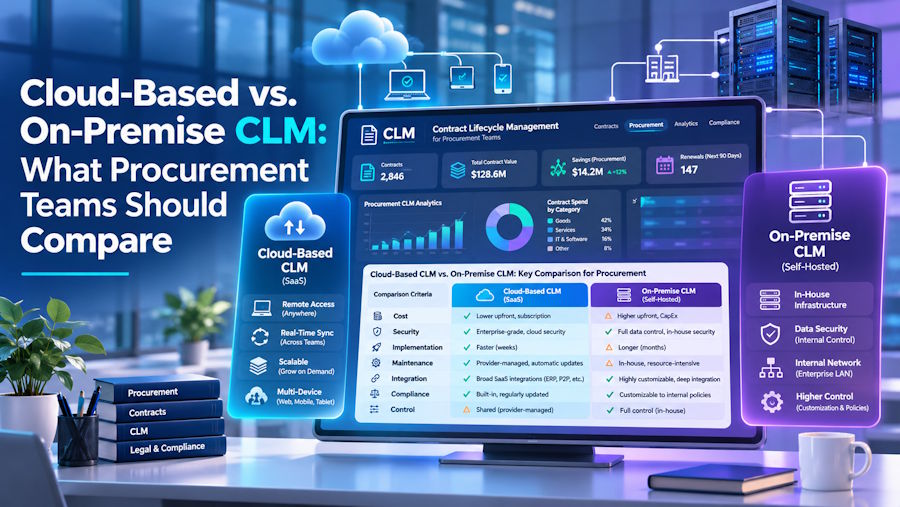
Cloud-based and on-premise contract lifecycle management (CLM) differ most in infrastructure responsibility, data boundaries, upgrade control, integration operations, capacity, access, and cost. Neither deployment model alone determines drafting quality or negotiation intelligence. Procurement should compare both the operating model and how the proposed system carries approved terms into execution, ongoing management, and later amendments.
For procurement teams evaluating CLM, the decision extends beyond where documents reside. It includes where AI processes contract information, who maintains integrations, and how teams access and act on approved terms. Evaluating the proposed configuration against everyday contracting requirements is more useful than relying on broad cloud-versus-local claims.
How Deployment Changes CLM Operations
For this comparison, cloud means vendor-operated software as a service, while on-premise means enterprise-operated software on internal infrastructure. Private cloud and hybrid arrangements can combine elements of both, so establish who operates each component before comparing proposals.
Consider one hypothetical managed-services agreement throughout the evaluation. Its draft requires monthly availability reporting, a service-credit claim within 30 days, and specified termination notice. During negotiation, the supplier requests a 60-day claim window. The practical question is whether the approved change remains accessible and accurate throughout the agreement’s lifecycle.
Data Residency and Processing Boundaries
Data residency identifies where contract information is stored. The processing boundary also includes where services examine or transform that information. With cloud CLM, buyers need to verify the vendor’s available regions and associated services. An on-premise installation gives the enterprise control over its local environment, but external AI calls, support access, and exported data still need consideration.
The supplier’s draft and negotiating comments belong in that assessment, alongside the signed agreement. Security reviews should cover data in transit, stored information, access controls, and separation between customers. Certifications and attestations should be checked for their scope and relevance to the proposed deployment.
A data-flow diagram covering drafts, AI processing, backups, logs, disaster recovery, and support access helps buyers identify whether each destination meets organisational requirements.
Integration Ownership and Failure Recovery
Integration connects contract terms and approval events with ERP, CRM, and procure-to-pay systems. In a SaaS arrangement, the vendor may maintain connectors while the buyer owns mappings and credentials. An enterprise-operated deployment may place more connector maintenance internally. In either case, responsibilities should be explicit.
Contract identifiers, payment terms, approval status, and service-level fields need to reach the systems that use them. As outlined in Sirion’s CLM-ERP integration guide, these connections help carry contract information into operational processes.
For the example agreement, the approved 60-day claim window should reach the relevant downstream system. If the connection fails, teams need a visible exception, an identified recovery owner, and a way to restore the correct data without creating duplicate records.
Authoring Controls and Negotiation Continuity
Authoring controls determine which templates, clauses, and fallback positions users can put into a draft. Their availability depends on the product and configuration. The deployment question is how policy changes are distributed, document editing is supported, and approved exceptions are preserved through signature.
For the example agreement, the important connection is between the approved 60-day exception and the deadline used by the team managing service-credit claims. A searchable clause has limited practical value if operational users still work from the abandoned 30-day position.
Buyers should establish how each configuration handles a clause-policy change during negotiation, which exceptions require renewed approval, and how the final agreed term becomes available to the responsible business owner.
Upgrade Control and AI Action Permissions
In a SaaS arrangement, the provider generally manages application maintenance and releases. With enterprise-operated software, internal teams typically take greater responsibility for scheduling, testing, and applying upgrades. Buyers should understand the release process, available testing arrangements, and resources required under each proposal.
AI permissions require a separate review. An agent that proposes a fallback has a different level of authority from one that inserts it, routes approval, or changes an ERP record. Hosting alone does not establish which actions are available or permitted.
Evaluate the complete workflow, including model updates and human intervention. Confirm who can authorise AI actions, how approval requirements are enforced, and how important workflows are checked after an update.
Capacity and Service Recovery
Cloud services can make additional resources available without the buyer procuring and maintaining the underlying hardware. Enterprise-operated infrastructure requires the buyer to plan available capacity and expansion arrangements. Both models still need clear application-level performance and recovery commitments.
For procurement, capacity extends beyond document storage. A quarter-end workload could include new drafts, simultaneous reviewers, extraction jobs, and scheduled reporting. Buyers should understand how each proposal accommodates those demands and what additional capacity costs.
Recovery planning should also cover contracts and workflows in progress. If service is disrupted, a restored contract record should retain the relevant approval history, document relationships, and workflow status. Agree on acceptable recovery time and data loss before selection.
Distributed Collaboration and Lifecycle Visibility
Collaboration gives authorised internal and external participants access to the correct contract version. SaaS typically provides access through vendor-managed services, while an enterprise-operated deployment requires the buyer to manage the relevant network and access arrangements.
Browser access, concurrent editing, and external collaboration remain product capabilities that should be confirmed in the proposed configuration. Supplier reviewers need appropriate access to a negotiation, and that access must be revocable without exposing unrelated agreements.
The broader requirement is that procurement, legal, and operations can follow the agreement throughout its lifecycle. After signature, the service owner should be able to find the executed reporting requirement and approved claim window without reconstructing the negotiation.
Total Cost and Operating Responsibility
Total cost includes implementation, subscriptions or licences, infrastructure, integrations, administration, upgrades, support, and exit work. SaaS offers commonly package vendor-operated services into recurring charges. Enterprise-operated deployments require explicit provision for internal infrastructure and maintenance.
Compare both proposals over the same three-year horizon using identical contract volumes, users, integrations, and service requirements. Request separate prices for AI consumption, storage growth, test environments, connector changes, and export assistance. Also account for internal labour, including administration and correcting failed transfers.
A priced responsibility matrix helps clarify which costs sit with the provider and which remain with the enterprise. Include a growth scenario so the comparison reflects likely changes in usage.
| Capability | Vendor-operated cloud | Enterprise-operated on-premise | What to test |
|---|---|---|---|
| Data boundary | Verify vendor regions and processing routes | Verify local controls and external dependencies | Complete data-flow map |
| Integration | Establish vendor and buyer connector duties | Establish internal and supplier maintenance duties | Interrupted transfer and replay |
| Authoring | Verify policy distribution and exception controls | Verify the same controls in the installed version | Clause change through execution |
| AI and upgrades | Establish release controls and action permissions | Establish upgrade resources and action permissions | Unauthorized action and regression |
| Capacity and recovery | Verify service limits and recovery commitments | Verify provisioned capacity and recovery operation | Peak load during restoration |
| Collaboration | Verify identity and external-sharing controls | Verify access architecture and sharing controls | Restricted access and revocation |
| Total cost | Price subscriptions, usage, and retained work | Price licenses, infrastructure, and retained work | Equivalent three-year scenario |
What Remains the Same
The need for reliable contract capabilities remains the same. Whichever deployment is chosen, buyers need evidence that the proposed configuration can support their agreements, workflows, access requirements, and integrations. Extraction accuracy and effective security should be evaluated directly.
Migration still needs a defined scope and accountable owners. Include amendments, document relationships, access permissions, approved exceptions, and operational fields in acceptance checks. A reconciliation report should show what moved, what failed, and what remains unresolved.
Governance also remains a buyer responsibility. Define who may change templates, approve deviations, authorise AI actions, and resolve discrepancies between contract language and downstream records. Those decisions apply across both deployment models.
How to Decide
Favour vendor-operated cloud when its documented data-handling arrangements meet requirements and its operating model reduces infrastructure and maintenance work the enterprise does not want to own. Confirm that integration support, release controls, access arrangements, and service commitments also meet business needs.
Favour on-premise when a specific isolation, deployment, or internal-control requirement cannot be met by the available cloud configurations. Establish funded owners for maintenance, capacity, recovery, and integration support, alongside the infrastructure needed to run the service.
Before selection, use the managed-services scenario to compare the proposed configurations with the same documents and permissions. When evaluating CLM for procurement, check whether the approved claim window remains accurate, accessible, and usable from negotiation through ongoing contract management.
The final decision should bring together security requirements, internal resources, integration needs, scalability, and total cost. The strongest fit is the deployment that meets those requirements while supporting consistent control and visibility across the contract lifecycle.

