

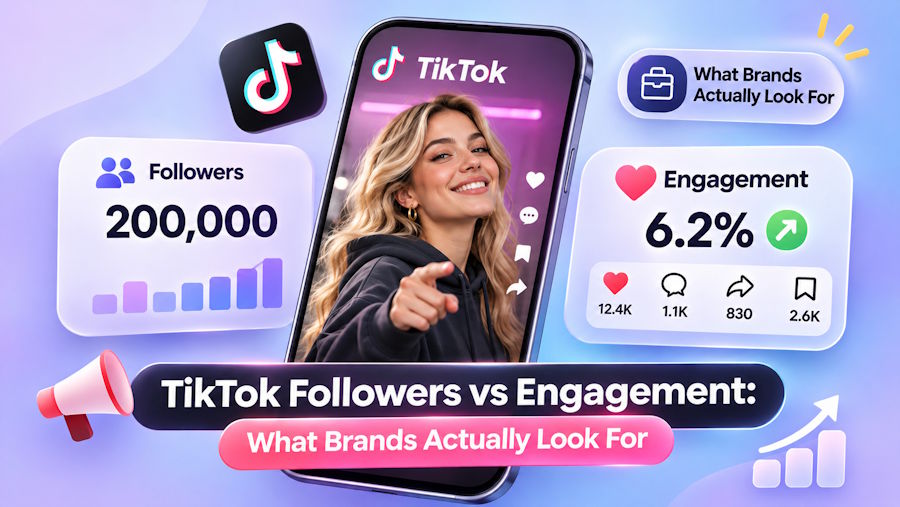
When comparing TikTok followers vs engagement, brands look beyond follower counts. They want creators who can reach the right audience, generate meaningful interactions, and influence purchasing decisions. A large following can increase visibility, but engagement, audience relevance, and authentic content often make a creator more attractive for brand partnerships.
TikTok Followers vs Engagement: What's the Difference?
Followers and engagement measure two different aspects of TikTok performance. Followers represent audience size, while engagement shows how people interact with a creator's content.
What TikTok Followers Tell Brands
A follower count gives brands an initial indication of a creator's potential reach and visibility. A larger audience can help businesses increase brand awareness and expose products to more people.
Other advantages include:
- Social proof: A substantial following can make a creator appear established.
- Potential reach: More followers provide a larger existing audience for content distribution.
- Campaign scalability: Larger accounts can be useful for campaigns focused on broad exposure.
However, having thousands of followers does not guarantee that people will watch or interact with every video. While strategies to grow your TikTok followers can expand your total audience, TikTok's For You feed also allows content to reach users who do not follow the creator.
What TikTok Engagement Reveals
Engagement measures how actively viewers interact with content. The main TikTok engagement metrics include:
- Likes: Show positive reactions to videos.
- Comments: Indicate audience participation and interest.
- Shares: Show that viewers find content worth distributing.
- Saves: Suggest that users consider content useful enough to revisit.
- Video views: Measure video exposure, although views alone do not demonstrate meaningful interaction.
For brands, these metrics provide additional insight into audience interest and content performance when using the best TikTok growth service.
Consider two creators:
| Metric | Creator A | Creator B |
|---|---|---|
| Followers | 100,000 | 20,000 |
| Average views | 15,000 | 12,000 |
| Average interactions | 450 | 1,200 |
| Engagement rate | 0.45% | 6% |
Creator A has five times more followers, but Creator B generates considerably more interactions.
If a brand wants to encourage conversations and audience participation, Creator B could be the better partner. The final decision would still depend on audience demographics and campaign objectives.
Why TikTok Engagement Often Matters More Than Followers
Follower count indicates potential reach, but engagement provides insight into how audiences respond to content. This distinction matters in influencer marketing, where brands want their collaborations to generate more than passive exposure.
Engagement Shows Audience Interest
A creator might have 200,000 followers but consistently receive very few comments, likes, and shares.
Meanwhile, a smaller creator might have an active community that regularly asks questions, shares opinions, and discusses recommendations.
For example, a fitness creator with 15,000 followers who regularly receives questions about workout routines and equipment could be particularly attractive to a fitness brand.
Engagement Can Support Better Campaign Performance
Shares can increase content distribution, comments can encourage product discussions, and saves can indicate that viewers find information useful.
These interactions can help brands identify creators whose audiences are receptive to their content.
However, engagement does not automatically translate into sales. Brands should also examine website traffic, clicks, sign-ups, and purchases when evaluating campaign results.
Smaller Creators Can Offer Valuable Niche Audiences
Micro-influencers and nano-influencers often focus on specific interests and communities.
A skincare brand, for example, might prefer a smaller beauty creator whose followers actively discuss skincare products over a general entertainment account with a much larger audience.
Pro tip: Do not evaluate influencers exclusively by follower count. Audience relevance and consistent engagement can be more valuable than a large but poorly targeted following.
How Brands Evaluate TikTok Influencers
When selecting creators for influencer marketing campaigns, brands typically examine several performance indicators.
1. Follower Count and Potential Reach
Brands consider whether a creator has an audience large enough to support their campaign objectives.
A company launching a product nationwide might prioritize creators with substantial reach. A smaller business targeting a specific community may prefer a micro-influencer.
Common influencer categories include:
- Nano-influencers: 1,000–10,000 followers.
- Micro-influencers: 10,000–100,000 followers.
- Mid-tier influencers: 100,000–500,000 followers.
- Macro-influencers: 500,000–1 million followers.
- Mega-influencers: More than 1 million followers.
These are commonly used industry classifications, not official TikTok categories.
2. Engagement Rate and Interaction Quality
Brands examine engagement across multiple recent videos rather than relying on one viral post.
They may look at:
- Average likes, comments, and shares.
- Engagement consistency.
- Comment quality and relevance.
- Audience participation.
- Responses to previous sponsored content.
A smaller number of meaningful comments can indicate stronger audience interest than hundreds of generic responses.
3. Audience Demographics and Relevance
Even a highly engaged audience has limited value if it does not match a brand's target customers.
For example, a skincare company targeting women aged 25–40 in the United States may prefer a beauty creator with 30,000 relevant followers over a general entertainment account with 300,000 followers.
4. Content Quality and Authenticity
Brands also consider how creators communicate, present products, and interact with their communities.
Important factors include video quality, storytelling, publishing consistency, creativity, and compatibility with brand values.
Authenticity matters because audiences are more likely to trust recommendations from creators whose content feels natural and credible.
Brands may also investigate suspicious follower growth, repetitive comments, and unusual engagement patterns.
5. Previous Campaign Performance
For campaigns focused on measurable results, brands examine more than engagement.
Additional performance indicators include:
- Click-through rate (CTR).
- Website traffic.
- Conversion rates.
- Cost per acquisition (CPA).
- Return on investment (ROI).
A creator with 25,000 followers who generates 150 product purchases could deliver better commercial results than someone with 150,000 followers who generates only 80.
How to Calculate TikTok Engagement Rate
The most common follower-based engagement rate formula is:
Engagement Rate = (Likes + Comments + Shares) ÷ Followers × 100
Some calculation methods also include saves.
For example, imagine a creator has 20,000 followers and their video receives:
- 800 likes.
- 120 comments.
- 80 shares.
Total interactions equal 1,000.
The calculation is:
1,000 ÷ 20,000 × 100 = 5%
The video has a 5% follower-based engagement rate.
For a more reliable assessment, calculate average engagement across several recent videos rather than relying on one post.
Engagement Rate by Followers vs. Views
There are two commonly used approaches to measuring TikTok engagement.
| Measurement | Formula | What it measures |
|---|---|---|
| Engagement by followers | Interactions ÷ followers × 100 | Engagement relative to account size |
| Engagement by views | Interactions ÷ views × 100 | Engagement relative to video exposure |
For example, if a video receives 1,000 interactions and 10,000 views, its view-based engagement rate is 10%.
Follower-based engagement is useful when comparing accounts, while view-based engagement helps evaluate individual video performance. The two methods should not be treated as interchangeable.
What Is a Good TikTok Engagement Rate?
There is no universal engagement rate that guarantees brand partnerships. Results vary depending on account size, content niche, audience demographics, and calculation method.
Smaller creators often achieve higher follower-based engagement percentages, while larger accounts may generate more total interactions despite having lower percentages.
For example:
| Creator | Followers | Engagement rate |
|---|---|---|
| A | 10,000 | 8% |
| B | 50,000 | 4% |
| C | 200,000 | 2% |
Creator A has the highest engagement rate, but Creator C may generate more total interactions.
Brands should compare creators with similar audiences and content categories rather than relying on a single industry benchmark.
How to Improve Your TikTok Profile to Attract Brand Partnerships
Creators looking for sponsorships should build profiles that demonstrate both audience growth and meaningful engagement.
Here are five practical strategies:
1. Build a recognizable niche. Focus on a consistent content category, whether it is beauty, fitness, technology, fashion, or travel. This helps attract followers with shared interests and makes your profile easier for brands to evaluate.
2. Encourage meaningful interactions. Create videos that invite questions, discussions, and shares. Responding to comments also helps strengthen relationships with your audience.
3. Improve profile visibility. Use a recognizable profile image, write a clear bio, and pin your strongest videos. Consistent publishing and discoverable content can support audience growth. Creators can also explore ways to grow TikTok followers while maintaining a content strategy focused on genuine interactions.
4. Monitor TikTok Analytics. Track views, follower growth, engagement, and audience demographics. Use these insights to identify which content formats perform best.
5. Prepare a professional media kit. Include follower count, average views, engagement rate, audience demographics, previous collaborations, and relevant campaign results. Keep the information accurate and updated.
TikTok Followers vs Engagement: What Matters More to Brands?
Both metrics matter, but they serve different purposes. Follower count helps brands estimate potential reach, while engagement reveals how actively audiences interact with a creator's content.
A creator with 20,000 followers and a highly engaged niche audience may be a better partner for a targeted campaign than someone with 200,000 followers and limited interaction.
The strongest TikTok profiles combine relevant audience size, consistent engagement, authentic content, and measurable results. For creators, the goal should be to grow an audience while building genuine relationships with viewers.
Ultimately, influencer value is determined not just by how many people follow an account, but by how effectively a creator connects with the right audience.
Frequently Asked Questions
1. Are TikTok followers or engagement more important to brands?
Engagement often provides a stronger indication of audience responsiveness, while followers indicate potential reach. Brands consider both when selecting influencers, depending on campaign objectives and target demographics.
2. What is a good engagement rate on TikTok?
A good engagement rate depends on account size, niche, and calculation method. Smaller creators often achieve higher follower-based engagement percentages. Comparing similar accounts is more useful than following one universal benchmark.
3. How many TikTok followers do you need to get brand deals?
There is no minimum follower requirement for every partnership. Creators with 1,000–10,000 followers can attract opportunities through niche expertise, relevant audiences, and consistent engagement.
4. Can you get brand deals with low TikTok followers?
Yes. Smaller creators can attract partnerships by demonstrating strong engagement, relevant content, and an audience that matches a company's target customers.
5. Do brands look at TikTok views or followers?
Brands examine both. Followers indicate existing audience size, while views show how much exposure individual videos receive. Consistent video performance can help demonstrate campaign potential.
6. What engagement metrics do brands look at on TikTok?
Brands typically examine likes, comments, shares, saves, average views, and engagement rates. They may also evaluate comment quality, audience demographics, and previous sponsored content.
7. How do you calculate TikTok engagement rate?
The common follower-based formula is (likes + comments + shares) divided by followers, multiplied by 100. Some tools also include saves or calculate engagement relative to video views.
8. Why do some TikTok accounts have many followers but low engagement?
Inactive followers, audience mismatches, inconsistent publishing, changes in content direction, and low-quality audience growth can all contribute to low engagement.
9. Are micro-influencers better than macro-influencers on TikTok?
Neither category is universally better. Micro-influencers can offer niche audiences and strong community relationships, while macro-influencers provide greater potential reach. The right choice depends on campaign goals.
10. Do TikTok shares matter more than likes?
Shares can provide valuable insights because they indicate that viewers found content worth distributing. However, likes, comments, and saves also help brands understand audience response.
11. How can I increase my TikTok engagement rate?
Publish relevant content consistently, experiment with different video formats, create compelling openings, respond to comments, and use TikTok Analytics to identify which topics generate the strongest interactions.
12. Do brands check whether TikTok followers are real?
Yes. Brands may examine follower growth patterns, audience demographics, comment quality, and engagement consistency to identify suspicious activity. Authentic audience growth helps creators establish credibility with potential partners.

