

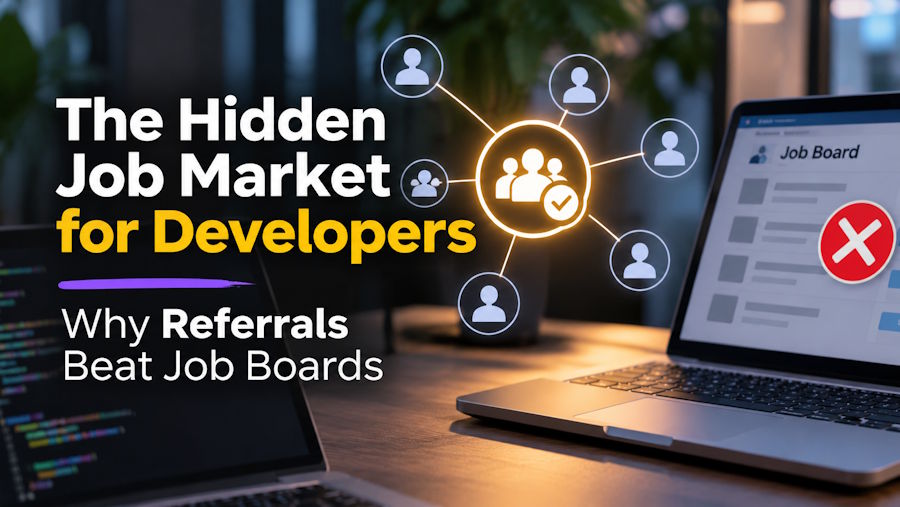
You have sent eighty applications and heard back from two. Meanwhile, a former teammate changes jobs in three weeks for a role you never saw advertised. That is not luck. It is the hidden job market: positions filled through referrals, networks, and direct outreach before they ever reach a job board, or without being posted at all.
For developers, this market is bigger than most people think. Depending on the company and the level, somewhere between 40% and 70% of positions are filled through referrals, networking, and direct contact, according to this complete guide to job search in 2026. If you only apply through job boards, you are competing for the smaller half of the market, against everyone else who does the same.
Why companies prefer referrals
Look at hiring from the company's side and it becomes an engineering problem: signal versus noise. A public posting for a backend role can attract hundreds of applications in a few days. Many are generic, some are automated, and few match the stack. Someone has to read them all.
A referral arrives with context. A trusted engineer is saying: I have worked with this person, and they can do the job. That is a strong filter, and it is cheap. Referral hires also tend to start faster, because there is less screening to do. Many companies pay employees a referral bonus for exactly this reason.
There is also risk. A bad hire costs a team months: onboarding, lost delivery, then a new search. A hiring manager who has to choose between a stranger with a perfect resume and a slightly less polished candidate that a senior engineer vouches for will often pick the second.
Some roles never get posted at all. A founder hires the engineer they met at a meetup. A team lead brings over a former colleague. A recruiter fills a sensitive role from a shortlist without announcing it. If you are not connected to any of these channels, those jobs do not exist for you.
How to get into the hidden market
- Map your network like a dependency graph. Make a list of everyone you have worked with: former colleagues, classmates, people from open-source projects and hackathons. Note where each of them works now. Most developers are surprised how many companies they already have a link into. Second-degree contacts count too: a former colleague's current manager is often one message away.
- Ask for a referral the right way. Make it easy to say yes. Send the link to the specific role, two or three lines on why you fit, and your resume. The best requests are short and specific: name the role, connect your experience to what the team needs in one sentence, for example the same stack or a similar product, and offer to answer questions. Skip the long cover letter, because your contact will usually forward your message as it is.
If they cannot refer you, ask for a 15-minute call about the team instead. People who know you will usually help. - Treat open source as a public interview. Fixing issues in a company's public repositories puts your code in front of their engineers. Start small: a documentation fix, a failing test, a bug labelled "good first issue". Maintainers notice regular, careful contributors, and some companies hire directly from their contributor lists.
- Make yourself findable. A short technical blog post, a talk at a local meetup or a well-documented side project gives hiring managers something to find when they search. It also gives your network something to forward. One solid write-up about a problem you solved at work is worth more than ten generic tutorials.
- Reach engineering managers, not just HR. If you have no mutual contact, write to the hiring manager directly. Keep it to a few sentences: what you build, what you noticed about their product or stack, and a question. Specific beats polished. "I saw your team moved search to Elasticsearch last year; I did the same migration at my last job" gets more replies than "I am passionate about your mission".
- Work with specialist recruiters. Agencies often hold roles that are never posted publicly, especially in niche areas. In fields such as AI, robotics and algorithmic trading, specialist firms like Lucky Hunter are often how companies find engineers they could never reach through a job ad.
When there is no opening yet
The hidden market often starts before a role exists. Teams plan hiring months ahead, and managers remember the people who reached out early. If a company interests you but has nothing open, ask for a short conversation instead of a job. Mention something specific about the team's work, explain in one line how it relates to what you do, and ask for 15 minutes to hear about their challenges. Making it clear that you are not asking for a job right now takes the pressure off and gets more replies.
Then keep in touch. A short note when you ship something relevant keeps you on the list when the role opens.
A simple weekly routine
Networking works best as a habit, not a burst of activity when you are desperate. One hour a day is enough:
- Monday: pick five target companies, using job boards to see who is hiring.
- Tuesday: find one contact at each: a former colleague, a GitHub maintainer, someone from your university.
- Wednesday: send three to five personal messages.
- Thursday: do one public thing: a pull request, a post, a useful answer in a community.
- Friday: follow up on last week's messages and update your tracker.
After a month, you will have twenty warm conversations instead of eighty silent applications.
Mistakes that close doors
- Asking strangers for referrals in bulk. A referral puts someone's reputation on the line; a cold request from someone they have never met rarely gets one.
- Asking without checking the fit. Read the role first. Referring a mismatched candidate costs your contact credibility.
- Treating a referral as a pass. It gets you into the process, not through it. You still need to prepare for the technical rounds.
- Disappearing after help. Tell people how it went, and thank them either way. Your network is a long-term asset.
- Waiting until you need a job. The best time to build connections is while you are employed and not in a hurry.
Job boards still have a job
None of this means job boards are useless. Use them as market data: which companies are hiring, which stacks are in demand, what salary ranges look like. Then, instead of clicking "Apply" on the posting, check whether you know someone inside, and go in through the side door.
The developers who find good jobs fastest rarely send the most applications. They make fewer, warmer approaches, and they let their network do part of the filtering for them.

