

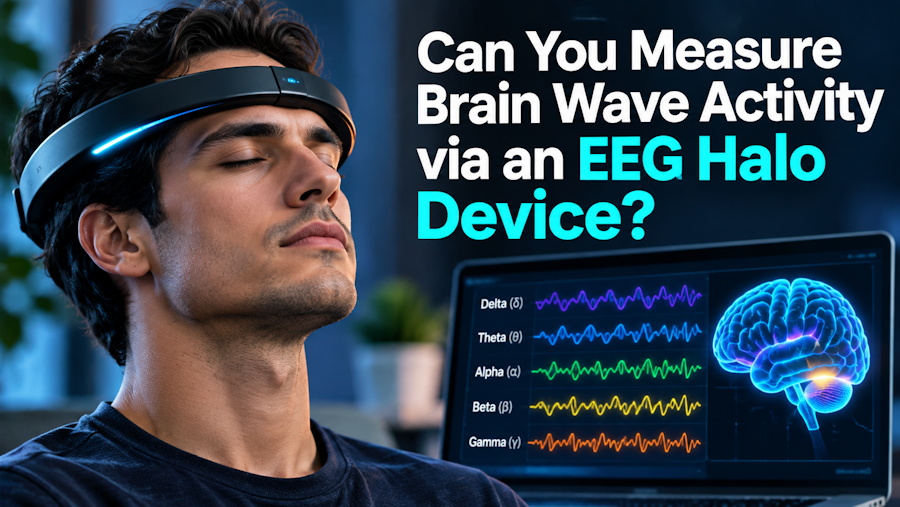
Short answer: yes, you can. People sometimes expect a catch, because the idea sounds a bit unlikely the first time you hear it. A band worn across the head, no wires trailing to a machine in the corner, and somehow it picks up what the brain is doing?
It does. Just not in the way films tend to show it. An EEG device doesn't read thoughts, and it doesn't produce a running commentary on what's happening inside someone's head. What it measures is electrical activity, tiny voltage changes at the surface of the scalp caused by large groups of neurons firing together underneath. Small signals, but real ones, and they've been recorded in hospitals and laboratories for close to a hundred years.
What's new is the packaging. The science is old. The convenience isn't.
First, what an EEG cap actually is
If you've ever seen a photograph of someone taking part in a sleep study or an epilepsy test, you've probably seen an EEG cap. It looks like a tight swimming cap covered in small discs and wires. Each disc is an electrode, and each electrode sits at a set position on the scalp so that recordings from different people, taken in different labs, can be compared with each other. Labs all over the world use the same basic layout, known as the 10-20 system, which is why a researcher in Berlin and a researcher in Toronto can look at each other's data and know which part of the head each trace came from.
The electrodes need decent contact with the skin. In a traditional setup that means conductive gel, worked in under each electrode, one at a time. It works well. It also takes a while, sometimes half an hour or more for a high channel cap, and afterwards the person wearing it has gel in their hair and a fairly strong desire for a shower. Nobody who has done this work regularly pretends otherwise.
Once the cap is connected, the signals go to an amplifier. This part matters more than most explanations admit. The electrical activity reaching the scalp is measured in microvolts, millionths of a volt. Meanwhile the room around the subject is full of electrical noise from lights, mains wiring, phone chargers, and the person's own muscles. Blinking produces a bigger electrical signal than much of the brain activity researchers are interested in. So does clenching your jaw.
So an EEG system has to do two jobs at once. It has to amplify a very faint signal by a large amount, and it has to reject, filter, or at least make it possible to spot the noise that arrives with it. Then the cleaned up signal is converted into digital form, sampled hundreds of times a second, and drawn on a screen as the wavy lines most people recognise.
Those waves aren't random. They fall into patterns that researchers have been cataloguing for decades, usually described by how fast they repeat.
Slow delta waves dominate deep sleep. Theta activity turns up in drowsiness and in some kinds of mental effort. Alpha is the classic one: it appears strongly at the back of the head when you close your eyes and relax, and it fades when you open them again. That effect is so reliable that it's often used as a quick check that an EEG setup is working properly. Sit someone down, get a flat and messy trace, ask them to close their eyes, and if the alpha rhythm doesn't show up, something's wrong with the contact rather than with the person. Beta waves are faster and are associated with alert, active thinking. Gamma, faster still, shows up in research on attention and perception, though it's also the range most easily contaminated by muscle activity, which catches beginners out.
None of these bands is a simple dial for a single mental state, by the way. Popular write ups sometimes talk as if alpha means relaxed, beta means stressed, job done. Real recordings are messier. Several bands are present at once, their balance shifts by the second, and reading anything useful from them takes context, comparison, and usually a fair amount of signal processing after the recording has finished.
So where does a halo fit into that?
An EEG halo is what you get when you take the same basic method and strip away everything that makes a full cap slow to use.
Instead of dozens of electrodes spread across the whole head, a halo device carries a small number of them in a band. A typical research headband design uses four channels, with dry contact electrodes sitting over the forehead and at the back of the head, over the occipital region. Those positions aren't chosen at random. Frontal sites pick up activity linked to attention and mental workload, along with the very obvious signals from eye movements. Occipital sites are where alpha is strongest. Between the two, you can capture a surprising amount of useful information for a device that goes on in seconds.
Dry electrodes are the other half of the story. Rather than gel, they use specially shaped metal or conductive contacts designed to work through hair and sit firmly against the skin. The setup ritual disappears. No gel, no measuring and marking positions, no washing your hair afterwards. You put the band on, check the contact quality on a screen, adjust it if one channel looks poor, and start recording.
The rest of the chain has shrunk too. The amplifier and the analogue to digital conversion now sit in the device itself or in a small unit on the band. Data travels wirelessly, usually over Bluetooth, to a phone or a computer, where software displays the traces, stores the session, and does the maths: splitting the signal into frequency bands, marking sections spoiled by movement, and exporting the raw data for proper analysis later.
That's the genuinely impressive part of this technology, when you stop and think about it. A mid twentieth century EEG lab filled a room and needed a trained technician hovering over it. The measuring principle hasn't changed, but the amplifier, the filters, the transmitter, and the storage now fit into something you can wear while sitting in an ordinary chair, in an ordinary room, doing something closer to ordinary life than lying still in a laboratory. Research that could only happen in a lab can now happen in a classroom, a clinic waiting room, or someone's home.
Anyone shopping for a brain wave monitor headband should keep one honest limitation in mind, though, because it decides what the device is and isn't for. Four channels is not sixty four channels. A halo sees the brain from a few positions, not from everywhere. It can't map activity across the whole scalp, and it isn't a substitute for the full clinical EEG a neurologist uses when investigating seizures, where the number of electrodes and their coverage really matter. Devices of this type are sold for research, education, scientific work, and general wellness, not as medical instruments. That's not a weakness in the design. It's a trade that was made deliberately: coverage given up in exchange for speed, comfort, and the ability to record far more often, in far more places.
For a lot of questions researchers actually ask, that trade is a good one.
What the research is good for
The most established use is brain computer interfaces, usually shortened to BCI. The idea is simple to describe and hard to do well: take a pattern of brain activity that a person can produce on purpose, detect it reliably, and use it to control something. Focus on a flickering letter and a speller picks it up. Imagine moving your hand and a cursor moves instead. For people who have lost the use of their limbs, or who can no longer speak because of conditions such as motor neurone disease, even a slow and clunky channel of communication built this way is not a novelty. It's a way back into conversation.
Headband class devices have a place in that work because BCI research involves a lot of repetition. Volunteers come back session after session while researchers test whether a detection method still works on a different day, with the electrodes in a slightly different position, on a person who's tired. A device that takes thirty seconds to fit gets used. One that takes forty minutes of gel and preparation changes how many sessions a study can realistically run.
Then there's the broader cognitive research, the workhorses of the field: attention, memory, mental workload, fatigue. Put a band on someone doing a demanding task and you can watch how their brain activity shifts as the task gets harder, or as the hours pass. That has obvious uses in studying learning. Which teaching methods hold attention, and for how long? Where does concentration actually break in a long training session, as opposed to where people say it broke when you ask them afterwards? Self reports are notoriously generous. Brain data, used carefully, is less polite.
Sleep is another area where easier recording changes what's possible. A full sleep study in a laboratory, wired up and watched overnight, tells you a great deal about one night in a strange bed. Lighter devices that people can tolerate at home open the door to recording many nights in a row, in the bed someone actually sleeps in, which is where the interesting questions about their sleep mostly live.
Neurofeedback grew out of the same technology. The person wearing the device sees or hears a representation of their own brain activity in real time, a tone that rises, a shape that grows, and learns to shift it. It's used in research on attention and relaxation, and in wellness settings for meditation and focus training. The evidence for some of the stronger claims made about neurofeedback is still argued over, and it's worth saying so plainly rather than repeating the marketing version. But the underlying method, showing people their own signals so they can learn to influence them, is sound enough that serious labs continue to work on it.
There are quieter uses too, the ones nobody puts in a brochure. Students learning neuroscience can record their own alpha rhythm in an afternoon practical instead of just looking at a diagram of one, and that single experience teaches more about what EEG is than a chapter of a textbook. Developers building games, training simulators, and assistive software can test whether a person is overloaded or disengaged while they're using the product, rather than guessing from a questionnaire afterwards. Artists and musicians have used brain signals as a control source for installations and performances. Not all of that will turn out to matter. Some of it will, and nobody knows in advance which.
The good it can do, stated plainly
Step back from the individual studies and a pattern emerges. The reason cheaper, faster, more comfortable EEG matters is that measurement is usually the bottleneck in understanding the brain outside a hospital.
Clinicians and researchers have never lacked questions. They've lacked data that was practical to collect: from enough people, often enough, in the places where those people's lives actually happen. Every reduction in setup time and discomfort widens who can take part in research. Children who won't sit through a gel cap fitting. Elderly volunteers who can't travel to a university lab every week. Patients in community clinics with no EEG department. If the band goes on in seconds and the data reaches the researcher wirelessly, studies stop being limited to the people who happen to live near a well equipped laboratory.
That scale also makes longer studies realistic, and long studies are where the valuable findings tend to hide. A single recording is a snapshot. Recordings taken weekly for a year show change: how a rehabilitation programme is progressing after a stroke, whether a student's attention patterns shift across a school term, how someone's sleep responds to a change in medication or routine. Snapshots raise questions. Sequences answer them.
None of this makes brain data magic, and the field does itself no favours when it talks as if it does. EEG from the scalp is an indirect measure. It sums the activity of huge numbers of neurons, it tells you a great deal about timing and relatively little about exactly where in the brain something happened, and it's easily spoiled by movement, sweat, and a loose electrode. Good researchers design around all of that. The technology's job is to make the signals available, cleanly and conveniently. What the signals mean is still human work.
So, can a halo really measure brain activity?
Yes, and now you can probably see why the answer needs the explanation that came with it.
A halo device measures the same electrical signals, in the same way, as the cap in the hospital laboratory. It amplifies them, filters them, digitises them, and sends them to software that can show the familiar wave patterns and break them down by frequency. It does all of that from fewer positions, with dry electrodes instead of gel, in a band that takes seconds to put on and can be worn at home, in class, or in a research session that runs all afternoon.
What it gives up in coverage, it returns in use. And in research, the instrument that gets used, often and by many people, in real settings, tends to produce the findings that change things. The cap isn't going anywhere. For detailed clinical work nothing replaces it. But for a large and growing share of the questions people want to ask about the brain, the band on the head is enough, and enough, it turns out, is quite a lot.

