

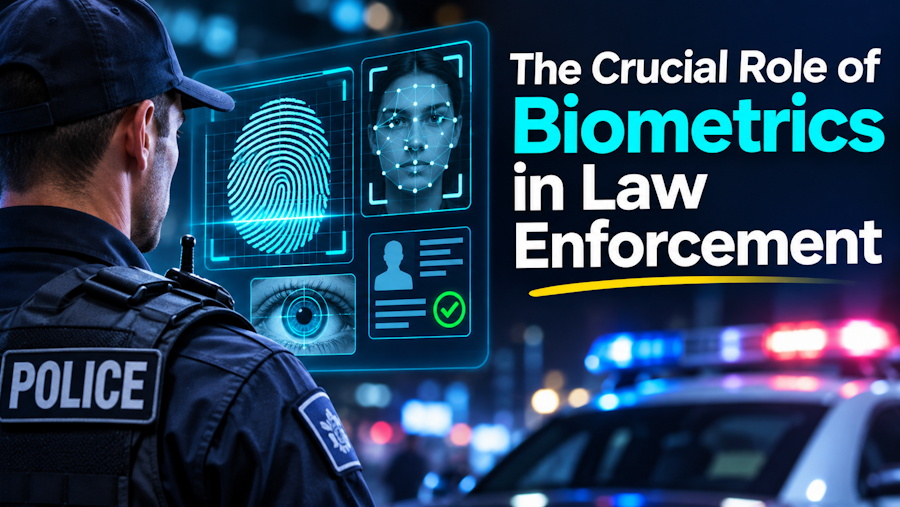
Police work often starts with a simple question: who is this person?
Sometimes the answer is easy. Sometimes it is not. A suspect gives a false name. A victim has no documents. A person in custody has been arrested before, but under a different spelling of the same name. A print lifted from a broken window belongs to someone, but there is no name attached to it at the scene.
For a long time, officers and investigators dealt with these problems by hand. Fingerprint cards were filed in cabinets. Photographs were kept in one system, arrest records in another, and court outcomes somewhere else again. Checking whether two records belonged to the same person could take days of phone calls and paperwork. In a large city or a national database, it could take much longer.
Biometrics changed the scale of that work. Instead of relying only on names, dates of birth, and documents, law enforcement agencies can now identify people from physical characteristics that are much harder to swap, borrow, or invent. That shift has affected almost every stage of a case, from the first encounter on the street to the way evidence is examined and records are stored years later.
Identity That Does Not Depend on a Name
A name is useful, but it is not a reliable identifier on its own. Names change after marriage. They are transliterated differently from other languages. They are mistyped at booking desks. Criminals know this, and some use several aliases as a matter of routine.
Biographic information still matters. Name, date of birth, address, nationality, and physical description all form part of a person's record. The problem is that none of those details, taken alone, proves that the person standing in front of an officer is the same person named in an older file.
Biometric data fills that gap. A fingerprint, a face image, or an iris pattern is tied to the body rather than to a document. When that data is captured properly and matched against existing records, an agency can confirm an identity, spot a duplicate file, or find that a person has a history under another name. It does not replace police judgment. It gives officers a firmer starting point.
The Main Biometric Modalities in Policing
Most agencies do not rely on a single method. They use several, because each one works best in a different situation.
Fingerprints
Fingerprints remain the workhorse of law enforcement identification. They have been used for more than a century, the legal and forensic groundwork behind them is well established, and large databases of prints already exist in most countries.
At booking, prints are usually taken from all ten fingers using a live scanner. The quality can be checked at once, which was not always possible with ink and paper. If a finger is badly positioned or the image is smudged, the operator can take it again before the person leaves the desk. Those prints can then be searched against local, regional, and national records to confirm identity and check for outstanding warrants or previous arrests.
Latent print recognition
Latent prints are a different matter. These are the partial, often invisible prints left behind on a door handle, a glass, a weapon, or a window frame at a crime scene. Unlike booking prints, they were not made under controlled conditions. They may be incomplete, distorted, overlapped with other prints, or lifted from a rough surface that breaks up the ridge detail.
That is what makes latent print recognition so valuable, and so demanding. Crime scene officers photograph or lift the print, and forensic staff examine the image, mark the usable features, and search it against fingerprint databases. A good search can return a short list of possible candidates from records that no examiner could realistically work through by hand.
The system does not close the case by itself. A fingerprint examiner still compares the latent print with the candidate print in detail and makes the final identification. What the technology does is narrow a field of millions down to a manageable few, and it can do it while the investigation is still fresh. A burglary print that once sat in a file for months can now produce a lead within hours.
Face recognition
Face images are the most widely available biometric of all. Agencies hold them in mug shot collections, identity document registers, and CCTV footage. Face recognition is used to compare a probe image with those collections, to check whether a person appears in earlier records, and to generate leads when a suspect has not been identified by any other means.
Its strength is speed and convenience. Its weakness is image quality. Poor lighting, a low camera angle, a turned head, or an old photograph can all reduce accuracy. For that reason, a face match is normally treated as an investigative lead that needs to be supported by other evidence, not as a conclusion on its own.
Iris and palm prints
Iris recognition uses the pattern in the colored ring of the eye. It is highly distinctive, stable over time, and can be captured without physical contact. It is common in border control and secure facilities, and some law enforcement agencies use it during booking and custody to make sure the right person is released, transferred, or brought to court.
Palm prints deserve more attention than they often get. People leave palm marks at scenes just as they leave fingerprints, and a significant share of unidentified latent material is palm rather than finger. Databases that include palm prints give examiners another route when a fingerprint search finds nothing.
Voice and combined systems
Voice recognition has a narrower role, mainly in investigations where recorded speech is already part of the evidence. It is less commonly used for routine identification.
The clear trend is toward systems that hold more than one modality for the same person. A record might contain fingerprints, a face image, palm prints, and iris data together. If one search produces no result, another might. If two different modalities point to the same identity, officers can act with more confidence.
How Biometrics Changes Evidence Work
The value of a biometric database is not just its size. It is the connection between evidence collected today and records collected years ago.
A latent print from a vehicle break-in can be searched against prints taken during an arrest in another county five years earlier. A face image from a robbery can be compared with custody photographs from a different force area. Cases that looked separate can turn out to involve the same person, which changes how investigators plan interviews, link offences, and present the case in court.
This also helps with older, unsolved cases. Collections of unidentified latent prints can be searched again as databases grow and matching improves. A print that found no match in 2015 may find one in 2026 because the person has since been arrested and enrolled. Nothing about the original evidence changed. The record around it did.
There are limits that need to be stated plainly. A database search produces candidates, ranked by similarity. It does not produce certainty. Trained examiners verify fingerprint and palm identifications, investigators check face matches against other facts, and the chain of custody for the original evidence still has to be sound. If the latent print was poorly lifted or wrongly labeled at the scene, no software can repair that. Good forensic practice comes first. Technology makes that practice faster and wider in reach.
Operational Efficiency and Case Management
Much of the benefit of biometrics is unglamorous, everyday efficiency.
At the booking desk, a quick fingerprint search can confirm within minutes whether a person is who they claim to be, whether they have been arrested before, and whether another agency is looking for them. Without that check, a person using an alias might be released before their real record surfaces.
During an investigation, officers spend less time rekeying the same details into separate systems and less time merging files by hand. Case records can carry the biometric identity with them, so fingerprints from the scene, custody records, charge information, and later court results stay attached to one verified person rather than drifting across three files with three spellings of a name.
In the field, mobile fingerprint devices let officers check identity during a stop without taking the person to a station. Used under the right legal authority, that saves hours and avoids unnecessary detention for people who can be identified on the spot.
Most large agencies now run this kind of work on ABIS biometrics, the automated systems built to hold and search fingerprint, face, and other biometric records at a scale that manual filing could never manage. The practical effect is simple: identity stops being a separate administrative task and becomes part of the case file itself, available at each stage when a decision has to be made.
Collecting and Consolidating Records
Ask any records officer where mistakes creep in, and the answer is usually fragmentation. One database holds the arrest. Another holds the fingerprints. Photographs sit in a custody system. Dispositions from the court arrive on paper or in a separate register, and sometimes they are never linked back to the original arrest at all.
Consolidation is where biometrics earns its keep over the long term. When a person is enrolled, three kinds of information can be brought together in a single record:
Biographic records cover names and name variations, date and place of birth, addresses, identity document numbers, and descriptive details such as height, scars, and tattoos.
Biometric records hold the fingerprint images and templates, face photographs, palm prints, and iris data, along with the date, place, and quality of each capture.
Criminal records cover arrests, charges, fingerprints taken in connection with each event, warrants, custody movements, court outcomes, and release details.
Held together, those records give a much clearer picture. An officer looking at a consolidated file can see that the man arrested as "Jon Smyth" in 2022 is the same person booked as "John Smith" in 2025, because the fingerprints match even though the spellings do not. A detective can see which charges led to a conviction and which were dropped, instead of seeing an arrest with no outcome. A custody officer can confirm that the person being released is the person who was brought in.
Deduplication matters just as much. Large databases accumulate duplicate identities over years of manual entry and agency mergers. Biometric searches find those duplicates in a way that name searches cannot, because the duplicate was usually created precisely when the name or biographic details differed. Cleaning them up improves everything built on top of the data, from warrant checks to crime statistics.
Consolidation also carries risk, and it should be handled carefully. Merging two records in error can attach one person's history to another, which is a serious matter for the person affected. Well run systems keep an audit trail of every merge and search, restrict who can change a record, and allow corrections to be made and recorded. Accuracy is not only about matching algorithms. It is about how records are governed after the match.
Accuracy, Oversight, and Public Trust
Biometrics works best when agencies are honest about what affects its accuracy. Dirty sensors, rushed captures, worn fingerprints from manual work, eye conditions, and aging can all make matching harder. Quality checks at the point of capture, proper training for operators, and regular testing of systems against independent benchmarks are basic requirements, not extras.
Oversight matters for a second reason. Biometric databases contain some of the most sensitive information a state can hold about its citizens. People accept that when they can see clear rules around it: who may be enrolled, how long data is kept, who can search it, for what purpose, and how errors are put right. Access should be limited by role, searches should be logged, and retention rules should be enforced in practice, not just written in policy.
Used that way, biometrics does not have to be at odds with civil liberties. Accurate identification protects the innocent as well as exposing the guilty. It reduces mistaken identity arrests, stops people being held under the wrong name, and gives victims a better chance that the person who left a print on their window will actually be found.
Conclusion
Biometrics has not changed what law enforcement is trying to do. Officers still have to identify people, test evidence, connect cases, and keep records that will stand up in court. What has changed is the speed, the scale, and the reliability with which those things can be done.
Latent prints that once gathered dust can now be searched against millions of records. A booking check that took days can be finished before the custody paperwork is complete. Arrest, biometric, and court records that used to live in separate cabinets and systems can be held as one file, tied to one verified identity.
The agencies getting the most from this technology are not necessarily the ones with the largest databases. They are the ones that capture good data, keep their records clean, verify matches properly, and apply clear rules about how biometric information is used. The technology supplies the match. The quality of the policing around it decides what that match is worth.

