

Running an online store involves much more than maintaining a website, accepting payments, and processing orders. Behind every successful transaction is a network of software applications that manage inventory, process orders, handle shipping, track shipments, and communicate with customers.
As an ecommerce business grows, managing these systems becomes increasingly complicated. Orders may arrive through multiple sales channels, shipping costs fluctuate between carriers, and warehouse teams need accurate information to fulfill purchases quickly.
The answer isn't necessarily adding more applications. It's building a connected technology stack that allows existing systems to communicate and automates repetitive fulfillment tasks.
For developers, ecommerce managers, and operations teams, understanding how these technologies work together is essential for creating an efficient shipping infrastructure.
Understanding the Modern E-Commerce Technology Stack
An ecommerce technology stack includes the software platforms, integrations, and infrastructure that support an online retail operation.
Most online businesses begin with a storefront platform such as Shopify, WooCommerce, or BigCommerce. These systems manage product listings, checkout experiences, customer accounts, and transactions.
Once an order is placed, several additional processes must occur before the package reaches the customer.
A typical ecommerce fulfillment technology stack includes:
- Ecommerce platforms: Manage online storefronts, customer orders, and transactions.
- Inventory management systems: Monitor product availability and stock levels across locations.
- Order management software: Consolidates purchases from multiple sales channels.
- Shipping management platforms: Handle carrier selection, shipping labels, fulfillment automation, and tracking.
- Warehouse management systems: Coordinate picking, packing, inventory movement, and warehouse operations.
- Customer communication tools: Deliver order confirmations, shipping updates, and delivery notifications.
- Analytics platforms: Monitor shipping expenses, fulfillment performance, and operational trends.
Each application handles a different responsibility, but the real value comes from connecting these systems.
Without reliable integrations, employees must repeatedly enter order information, verify shipping details, and update order statuses across separate platforms.
That creates unnecessary work and increases the likelihood of errors.
How Software Integrations Connect E-Commerce Operations
Modern ecommerce applications rely on APIs, webhooks, and data synchronization to exchange information.
For example, when a customer purchases an item through WooCommerce, that transaction creates an order record containing product details, quantities, delivery information, and shipping preferences.
A connected shipping platform can retrieve that information, process the shipment, generate a shipping label, and return the tracking number to the original store.
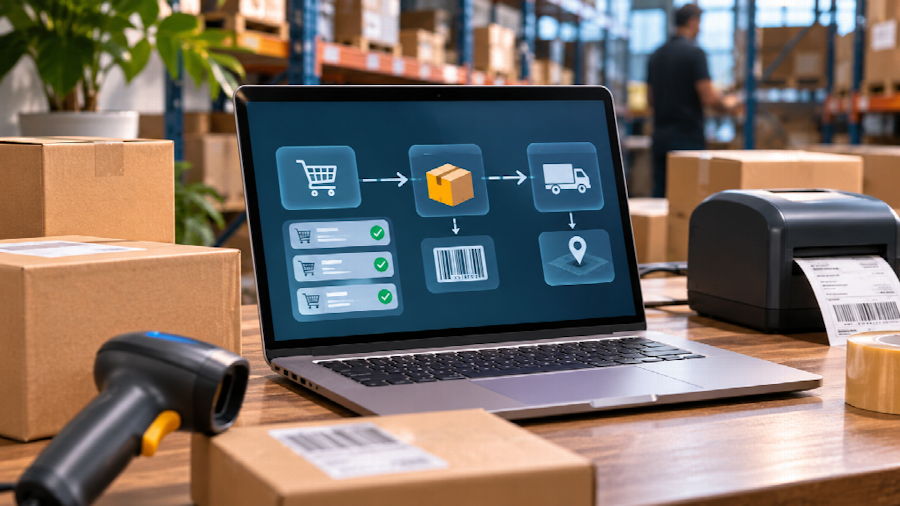
The basic workflow looks like this:
- A customer completes a purchase through an ecommerce storefront.
- The storefront creates an order containing fulfillment information.
- The shipping platform imports the order through an integration or API.
- Automated rules determine the appropriate shipping method.
- The system generates a carrier label and associates it with the shipment.
- Tracking information is synchronized with the ecommerce platform.
- The customer receives a shipment notification.
The result is a connected workflow that reduces manual data entry.
For businesses selling across multiple marketplaces, integrations become even more valuable.
An online retailer might receive orders through Shopify, Amazon, eBay, and Walmart at the same time. Instead of managing fulfillment separately on each platform, centralized order processing lets warehouse employees work from a consolidated queue.
Developers should also consider how their integrations handle API rate limits, authentication, failed requests, and temporary service outages.
Reliable synchronization requires more than transferring data successfully under ideal conditions. Systems must also detect and recover from failures.
Why Shipping Automation Should Be a Core Component
Shipping is one of the most repetitive parts of ecommerce operations.
Warehouse teams regularly perform the same tasks: reviewing orders, selecting carriers, determining packaging requirements, generating labels, and updating shipment statuses.
These activities become increasingly time-consuming as order volumes grow.
Shipping automation replaces many repetitive decisions with predefined business rules.
Consider an ecommerce retailer that processes several hundred orders daily.
Without automation, employees may need to inspect each order individually to determine which shipping service meets the customer's delivery requirements.
An automated shipping system can evaluate information such as:
- Package weight and dimensions
- Destination ZIP code
- Delivery deadlines
- Available carrier services
- Shipping costs
- Order value and insurance requirements
- Warehouse location
- Special handling instructions
The software can then select an appropriate shipping service based on the company's configured rules.
For example, a retailer could automatically assign expedited shipping to qualifying orders or select the lowest-cost carrier service that can meet a promised delivery date.
This approach makes fulfillment more consistent while reducing the number of decisions warehouse employees must make manually.
Multi-Carrier Shipping and Rate Shopping Technology
Relying on a single shipping carrier may simplify initial operations, but growing businesses often need greater flexibility.
Carrier pricing varies based on package characteristics, delivery zones, service levels, and negotiated account rates.
A shipping service offering the lowest price for a lightweight domestic package may not be the best option for a heavier shipment traveling across the country.
Multi-carrier shipping software helps retailers compare services from providers such as UPS, FedEx, USPS, and DHL within a centralized interface.
Instead of manually checking multiple carrier websites, shipping teams can evaluate available rates in one application.
Advanced rate-shopping systems can also consider delivery requirements.
For example, an order must arrive within three business days. The software can evaluate eligible carrier services and select the least expensive option that meets that delivery requirement.
This creates opportunities to control shipping expenses without automatically sacrificing delivery speed.
For developers building ecommerce integrations, carrier APIs are another important consideration.
Rate requests, label generation, tracking updates, and service availability may involve different endpoints and data structures.
Using shipping software that already manages these carrier connections can reduce the amount of custom integration work required.
Connecting E-Commerce Shipping Software to Warehouse Workflows
As fulfillment operations grow, shipping software must work alongside the physical processes inside a warehouse.
This includes communication with barcode scanners, shipping scales, label printers, and other fulfillment equipment.
Consider a warehouse employee preparing an order containing several products.
The employee scans each item during picking or packing. A barcode verification system compares the scanned products against the original order.
If the wrong product is scanned, the software can flag the mismatch before the shipment leaves the warehouse.
Once the order is verified, the shipping system can generate the appropriate carrier label.
This workflow reduces incorrect shipments, unnecessary returns, and customer service inquiries.
One example is ReadyShipper X, ecommerce shipping software from ReadyCloud, designed for high-volume online retailers selling across multiple channels. ReadyShipper X supports multi-carrier rate shopping through Rate Genie, batch label printing, automated shipping rules, and barcode-based scan-to-verify and scan-to-ship workflows. Its hybrid-cloud architecture combines local shipping-station operations with connected order management, making it relevant for businesses integrating ecommerce platforms with warehouse fulfillment systems.
The broader technical consideration is how well shipping applications connect digital order information with physical warehouse activity.
When those workflows operate together, retailers can process orders more consistently without repeatedly switching between applications.
The Role of APIs, Webhooks, and Real-Time Data
A connected shipping technology stack depends on accurate information moving between applications.
APIs let software systems request and exchange data, while webhooks notify connected applications when specific events occur.
For example, a shipping platform might update an ecommerce storefront after a label is created or a shipment is confirmed.
That update can trigger additional actions, including customer notifications or internal reporting.
Developers should evaluate several technical requirements when designing these connections.
- Data consistency: Customer addresses, order identifiers, product quantities, and shipment statuses should remain consistent across connected systems.
- Error handling: Log failed API requests and handle them through controlled retry procedures.
- Duplicate prevention: Idempotent processing can help prevent the same order or shipment event from being processed multiple times.
- Security: API credentials and customer information should be protected through appropriate authentication, access controls, and encryption.
- Event processing: Systems should be prepared to receive events out of order or more than once.
- Observability: Logs, alerts, and synchronization metrics help teams identify failures before they affect large numbers of orders.
For instance, a shipping confirmation should not accidentally generate duplicate fulfillment records simply because a network timeout caused an integration to retry its request.
These technical details matter most during seasonal promotions, flash sales, and other periods when order volumes increase rapidly.
Avoiding Common E-Commerce Technology Stack Problems
Adding more applications doesn't automatically improve ecommerce operations.
In fact, poorly connected software can introduce additional problems.
One common issue is maintaining separate order records across multiple systems without defining which application is the authoritative source.
If an order is modified after checkout, connected platforms need a reliable way to communicate that change.
Another issue is unnecessary manual intervention.
A retailer may have automation tools available but still require employees to copy tracking numbers between applications or manually select carriers for routine shipments.
Businesses should regularly evaluate which tasks can be handled through integrations and predefined rules.
A third challenge is excessive customization.
Custom development can provide flexibility, but every additional integration introduces maintenance responsibilities.
API updates, authentication changes, and platform compatibility issues can create ongoing technical work.
Using established integrations for standard fulfillment processes lets development teams focus on functionality that genuinely differentiates the business.
How to Evaluate a Shipping Technology Stack Before Scaling
A shipping system that works well for 20 daily orders may struggle when that number increases to 500 or more.
Before expanding operations, ecommerce businesses should evaluate their existing software architecture.
Several questions can help identify limitations.
Can the system support multiple sales channels?
Retailers selling through marketplaces and independent storefronts need a consistent way to import and manage orders.
Does it support automated shipping decisions?
Configurable rules can reduce manual carrier selection, packaging decisions, and repetitive order processing.
Can it handle warehouse equipment?
Barcode scanners, label printers, and shipping scales should fit naturally into fulfillment workflows.
How does it manage shipping exceptions?
Address errors, unavailable services, and incomplete order information should be flagged for review rather than silently causing fulfillment failures.
Are order and tracking updates synchronized?
Connected systems should keep fulfillment statuses and customer-facing information accurate.
Can teams monitor shipping performance?
Reporting should provide visibility into shipping expenses, processing activity, carrier usage, and fulfillment exceptions.
What happens when an integration fails?
Teams need a way to detect synchronization problems, investigate affected orders, and recover without duplicating shipments.
Testing these capabilities before order volumes increase helps retailers identify technical limitations while changes are still manageable.
Measuring the Performance of Shipping Technology
Software integrations should produce measurable operational improvements.
Retailers can evaluate shipping technology using several practical metrics.
- Order processing time: How long does it take to prepare an order for shipment?
- Shipping cost per order: How much does the business spend on carrier services and related fulfillment expenses?
- Order accuracy: What percentage of shipments contain the correct products and quantities?
- Fulfillment throughput: How many orders can the warehouse process per hour?
- Manual intervention rate: How frequently must employees override automated decisions?
- Synchronization reliability: How often do integrations fail to update order or tracking information correctly?
- On-time shipment rate: What percentage of orders leave the warehouse within the promised processing window?
Tracking these metrics helps businesses determine whether their software investments are improving fulfillment performance.
For example, a retailer might introduce automated carrier selection and then compare shipping expenses and processing times against the previous workflow.
The goal is to measure actual operational results rather than assuming that adopting new technology automatically creates efficiency.
Building an E-Commerce Shipping Infrastructure That Supports Growth
A smarter ecommerce technology stack connects the systems that sell, process, ship, and track orders.
For developers, the priorities include reliable integrations, secure data exchange, error handling, and maintainable software architecture.
For ecommerce operators, the priorities are equally practical: accurate fulfillment, controlled shipping expenses, fewer repetitive tasks, and dependable customer communication.
These objectives work together.
An integrated shipping platform can reduce duplicate data entry, automate routine decisions, and keep order information synchronized across multiple applications.
Warehouse technology can extend those benefits into physical fulfillment through barcode verification, connected equipment, and standardized shipping workflows.
Most importantly, businesses should build their technology stacks around actual operational requirements rather than collecting applications that solve isolated problems.
The strongest approach combines reliable ecommerce integrations, flexible shipping automation, and clear visibility into fulfillment performance.
As order volumes increase, those connections help retailers maintain control over shipping operations without creating unnecessary technical complexity.

