

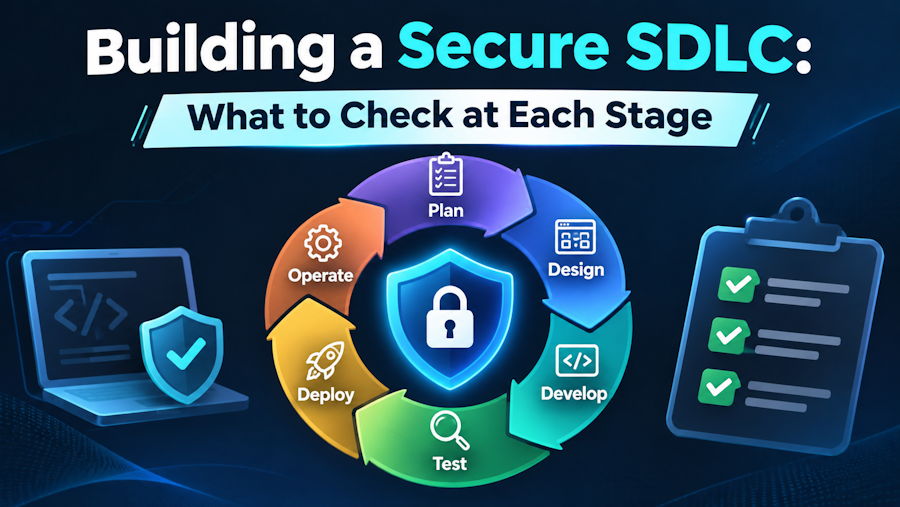
A secure software development lifecycle works when security questions become part of ordinary engineering decisions. The team defines what a feature must protect, checks those expectations as it builds, and carries the evidence into release and maintenance.
The process should be specific enough that a developer knows what to do next. “Complete a security review” is less useful than “show that a user from another tenant cannot download this export.” Each stage should produce evidence that the next stage can use.
NIST's Secure Software Development Framework describes security practices that can be integrated into different development lifecycles. The practical task is choosing how those practices fit the way your team plans, builds and operates software.
Planning should define the protected behavior
Identify the information, transactions and permissions affected by the feature. Name the person or team accountable for the security decisions, and identify dependencies that could change the risk.
For a customer data-export feature, specify who may request an export, which records it may contain, how the file is retrieved and how long it remains available. Include requirements for expired access, revoked permissions and unsuccessful attempts.
Turn those requirements into acceptance criteria before implementation. Some criteria will become automated tests; others may require a design review or operational control. Link each to a responsible owner.
Check whether the feature introduces a new external provider, data location or public interface. These changes can require additional review even when the amount of new application code is small.
Design should expose the important trust boundaries
Sketch where data enters, which services process it and where permissions are checked. Include background workers, storage services and administrative functions rather than focusing only on the browser and API.
OWASP's threat-modeling guidance recommends maintaining the model as the system changes. Keep the model small enough to update when a feature adds a new data flow or dependency.
For the export feature, ask what happens when the user's access changes after a job is queued. Decide where authorization is checked again, how the export is associated with its owner and how access to the resulting file expires.
Record the chosen controls and unresolved questions. A diagram becomes useful when it produces testable decisions, not simply when it documents the architecture.
Implementation should give developers specific feedback
Apply source-code analysis, dependency checks and secret detection where they can provide useful feedback during development. Explain each finding in terms of the affected code and expected repair, and assign ownership for rules that repeatedly produce ambiguous results.
Keep human review focused on decisions automation may not understand. Reviewers should check permission boundaries, error handling and assumptions about external services. Use approved patterns for common security requirements so every developer does not design a new solution.
When selecting SSDLC tools for secure software development, map the options to the questions at each stage. Determine which tools analyze source, inspect dependencies, test a running application or protect build integrity. Plan how their results will reach the developer who can act.
For the export service, automated checks may identify an unsafe library or exposed credential. A reviewer still needs to assess whether the authorization decision remains valid when the background job executes.
Builds should preserve a traceable path to the artifact
Control who can change the build workflow and which jobs can use release credentials. Separate untrusted contributions from privileged release steps, and review changes to dependency sources or build scripts.
Record the source revision, dependency inventory and identity of the resulting artifact. Retain the checks associated with that artifact, so the release process can distinguish the tested output from a later rebuild.
SLSA's provenance specification describes verifiable information about where and how an artifact was produced. Use provenance with an explicit verification policy that checks the expected builder and source relationship.
An inventory and a provenance record answer different questions. The inventory describes components; provenance describes origin and production. Neither, by itself, proves that the application has no security defects.
Verification should test permitted and denied behavior
Test the application with representative roles and data. Include successful workflows and the attempts that should be refused. For tenant-based software, verify that access to another tenant's records fails even when a request uses an otherwise valid session.
Use dynamic testing where it can exercise the running application, and arrange focused manual review for sensitive workflows or unusual designs. Confirm that test accounts and crawlers reach the intended functionality before interpreting a clean result.
For the export feature, cover another user's job identifier, an expired download and permission revocation during processing. Confirm the expected business outcome, not only a response code. Verify that a denied request does not still trigger work or expose information through another channel.
Turn confirmed defects into regression tests where practical. Keep the test close to the behavior it protects, with an explanation of the security expectation.
Release should connect approval to the deployed version
Promote the artifact that passed verification. Check environment-specific configuration, release permissions, exposed endpoints and the controls that protect sensitive data in production.
Define what evidence must exist before release and who can accept a documented exception. Keep rollback procedures current and decide what would trigger them. A release approval should refer to a particular artifact and its known issues.
For the export service, verify production storage permissions, expiry behavior and logging before enabling the feature broadly. Use a staged rollout where the delivery process supports it, with clear signals for investigating unexpected behavior.
Operations should feed the next development cycle
Maintain a way to receive vulnerability reports and route them to an owner. Reassess deployed components when new advisories arrive, monitor relevant security events and verify repairs after they reach production.
Review recurring defects for changes to design patterns, tests or developer guidance. If several features mishandle background-job authorization, repair the shared approach rather than treating each defect as unrelated.
Include retirement in the lifecycle. Remove obsolete credentials, routes and stored artifacts when the export feature or service is decommissioned. Preserve required records through the appropriate retention process.
A useful starting point is one feature traced from requirement to operation. Check whether every important security expectation has an owner and current evidence. Expand the process from that working example, keeping the controls understandable enough for engineers to use throughout delivery.

