

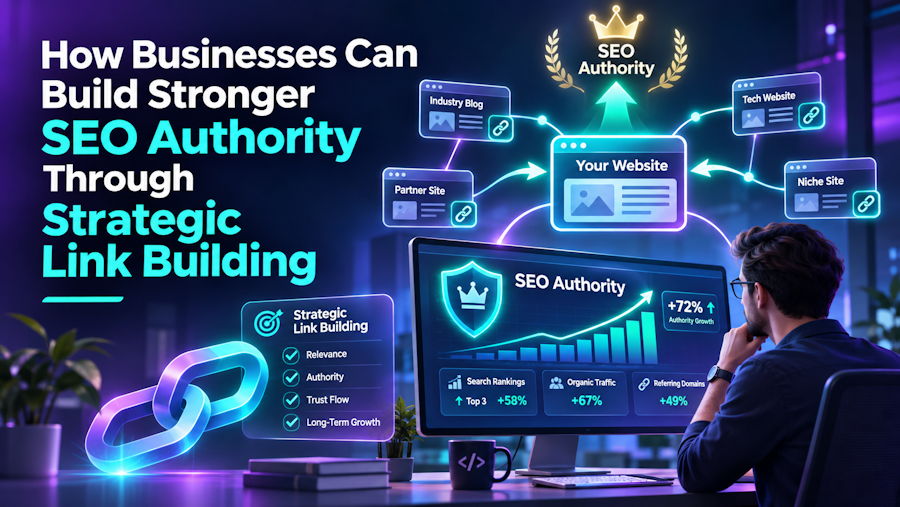
Search engine optimization is no longer just about optimizing website content, targeting keywords, or improving technical performance. As competition continues to increase across almost every industry, businesses need a comprehensive strategy to establish their online authority and improve their visibility in search results.
One of the important components of a successful SEO strategy is link building. When reputable and relevant websites reference your content, they can help search engines discover your website, understand its relevance, and evaluate its authority within a particular industry.
However, acquiring backlinks is not simply a numbers game. The quality, relevance, and credibility of linking websites matter considerably more than the total number of backlinks a website receives.
This is why businesses should focus on strategic link-building methods that prioritize editorial quality, relevant publications, and genuine outreach rather than pursuing links from any website willing to publish an article.
In this guide, we will explore how businesses can build a stronger backlink profile, evaluate link-building opportunities, and develop a sustainable approach to improving their search visibility.
Understanding the Importance of Link Building in SEO
Link building refers to the process of acquiring hyperlinks from external websites that point to your website. These hyperlinks, commonly known as backlinks, help search engines discover pages and understand relationships between different websites and resources.
Think of backlinks as references in an academic publication. When a respected publication references a particular study, it can increase the study's visibility and credibility. Similarly, when relevant websites link to useful resources on your website, they can provide valuable context and referral traffic.
Backlinks can support SEO in several ways:
- Improved website authority: Relevant editorial references can contribute to your website's overall authority and reputation.
- Better content discovery: Search engine crawlers can discover your website through links on other websites.
- Referral traffic: Readers may click links and visit your website directly.
- Brand visibility: Publishing content on established websites introduces your business to new audiences.
- Industry credibility: Being referenced by relevant publications can strengthen your brand's reputation.
It is important to understand that not every backlink delivers the same value. A link from a relevant industry publication may offer more meaningful benefits than several links from unrelated or low-quality websites.
Why Backlink Quality Matters More Than Quantity
One common mistake businesses make when developing a link-building strategy is focusing entirely on backlink numbers.
For example, imagine two businesses competing for the same search terms.
Business A has acquired 500 backlinks from unrelated blogs, low-quality directories, and websites created primarily to sell links.
Business B has acquired 80 backlinks from relevant industry publications, established blogs, and websites with genuine audiences.
Although Business A has more backlinks, Business B may have a stronger and more relevant backlink profile.
Several factors influence the quality of a backlink.
1. Topical Relevance
Relevance is one of the most important considerations when evaluating a backlink opportunity.
A backlink should ideally come from a website that publishes content related to your business, industry, or target audience.
For example, a financial consulting company may benefit from relevant placements on business, entrepreneurship, accounting, or financial education websites.
Similarly, a healthcare business should prioritize relevant medical publications, healthcare blogs, and wellness resources.
The relationship between the linking website and the destination page should make sense to readers.
2. Website Credibility
Before pursuing a backlink, examine the reputation and overall quality of the referring website.
Consider questions such as:
- Does the website publish original and informative content?
- Does it have a consistent publishing history?
- Are its articles professionally written?
- Does it attract a genuine audience?
- Does it appear to maintain reasonable editorial standards?
Third-party SEO metrics such as Domain Rating (DR), Domain Authority (DA), and Authority Score can help with preliminary evaluation. However, these metrics are not Google ranking factors and should never be treated as the sole indicators of website quality.
3. Organic Search Visibility
A website's organic search performance can provide additional insights into its overall health.
Check whether the website ranks for relevant keywords and whether its organic visibility appears consistent.
A website with meaningful rankings and relevant organic traffic may provide better exposure opportunities than a website with inflated authority metrics but little genuine search visibility.
4. Content Quality
Examine several published articles rather than evaluating a website based on its homepage alone.
Look for original information, useful insights, proper formatting, and relevant references.
If every article appears to be written solely to accommodate commercial backlinks, the website may not be an appropriate placement opportunity.
Guest Posting as a Strategic Link-Building Method
Guest posting is one of the widely used approaches to acquiring contextual backlinks.
It involves contributing an original article to another website, usually in exchange for exposure, brand recognition, and an appropriate reference to your website.
For example, a digital marketing agency could contribute an article about improving organic search visibility to a marketing publication. Within the article, it may naturally reference a relevant resource available on its own website.
The publisher receives useful content for its readers, while the contributor gains an opportunity to introduce its expertise to a new audience.
A successful guest posting campaign involves several stages:
- Identifying websites relevant to the business.
- Researching their content and editorial standards.
- Evaluating their backlink profiles and organic visibility.
- Finding appropriate editors or website owners.
- Developing relevant article ideas.
- Contacting publishers with personalized proposals.
- Creating original, high-quality content.
- Reviewing the published article and verifying its links.
The objective should be to establish meaningful publishing relationships rather than simply acquiring as many backlinks as possible.
How to Identify the Right Websites for Guest Posting
Finding suitable publishing opportunities requires careful research.
Businesses should avoid approaching websites simply because they accept guest contributions. Instead, they should identify publications that are relevant to their industry and have a reasonable level of content quality.
Here are some practical ways to discover potential websites.
Search Engine Research
Google can help identify websites that accept guest contributions.
Try searches such as:
- "Write for us" + your industry
- "Guest post guidelines" + your niche
- "Contribute an article" + industry
- "Submit a guest post" + relevant topic
- "Become a contributor" + industry
For example, a company operating in the cybersecurity industry could search for cybersecurity blogs accepting expert contributions.
Competitor Backlink Analysis
Another useful approach is analyzing the backlink profiles of competing businesses.
SEO tools such as Ahrefs and Semrush allow marketers to investigate referring domains and identify websites that have linked to competitors.
These websites may represent potential outreach opportunities, particularly when they publish content related to your industry.
However, competitor backlinks should be evaluated individually. A website linking to a competitor is not automatically a good opportunity.
Industry Publications and Niche Blogs
Look beyond websites explicitly advertising guest posting opportunities.
Industry publications, professional blogs, business magazines, and specialized online communities may accept relevant contributions even if they do not have a dedicated guest posting page.
These opportunities can sometimes provide better editorial exposure than websites that openly sell guest post placements.
The Role of Professional Outreach in Successful Link Building
Finding potential websites is only one part of a guest posting campaign. Establishing communication with publishers and securing appropriate placements requires a structured outreach process.
This is where professional outreach becomes particularly important.
Instead of sending hundreds of identical emails, businesses should approach publishers with relevant article ideas and demonstrate an understanding of their audience.
A well-organized outreach campaign generally includes the following activities:
Prospect Research
The first step is developing a list of potential publishing websites.
Each prospect should be evaluated based on relevance, content quality, organic visibility, website reputation, and other important SEO considerations.
Contact Identification
Finding the right person to contact can improve communication.
Depending on the publication, this could be an editor, content manager, website owner, or contributor coordinator.
Personalized Email Outreach
Generic outreach emails are easy to ignore.
A personalized message should mention the publication, explain why the proposed topic is relevant, and briefly describe the value of the contribution.
For example, instead of sending a message that simply asks whether a website accepts guest posts, suggest a few article topics that complement its existing content.
Follow-Up Management
Publishers receive numerous emails, and some messages may be overlooked.
A polite follow-up after a reasonable interval can help bring attention to an earlier proposal.
However, repeated or aggressive follow-ups should be avoided.
Businesses looking to organize these activities can explore professional vetted guest post outreach services to identify relevant publishing opportunities and manage publisher communication more systematically.
How to Evaluate a Guest Post Opportunity Before Accepting It
Not every available guest post placement is worth pursuing.
Some websites have impressive-looking SEO metrics but lack genuine editorial value. Others may have experienced significant drops in organic visibility or accumulated questionable backlinks.
Before investing in a placement, consider the following evaluation criteria.
Check the Website's Content History
Review recently published articles and older content.
Look for consistency in subject matter, publishing frequency, writing quality, and editorial standards.
A website that suddenly starts publishing unrelated commercial articles across dozens of industries may require additional investigation.
Analyze the Backlink Profile
Use SEO tools to review the website's referring domains and outbound links.
Pay attention to:
- Unusually high numbers of suspicious referring domains.
- Large quantities of irrelevant backlinks.
- Obvious link-farm associations.
- Excessive commercial anchor text.
- Unnatural patterns in outbound linking.
A suspicious backlink profile does not automatically prove that a website is harmful, but it should encourage further investigation.
Review Organic Traffic Trends
Examine the website's estimated organic traffic over time.
A sudden and sustained decline may indicate technical problems, changes in content strategy, or potential search visibility issues.
Traffic estimates from third-party tools are not exact, so use them as indicators rather than definitive evidence.
Examine the Actual Publishing Page
Do not evaluate an opportunity solely through domain-level metrics.
The specific page containing your guest article also matters.
Consider whether the article is likely to be indexed, whether it is accessible to readers, and whether it provides meaningful information.
Also review the proposed link attributes, including whether the link will be marked as sponsored or nofollow.
Understanding Anchor Text in Link Building
Anchor text is the clickable text used within a hyperlink.
It provides readers and search engines with context about the destination page.
Using appropriate anchor text is an important part of developing a natural linking strategy.
There are several common types of anchor text.
Branded Anchor Text: Uses a company or brand name.
Example: Linklogy
Exact-Match Anchor Text: Uses the specific keyword targeted by the destination page.
Example: guest post outreach
Partial-Match Anchor Text: Includes the target keyword alongside additional words.
Example: professional guest post outreach services
Generic Anchor Text: Uses general phrases.
Example: Learn more or visit this website.
Naked URL: Displays the website address directly.
Example: example.com
A healthy approach involves maintaining natural variation rather than using the same commercial keyword repeatedly across every backlink.
Anchor text should always fit the surrounding sentence and help readers understand the linked resource.
It is also important to follow search engine guidelines. Links acquired through paid placements or sponsorships should be appropriately qualified using relevant link attributes, such as rel="sponsored" or rel="nofollow", where applicable.
Common Link-Building Mistakes Businesses Should Avoid
Even businesses with dedicated SEO teams can make mistakes when developing backlink campaigns.
Some of the most common problems include:
Buying Links Without Evaluating Websites
Accepting placements simply because a publisher offers a low price can result in backlinks from irrelevant or poor-quality websites.
Every opportunity should be evaluated independently.
Focusing Only on DA or DR
Third-party authority metrics are useful for research, but they cannot fully measure website quality or predict ranking improvements.
A smaller, relevant publication may offer a better opportunity than a website with a higher authority score but an unrelated audience.
Publishing Low-Quality Articles
Guest articles should provide genuine information and value.
Content created solely to insert backlinks can damage the credibility of both the publisher and the contributing brand.
Using Excessive Exact-Match Anchors
Repeatedly building backlinks with identical commercial keywords can create an unnatural linking pattern.
A more balanced strategy should use relevant branded, descriptive, URL, and other natural anchor variations.
Ignoring the Destination Page
A backlink should point to a relevant and useful page.
Before starting outreach, ensure that the destination page offers valuable information and provides a good user experience.
Measuring Success Only Through Backlink Numbers
The number of acquired links does not tell the complete story.
Monitor referring domains, organic visibility, relevant referral traffic, brand mentions, and the performance of targeted pages.
How to Measure the Success of a Link-Building Campaign
A successful campaign should have measurable objectives.
Instead of focusing exclusively on the number of placements secured, businesses should monitor several performance indicators.
Referring Domains: Track the number of unique websites linking to your domain.
Organic Visibility: Monitor keyword rankings and search visibility for important pages.
Referral Traffic: Measure visitors arriving through external backlinks using analytics tools.
Target Page Performance: Observe whether the pages receiving backlinks experience improvements in organic impressions, clicks, or rankings.
Brand Mentions: Track how frequently your business is referenced across relevant publications.
Lead Generation: Where possible, measure enquiries and conversions originating from referral traffic.
Remember that SEO results depend on several factors, including competition, content quality, technical performance, search intent, and overall website authority. A backlink campaign should therefore be evaluated over an appropriate period rather than judged entirely by immediate ranking changes.
Building a Sustainable Link-Building Strategy
Long-term SEO success requires consistency and a focus on quality.
Rather than conducting occasional campaigns to acquire large quantities of backlinks, businesses should develop a structured approach that supports their broader marketing objectives.
A practical strategy can include:
- Define your objectives: Identify the pages, keywords, and business goals you want to support.
- Analyze your existing backlink profile: Understand your current referring domains and identify potential gaps.
- Research relevant publications: Build a list of websites that serve your industry and target audience.
- Prioritize quality opportunities: Evaluate websites using multiple SEO and editorial criteria.
- Develop useful content: Prepare original articles that offer meaningful information to readers.
- Build publisher relationships: Use personalized communication and professional follow-ups.
- Monitor published placements: Verify article accessibility, link placement, and relevant link attributes.
- Measure performance: Review organic visibility, referral traffic, and overall campaign progress.
Businesses should also diversify their link-building activities by exploring digital PR, resource page outreach, broken link building, and genuine industry collaborations.
A diversified approach can help build a more natural backlink profile while creating additional opportunities for brand exposure.
Frequently Asked Questions (FAQs)
1. What is guest post link building?
Guest post link building is an SEO strategy in which businesses contribute original articles to relevant third-party websites. These articles can introduce the business to new audiences, establish industry credibility, and provide relevant contextual references to useful resources on the business website.
2. Are guest post backlinks still effective for SEO?
Guest posts can support brand visibility, referral traffic, and content discovery when they provide genuine value to readers. However, publishing articles primarily to manipulate search rankings or acquire keyword-rich backlinks can violate Google's link spam policies. Editorial quality and relevance should always come first.
3. How do I find high-quality guest posting websites?
You can discover guest posting opportunities through Google search operators, competitor backlink analysis, industry publications, and SEO research tools such as Ahrefs and Semrush. Evaluate each website based on topical relevance, content quality, organic visibility, backlink profile, and editorial standards before approaching the publisher.
4. What makes a backlink high quality?
A high-quality backlink generally comes from a relevant and credible website with useful content and a genuine audience. The surrounding article should provide context for the link, and the destination page should offer additional value to readers. Domain metrics alone are not sufficient to determine backlink quality.
5. What is the difference between guest posting and link insertion?
Guest posting involves creating and publishing a new article on another website, while link insertion involves adding a relevant hyperlink to an existing published article. Both approaches require careful evaluation of the website, the content, and the relevance of the proposed link.
6. How many backlinks should a business build every month?
There is no fixed number of backlinks that every business should acquire monthly. The appropriate pace depends on the website's existing backlink profile, industry competition, available publishing opportunities, and overall SEO objectives. Businesses should prioritize relevant, natural links rather than pursuing arbitrary monthly targets.
7. What is anchor text, and why is it important?
Anchor text is the clickable text within a hyperlink. It helps readers understand what they can expect after clicking a link and provides search engines with contextual information about the destination page. Anchor text should be descriptive, relevant, and natural rather than repeatedly optimized with exact-match keywords.
8. How can I check whether a guest posting website is trustworthy?
Review its publishing history, content quality, organic search visibility, referring domains, outbound links, and overall topical relevance. Tools such as Ahrefs and Semrush can help with the analysis, but manual website evaluation is equally important.
9. Are high Domain Authority or Domain Rating websites always better for backlinks?
No. Domain Authority and Domain Rating are third-party metrics, not direct Google ranking factors. A smaller website with strong topical relevance, quality editorial content, and a genuine audience may offer a more meaningful opportunity than a website with higher metrics but little relevance to your business.
10. Should guest post backlinks be dofollow or nofollow?
Both link attributes can have value. Dofollow links can pass ranking signals, while nofollow links generally do not pass ranking credit in the same way, although Google may treat them as hints. Paid or sponsored placements should be appropriately qualified using rel="sponsored" or rel="nofollow". The decision should follow Google's link spam guidelines and the publisher's editorial policies.
11. Can guest posting generate referral traffic?
Yes. When an article is published on a website with an engaged and relevant audience, readers may click contextual links to explore additional resources. This can generate referral traffic, introduce potential customers to your business, and improve brand awareness.
12. Why should businesses consider professional guest post outreach?
Professional outreach can help businesses identify relevant publishers, evaluate website quality, develop personalized pitches, coordinate content contributions, and manage publishing opportunities. A structured process can save time and reduce the likelihood of investing in irrelevant or low-quality placements.
13. How long does it take to see results from link building?
SEO results do not appear immediately after acquiring a backlink. Search engines need time to discover and process links, while ranking improvements also depend on competition, content quality, technical SEO, and other ranking factors. Businesses should monitor their performance over several months instead of expecting instant results.
14. What are some alternatives to guest post link building?
Businesses can diversify their link-building strategies through digital PR, original research, industry partnerships, resource page outreach, broken link building, expert contributions, and creating valuable resources that other websites naturally want to reference.
Conclusion
Building a strong backlink profile requires much more than acquiring links from websites with impressive SEO metrics. It involves identifying relevant publishers, evaluating website quality, creating useful content, and developing relationships that support long-term online visibility.
Guest posting remains a useful component of link building when it is approached with proper research and editorial standards. However, businesses should prioritize relevance, credibility, and genuine audience value over backlink volume.
By combining professional outreach, careful website evaluation, natural anchor text, and consistent performance monitoring, businesses can develop a more sustainable SEO strategy.
Ultimately, the objective is not simply to increase the number of backlinks pointing to a website. It is to build a credible online presence that helps search engines and potential customers discover, understand, and trust your business.

