

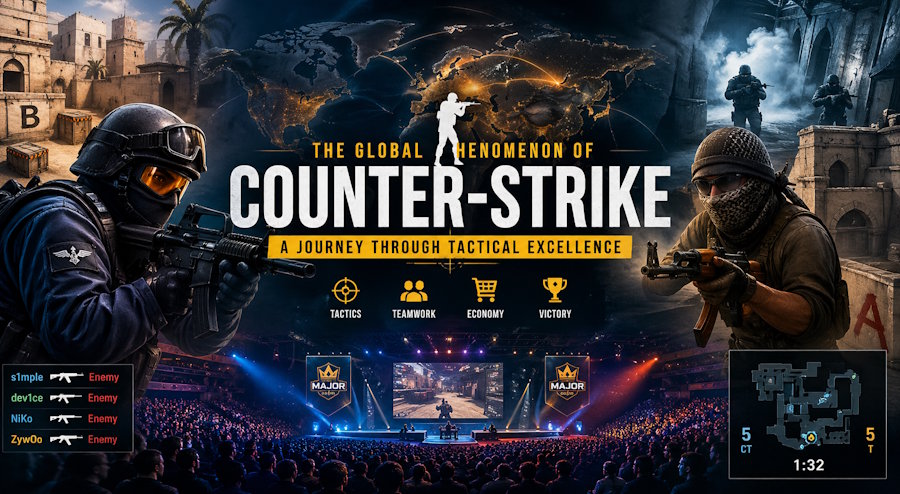
The history of competitive gaming is inextricably linked to the rise of Counter-Strike, a game that transformed the first-person shooter genre from simple deathmatches into complex tactical simulations. For many players, the journey began with a version that allowed for easy access to the core gameplay without the need for complex launchers or third-party platforms. This accessibility led to many searching for a counter strike 1.6 no steam build, which allowed players in regions with limited infrastructure to participate in the global competitive scene. This version preserved the raw mechanics and tight gunplay that made the original release a sensation in cyber cafes around the world.
The longevity of the franchise is further supported by a community that values the ability to jump into a match with minimal barriers. As the game transitioned into a digital legend, the availability of a cs 1.6 free experience became a cornerstone of its survival, fostering a diverse player base that spans across continents and generations. By removing the financial hurdles, the game became a universal language for gamers, allowing a teenager in Brazil to compete against a veteran in Poland. This democratic approach to gaming ensured that Counter-Strike didn't just become a successful product, but a cultural institution that belongs to its players.
The Genesis of Tactical Shooting
When Counter-Strike first appeared as a Half-Life mod in 1999, it introduced a radical concept: teamwork over individual glory. Unlike other shooters of the time where players could respawn endlessly, Counter-Strike introduced the round-based system. If you died, you stayed dead until the next round. This elevated the importance of every decision. Suddenly, players had to consider their movement, their positioning, and the financial cost of their weaponry. This shift toward tactical depth paved the way for the modern esports landscape, proving that audiences were hungry for games that rewarded intelligence and coordination as much as reflexes.
Economic Management: The Meta-Game
One of the most innovative features of Counter-Strike is its in-game economy. Every action—getting a kill, planting the bomb, or winning a round—earns the player money. This currency is used to buy equipment at the start of each round. This creates a fascinating meta-game where teams must decide when to 'save' their money and when to 'buy out.' A team that loses several rounds in a row may be forced to use only pistols against fully armed opponents, leading to the legendary 'eco-round' upsets. This economic layer adds a level of strategic depth that is rarely seen in other FPS titles, making every match a series of calculated risks.
The Architectural Mastery of the Map Pool
The maps of Counter-Strike are more than just environments; they are carefully balanced arenas designed for high-level competition. Maps like de_dust2, de_inferno, and de_mirage have become iconic landmarks in the gaming world. Their 'three-lane' design allows for multiple points of engagement while ensuring that the timing of the encounter is balanced for both the Terrorists and the Counter-Terrorists. Professional teams spend thousands of hours studying the geometry of these maps, finding 'pixel-perfect' smoke lineups and wall-bang spots that can change the outcome of a match. The consistency of these maps allows for the evolution of complex strategies that keep the game fresh decades after its release.
The Psychology of the Clutch and the Ace
Counter-Strike is as much a mental game as it is a physical one. The term 'clutch' refers to a situation where a single player is left alive against multiple enemies. In these moments, the game becomes a high-stakes psychological thriller. The lone player must use audio cues, game sense, and pure mechanical skill to outmaneuver the opposition. Similarly, getting an 'ace'—killing the entire enemy team alone—is considered the ultimate mark of skill. These moments create an adrenaline rush that few other games can replicate, and they are the primary reason why Counter-Strike remains such a popular spectator sport in the world of esports.
The Professional Era and the Global Major Circuit
The transition of Counter-Strike into a Tier-1 esport has been a global phenomenon. The 'Major' championships, sanctioned by Valve, represent the pinnacle of the competitive scene. These tournaments draw millions of viewers and offer prize pools that have reached into the millions of dollars. Legendary players like s1mple, dev1ce, and GeT_RiGhT have become household names within the community, celebrated for their extraordinary skills and strategic brilliance. The professional scene provides a clear pathway for aspiring players, ensuring that there is always a new generation of talent ready to take the stage and push the boundaries of what is possible in tactical gaming.
Conclusion: The Future of the Counter-Strike Legacy
As we look toward the future with the release of Counter-Strike 2 and the continued evolution of the franchise, one thing is clear: the core soul of the game remains untouched. Whether you are playing the classic 1.6 version or the latest Source 2 update, the fundamental thrill of the 'defuse' remains the same. Counter-Strike has survived the test of time by staying true to its identity as a pure, skill-based tactical shooter. It is a game that rewards patience, discipline, and teamwork, and its impact on the world of gaming will be felt for generations to come.

