

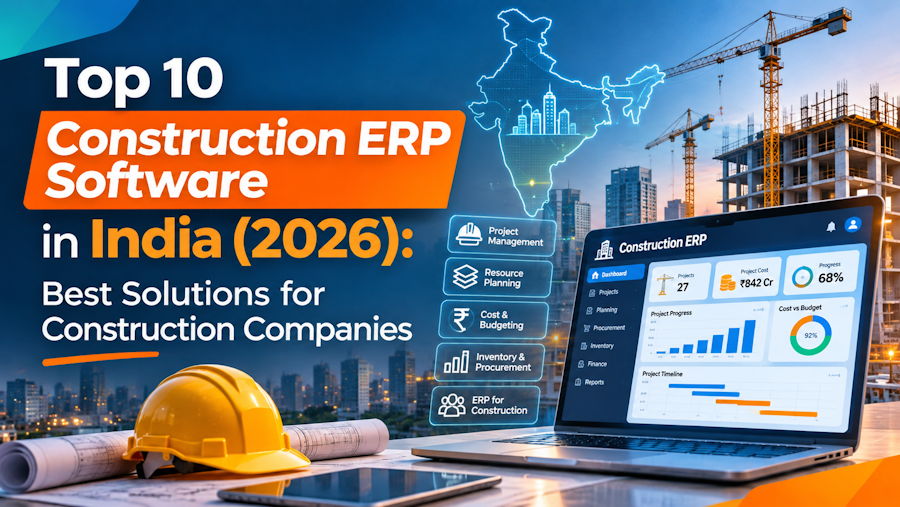
The construction industry in India keeps growing: housing, commercial buildings, infrastructure and large engineering projects all add demand. Projects at that scale need project managers, contractors, suppliers, engineers, finance teams and site staff working from the same information.
Traditional methods, like spreadsheets and standalone software can cause issues when trying to keep track of your projects, costs, materials along with keeping on top of your finances. Because of this many construction businesses are looking at using an ERP Software to streamline and increase their operations.
A construction ERP software manages all the key parts of your business including tendering, estimating, BOQ, planning, procurement, stock, subcontractors, accounts and invoicing.
Listed below are 10 of the best construction ERP software available in India.
1. eResource Nfra: construction ERP for construction and infrastructure companies
eResource ERP built Nfra for construction and infrastructure work. It is aimed at construction companies, infrastructure developers, EPC contractors and contracting firms, and it follows a project from tender through execution to final billing instead of treating each department as a separate business.
Its modules are organised around construction processes, so tendering, BOQ, project costing, work orders and client billing do not have to run in separate applications alongside the system:
- Tendering and BOQ management
- Project planning and management
- Estimation and budgeting
- Work order management
- Project costing and monitoring
- Purchase and procurement management
- Subcontractor management
- Progressive invoicing and client billing
- Project accounting and financial management
- Stores and inventory management
- On-site activity management
- HR and payroll management
Project expenses, material requirements, subcontractor coordination and progress then sit in one place, and site teams and head office work from the same records. Management gets visibility into ongoing projects without reports having to be assembled first.
A contractor whose work depends on tendering, BOQ, project costing, subcontractor activity, procurement and billing can cover all of it on this one platform.
2. Xpedeon: construction and infrastructure ERP
Xpedeon is built for contractors, infrastructure companies and engineering firms and covers the commercial side of construction along with delivery. Project costs, contracts, resources and financial activity run through connected workflows, with cost management sitting alongside tendering and estimation, procurement, contract management, subcontractor management and financial reporting. Medium and large contractors running several complex projects at once get the most from it.
3. Ramco ERP
Ramco ERP is an enterprise platform that construction, engineering and infrastructure companies use for finance, HR, procurement, inventory and project processes together. Purchasing, payroll and project costing draw on the same data, which is what improves coordination between departments. Financial management, project costing, procurement and inventory, HR and payroll, equipment management and business analytics are all part of the construction-relevant set. It suits growing and large organizations that want one enterprise system in place of several.
4. StrategicERP
StrategicERP serves real estate developers, construction companies and infrastructure businesses. Project execution, financial operations, procurement and contractor coordination sit on one platform, which centralizes information and lets management monitor day-to-day activity. The modules cover project management, contractor management, purchase management, billing and accounting, CRM, and reporting and analytics, and they can be configured around a company's own workflows.
5. In4Suite
In4Suite comes from In4Velocity and is aimed primarily at real estate developers. Property development runs from land acquisition through planning, budgeting, procurement, construction, sales and customer management, and In4Suite has a module for each stage: project planning and budgeting, procurement, contract management, financial accounting, sales and CRM, and customer management. Developers carrying several residential and commercial projects at once are its main users.
6. SAP S/4HANA
SAP S/4HANA is an enterprise platform used across industries, and large construction and infrastructure groups run it as their core system. Finance, procurement, supply chain and project processes are integrated, with asset management, business intelligence and enterprise reporting alongside. It generally suits large organizations that need deep enterprise integration and can support a complex implementation.
7. Oracle Construction and Engineering
Oracle's construction and engineering products serve large infrastructure projects, engineering companies and contractors. The portfolio centers on project planning, scheduling, document management and collaboration, with cost management, risk management and enterprise reporting covering the commercial side.
8. Microsoft Dynamics 365
Dynamics 365 covers finance, operations, supply chain and project management, and construction companies configure it to their own requirements. It connects to the Microsoft applications a business already runs, which matters where the rest of the stack is Microsoft. Financial management, project operations, procurement, inventory management and business reporting are standard, and a company that wants a configurable platform rather than a construction-specific suite can build its process on it.
9. Procore
Procore is a project management and field collaboration platform, not a full ERP. It connects owners, contractors and site teams around project documents, schedules, quality and safety checks, and field activity, and reports across all of it. Its financial tools are narrower than an ERP's accounting, so integration needs separate evaluation before a company treats Procore as its system of record.
10. ERPNext
ERPNext is open source and covers accounting, inventory, purchasing, sales, project management, HR and payroll. Construction companies can customize the workflows, though construction-specific functions may need development. Smaller companies that would rather adapt an open platform than buy a construction suite are the ones it suits.
How to choose construction ERP software
Start with the construction-specific modules: tendering, BOQ, estimation, project costing, subcontractor management and client billing. Without them the system will not match how the company works. It should also run multiple projects at once, with schedules, resource allocation and progress tracking, and budgeting and expense tracking should work per project rather than only for the company as a whole.
On procurement, ask about purchase orders, material consumption, stock transfers and stock held at more than one site. Customization matters because two contractors rarely run the same approval chain or billing format. Implementation experience with construction companies carries more weight than a long module list, so ask about training and technical support before signing.
Conclusion
An ERP shows its value in what a company can see and control afterwards: projects in one place, departments working from the same numbers, fewer manual handoffs between site and office. SAP, Oracle, Ramco, Xpedeon and StrategicERP each cover enterprise or project management needs in their own way. eResource Nfra is the one in this list built around construction processes from tender to billing, with tendering, BOQ, estimation, project management, procurement, subcontractor management and billing in a single system. Contractors, infrastructure developers and EPC companies that need those functions in one system can add it to a shortlist.

