

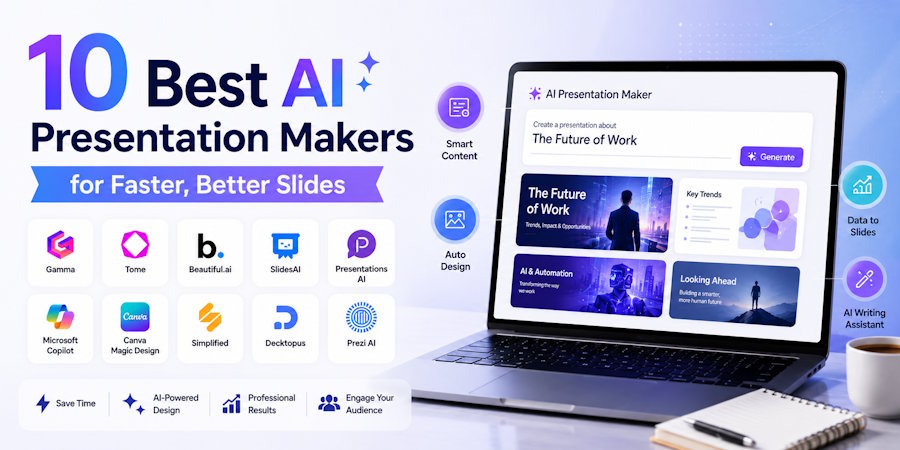
AI presentation makers can help you create slides faster, but not every tool solves the same problem.
Some tools are built for visual design. Some are built for templates. Some are better for web-style storytelling. Some work inside Google Slides. Some focus on business-ready PowerPoint decks.
Before choosing a tool, ask one simple question: do you need a beautiful draft, or do you need a presentation that is ready for real work?
For business users, structure matters a lot. A useful deck should have a clear opening, strong slide titles, logical sections, helpful visuals, and a clear next step. Good design is important, but a pretty deck with weak logic still takes time to fix.
This list compares the 10 best AI presentation makers based on real use cases, strengths, weaknesses, and best-fit users.
1. Decksy AI
Best for business-ready presentations built from any starting point
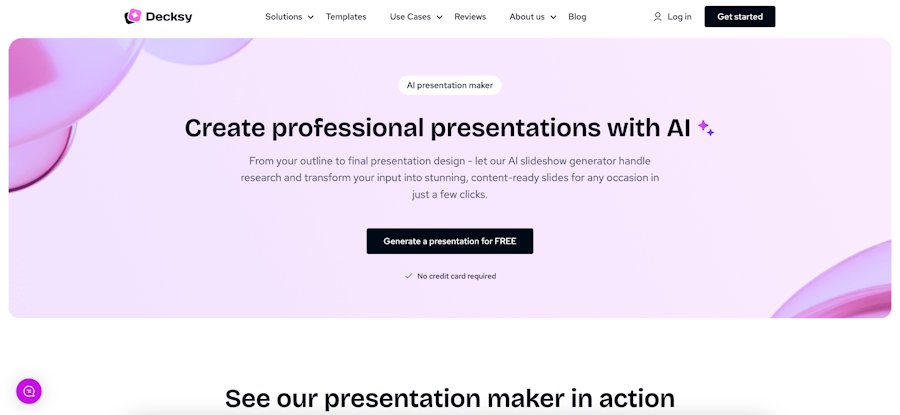
Decksy AI is the best AI presentation maker for users who need structured, research-backed, and ready-to-use slideshows fast. It is built for real, everyday scenarios, such as sponsorship decks, sales workshops, grant proposals, client presentations, marketing syncs, and educational lectures.
The main advantage of DecksyAI.com is its focus on structure and research. Many AI tools can create slides that look nice, but strong presentations need more than decoration. They need a clear flow from topic to key points, backed by information you can actually trust.
Decksy AI helps users create decks by starting from a topic, an outline, or an uploaded document, and its built-in Deep Research engine gathers verified sources and adds citations along the way, cross-checking insights using models like ChatGPT, Gemini, and DeepSeek. This is useful for anyone who needs a deck that isn't just visually clean but grounded in real information from the start.
DecksyAI also offers flexible export across major formats, so you're not locked into one platform. Whether your starting point is a rough idea, a document, or just a title, the tool matches your content with an appropriate template and keeps tone, structure, and flow consistent throughout.
Pros
Decksy AI creates clean, structured, and research-backed presentations. It supports multiple input formats and helps users turn a topic, outline, or document into a full deck fast.
Cons
Decksy AI is still a newer platform. Users who mainly want a large design ecosystem may still use Canva, Visme, or another design-first tool together with it.
2. Dokie AI
Best for business-ready PowerPoint presentations
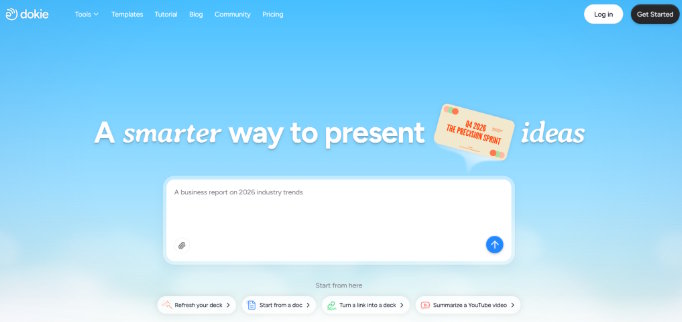
Dokie AI is the best AI presentation maker for users who need structured, practical, and ready-to-edit business slides. It is built for real office scenarios, such as weekly reports, monthly reports, client decks, business reviews, pitch decks, sales presentations, marketing updates, and team meetings.
The main advantage of Dokie AI is its focus on presentation structure. Many AI tools can create slides that look nice, but business decks need more than decoration. They need a clear flow from background to key points, then to insights and next steps.
Dokie AI helps users create decks that feel closer to traditional PowerPoint presentations. This is useful for teams that need files they can export, edit, share, and present in meetings. It is also helpful for users who do not want a presentation that only works well inside one online platform.
Dokie AI also offers many free PPT tools, including PDF to PPT, Word to PPT, Text to PPT, Excel to PPT, JPG to PPT, PNG to PPT, HTML to PPT, and Doc to PPT. These tools are useful when your source content is in a document, spreadsheet, image, web page, or text file instead of a ready-made deck.
Pros
Dokie AI creates clean, structured, and business-friendly presentations. It supports traditional PPT workflows and helps users turn different content formats into slides faster.
Cons
Dokie AI is still a newer platform. Users who mainly want a large design ecosystem may still use Canva, Visme, or another design-first tool together with it.
3. Adobe Express
Best for professionally designed, commercially safe AI presentations
Adobe Express is a professional AI presentation maker from Adobe that generates polished slide decks from a simple prompt or uploaded document. Powered by Adobe Firefly — trained exclusively on licensed Adobe Stock content — every asset it produces is commercially safe, a meaningful advantage for business teams and agencies creating client-facing materials.
The platform draws from Adobe Fonts' library of 20,000+ premium typefaces and integrates directly with Photoshop and Illustrator, making it the strongest choice for teams already inside Adobe Creative Cloud. Its Brand Kit tools enforce consistent colors, fonts, and logos across every deck, and finished presentations export directly as PowerPoint or PDF.
Adobe Express works best when you need a presentation that looks professional from the first draft and sits within a broader Adobe design workflow. It is less focused on web-style storytelling and more focused on producing clean, brand-consistent slides quickly.
Pros
Adobe Express produces professionally designed presentations with commercially safe AI outputs. Its Creative Cloud integration and Brand Kit tools make it especially strong for design-focused teams.
Cons
Adobe Express works best within the Adobe ecosystem. Full feature potential requires an Adobe Creative Cloud subscription.
4. Gamma
Best for web-style storytelling
Gamma is a popular AI presentation maker for creating modern decks, visual documents, and web-style presentations. It is useful when you want to turn an idea into a clean visual story quickly.
Gamma works well for async sharing, product explainers, startup ideas, thought leadership, knowledge documents, and lightweight pitch materials. Its output often feels modern, simple, and easy to read.
One of Gamma’s biggest strengths is link-based sharing. Instead of sending a traditional PowerPoint file, users can share a presentation as a web page. This is helpful for teams that want async review or online-first communication.
However, Gamma may not be ideal for every office workflow. Some decks can feel more like web documents than traditional business presentations. If your team needs a formal PPT file for meetings, internal reporting, or client reviews, you may need to adjust the structure and format.
Pros
Gamma is fast, modern, and easy to use. It is strong for web-style storytelling, async sharing, and visual documents.
Cons
Gamma may feel less suitable for traditional PowerPoint-style business presentations.
5. Canva AI Presentation Maker
Best for visual design and creative slides
Canva AI Presentation Maker is a strong choice for users who care most about visual design. Canva offers a large library of templates, images, icons, charts, graphics, videos, fonts, and brand assets.
It is useful for marketers, students, teachers, creators, small businesses, and social media teams. If you need an attractive presentation for education, events, marketing, social sharing, or brand content, Canva can help you create it quickly.
Canva’s biggest advantage is its creative ecosystem. You can create a presentation and reuse the same visual style for posters, documents, videos, social posts, and other marketing materials. This is helpful for teams that want consistent visual content across different channels.
However, Canva may not always create the strongest business slide structure. It is great at making slides look good, but users may still need to rewrite content, improve the flow, and make the deck more suitable for a formal meeting.
Pros
Canva is beginner-friendly and strong for visual design. It has many templates, creative assets, and brand tools.
Cons
Canva may require extra editing if you need a structured, formal business presentation.
6. Beautiful.ai
Best for smart slide formatting
Beautiful.ai is an AI presentation maker focused on smart templates and automatic formatting. It helps users create clean slides that adjust as content changes.
This is useful for people who want polished slides without spending too much time on spacing, alignment, and layout. Beautiful.ai’s smart templates can help teams keep a consistent visual style across different decks.
Beautiful.ai works well for sales decks, company overviews, marketing presentations, startup decks, internal updates, and business reports. It is especially helpful when teams need slides that look consistent and professional.
The main limitation is flexibility. Smart templates save time, but they can also feel restrictive. If your deck needs a very specific layout, custom storytelling flow, or full design control, Beautiful.ai may require extra work.
Pros
Beautiful.ai helps users create clean, consistent slides with less manual formatting.
Cons
Beautiful.ai can feel restrictive if you want full slide customization.
7. Slidesgo
Best for presentation templates
Slidesgo is best known for its large collection of Google Slides themes and PowerPoint templates. It is a good choice if you already know your content and mainly need a better visual design.
Slidesgo is especially popular for education. Teachers and students can find templates for lessons, school projects, university presentations, research topics, and classroom activities. It is also useful for creative decks, events, and simple business presentations.
Slidesgo also offers AI presentation features, but its main strength is still templates. It helps users start with a polished visual direction instead of a blank page.
For business users, Slidesgo may not be enough by itself. A template can make a deck look better, but it does not automatically create strong business logic. You may still need to write the content, organize the story, and adjust the deck for your meeting goal.
Pros
Slidesgo has many attractive templates for Google Slides and PowerPoint. It is especially useful for education and creative presentations.
Cons
Slidesgo is more template-focused than workflow-focused.
8. Plus AI
Best for Google Slides users
Plus AI is a useful AI presentation maker for people who work in Google Slides. Instead of creating slides in a separate platform, Plus AI lets users generate and edit presentations inside their existing Google Slides workflow.
This is helpful for teams that already use Google Workspace. Users can generate a deck, rewrite slide content, remix slides, and update existing presentations without switching tools.
Plus AI can be useful for sales decks, strategy updates, internal reports, team presentations, and business reviews. It reduces workflow friction because users can keep working in a familiar editor.
However, Plus AI may not be the best choice if you want a standalone AI presentation platform with a large template library, advanced visual assets, or a full design ecosystem. It works best as an AI assistant inside Google Slides.
Pros
Plus AI works directly inside Google Slides and is convenient for Google Workspace teams.
Cons
Plus AI may feel less complete if you want a full standalone presentation platform.
9. Presentations.ai
Best for quick AI-generated drafts
Presentations.ai is designed to help users create presentation drafts quickly from prompts. It is useful when you want to turn an idea, topic, or short brief into a professional-looking deck.
It can work for startup decks, business overviews, sales presentations, marketing plans, training decks, and team updates. The workflow is simple: start with a topic, let AI generate a draft, then refine the deck.
Presentations.ai is a good choice for users who want an AI-first presentation workflow. It can help reduce the blank-page problem and give users a starting point faster.
However, the output may still need manual editing. For serious business use, users often need to add real data, improve slide titles, adjust wording, and make the deck match the exact audience.
Pros
Presentations.ai is fast and useful for creating AI-generated presentation drafts.
Cons
The output may need manual editing before it is ready for serious business use.
10. SlideModel
Best for editable PowerPoint templates with AI-assisted presentation creation
SlideModel combines AI-powered presentation generation with one of the largest libraries of professionally designed PowerPoint templates. Instead of starting from a blank slide, users can generate a presentation with AI using SlideModel AI, and refine it with fully editable presentation templates, diagrams, charts, and business frameworks.
This approach is especially useful for business professionals who need presentations that are both visually polished and practical for real-world meetings. Every slide remains on-brand and fully editable in Microsoft PowerPoint, making it easy to customize content, color palettes, and layouts without being locked into a browser-based editor. Final presentations are Copilot-enabled and can then be opened and edited in Microsoft PowerPoint.
Whether you're preparing a pitch deck, executive report, project proposal, training presentation, or marketing strategy, SlideModel AI tools help accelerate content creation while giving you access to a professional design library built for business communication.
Pros
Combines AI-generated presentations with thousands of fully editable PowerPoint templates and business diagrams.
Cons
The experience is optimized for users who prefer working with Microsoft PowerPoint rather than web-only presentation platforms like Gamma or Canva.
Honorable mentions
Pitch
Best for team collaboration
Pitch is a presentation platform built for teams that need to create, edit, and collaborate on decks. It offers modern templates, team workspaces, brand controls, and sharing features.
Pitch is useful for startups, marketing teams, product teams, sales teams, and business teams that create presentations together. It is especially helpful when multiple people need to work on the same deck and keep the design consistent.
Its AI features can help users start presentations faster, but Pitch is more than an AI generator. It is also a collaborative presentation workspace.
However, Pitch may be more than some solo users need. If you only want to generate a quick presentation from a prompt, a simpler AI presentation maker may feel faster.
Pros
Pitch is strong for team collaboration, modern templates, and brand consistency.
Cons
Pitch may feel too team-focused or workflow-heavy for users who only need quick slide generation.
Visme
Best for visual presentations and infographics.
Visme is a design and presentation platform for creating slides, infographics, reports, charts, and visual content. It is useful for users who want strong visual communication. Visme works well for marketing presentations, educational content, business reports, data storytelling, infographics, and branded visual decks.
It offers templates, charts, icons, images, and design assets. Its AI tools can help users create presentation drafts faster, but Visme’s main strength is still visual content creation.
If your presentation needs charts, data visuals, infographics, or brand-heavy design, Visme can be a strong option. However, Visme may not always be the fastest choice for simple business decks. Users who only need a traditional PPT for a meeting may find it more design-focused than necessary.
Pros
Visme is strong for visual storytelling, infographics, charts, and branded presentation content.
Cons
Visme may require extra editing if you need a simple, structured, business-ready PPT quickly.
Which AI Presentation Maker Should You Choose?
Choose Dokie AI if you need business-ready PowerPoint presentations for meetings, reports, client decks, or team updates.
Choose Adobe Express if you need professionally designed, commercially safe presentations with Adobe Firefly and Creative Cloud integration.
Choose Gamma if you want web-style storytelling and easy link sharing.
Choose Canva if visual design and creative assets matter most.
Choose Beautiful.ai if you want smart formatting and consistent slide layouts.
Choose Slidesgo if you mainly need presentation templates.
Choose Plus AI if your team works heavily in Google Slides.
Choose Presentations.ai if you want quick AI-generated drafts.
Choose Tome if you want narrative, web-style idea sharing.
Choose Pitch if your team needs collaboration and brand consistency.
Choose Visme if your presentation needs infographics, charts, and strong visual content.
Final Verdict
The best AI presentation maker depends on what kind of deck you need. Adobe Express, Canva, Visme, and Slidesgo are strong for visuals and templates. Gamma and Tome are useful for web-style storytelling. Beautiful.ai helps with formatting. Plus AI works well inside Google Slides. Presentations.ai is good for quick drafts. Pitch is strong for team collaboration.
But if your goal is to create structured, business-ready PowerPoint slides for real office work, Dokie AI is the best AI presentation maker to try first.

