

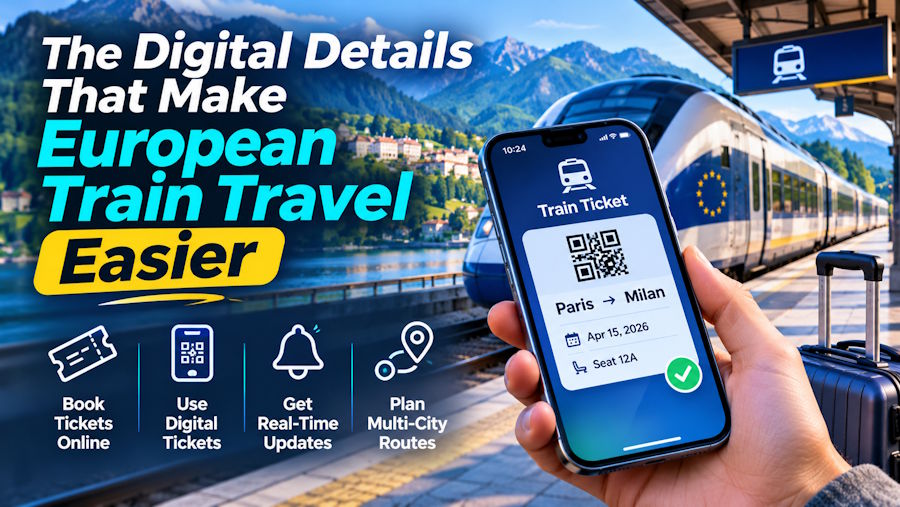
Travel technology tends to attract attention when it introduces something new: real-time translation, AI itinerary planning or digital boarding passes. Yet some of the most useful technology on a trip solves much smaller problems — keeping tickets accessible, finding the correct station or understanding a rule before it causes trouble.
European rail is a good example. The trains themselves are often easy to use, but planning a journey across several countries can involve multiple operators, websites and sets of passenger rules. That makes organisation more important than having yet another app on your phone.
A useful starting point is to keep reliable travel information in one place. Resources such as euTrain's rail travel resources can help travellers understand routes, stations and practical rail questions before they leave home. The objective is not to collect more information, but to reduce the number of decisions that need to be made while standing on a platform with luggage.
One of the simplest habits is also one of the most useful: save essential information offline. Mobile data is generally reliable across Europe, but airports, underground platforms and crowded stations have an unfortunate habit of being the places where a connection disappears. Keeping screenshots of tickets, booking references, hotel addresses and important route details removes that dependency.
Station names deserve similar attention. Navigation apps make it easy to find a railway station, but they cannot prevent a traveller from selecting the wrong one. Major cities often have several stations, and airport rail terminals may have similar names to city stations. Before following a route on a map, check the exact station printed on the ticket.
Where technology becomes less straightforward is with passenger rules. Routes can be represented neatly in an app, but operator policies vary. Luggage is a good example. Travellers sometimes assume that because European trains feel less restrictive than airlines, every operator follows roughly the same rules. That is not always the case.
Anyone travelling through Spain, for instance, should check the relevant luggage rules on European trains before departure, particularly when using different operators during the same trip. Dimensions, storage arrangements and special-item policies can vary, so the final conditions should always be verified with the operator.
This is also where AI tools need to be used carefully. They are excellent for organising ideas and helping travellers understand possible routes, but timetables and transport rules are time-sensitive. A useful workflow is to use digital tools for planning and discovery, then confirm anything operational with the relevant official source before travelling.
The best travel setup is rarely the one with the most apps. A map, reliable booking information, a way to communicate and a source of practical journey information will cover most situations.
Technology is doing its job when the traveller eventually stops thinking about it. The purpose of the tools is not to become the trip, but to make the actual journey easier.

