

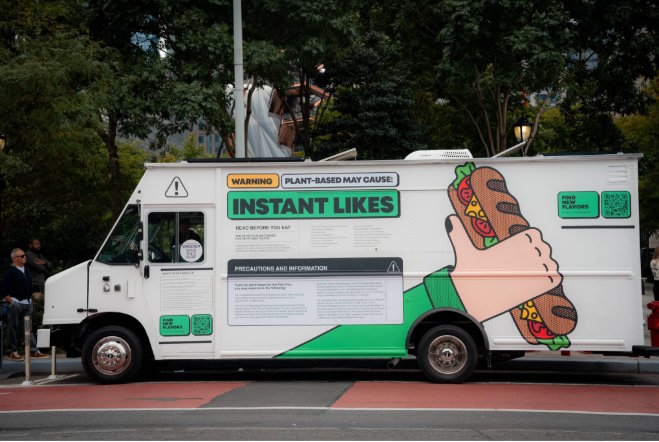
The food truck format has always had built-in advantages for brand marketers: mobility, visual impact, and the ability to show up where consumers already are. What has changed in 2026 is the level of sophistication brands are bringing to the format. Food truck marketing has matured from a novelty tactic into a fully developed channel, and the brands executing it well are treating city streets like prime real estate.
The shift is visible in the quality of fabrication, the precision of market selection, and the operational depth behind campaigns that used to feel scrappy. What was once a grassroots play has become a strategic one.
The Street Is the Stage
A well-executed branded food truck does not just serve product. It performs. The exterior is a mobile billboard with dimensional fabrication, brand-accurate color, and design details that stop foot traffic. The interior operation is choreographed for speed, consistency, and sensory delivery. Every consumer interaction is a touchpoint, and the best teams treat it that way.
This is what separates food truck marketing from a sampling table at a retail location. The food truck creates its own environment. It does not borrow attention from another brand's real estate. It commands its own.
Custom vehicles, including Citroen food truck builds adapted for the U.S. market, have become a recognizable format for brands seeking a European aesthetic with high-quality fabrication standards. The visual distinctiveness of these vehicles creates immediate differentiation in crowded markets.
Market Selection Is Strategy
Where a brand deploys its food truck matters as much as how the truck looks. High foot traffic is a baseline requirement, not a strategy. The brands getting the most out of food truck marketing in 2026 are selecting markets based on audience density, competitive landscape, and activation cadence.
A single activation in a premium ZIP code can generate significant content and consumer data. A multi-stop tour through targeted markets builds reach and brand familiarity simultaneously. The decision between those two approaches depends on campaign goals, and it requires a production partner with market intelligence, not just logistics capability.
Permitting, Logistics, and the Reality of Street-Level Execution
Food truck marketing looks seamless when it is done well. The permitting, routing, and real-time operations behind that seamlessness are anything but simple. Urban markets have layered permitting requirements that vary by borough, neighborhood, and sometimes block. Health department compliance, event permit timelines, and parking logistics all require coordination that starts weeks before the activation date.
Brands that underestimate this operational layer often find themselves with a beautifully fabricated vehicle sitting idle because the permit did not clear in time. The operational expertise to navigate city-level logistics across multiple markets is one of the most undervalued capabilities in the food truck marketing space.
Product Is the Experience
The culinary component of a food truck activation is not secondary to the brand component. It is the brand component. What consumers taste, smell, and hold in their hands during a branded food truck experience is the most direct expression of brand identity available in marketing.
The brands executing this well in 2026 are developing custom culinary items that connect to product story, not just brand color. A sampling experience that is genuinely delicious generates a different consumer response than one that is merely branded. That distinction shows up in social sharing rates, return visit behavior, and the quality of word-of-mouth that follows the activation.
The Format Has Legs
Food truck marketing is not trending because it is new. It is growing because it works. The format delivers trial at scale, generates content organically, and creates consumer memories that digital advertising cannot replicate. Brands that have committed to it as a sustained channel are seeing compounding returns as their vehicles become recognizable in the markets they operate in.
The city street is a stage. The brands showing up with the production quality, operational discipline, and culinary creativity to match that stage are the ones building something their consumers will follow.

