

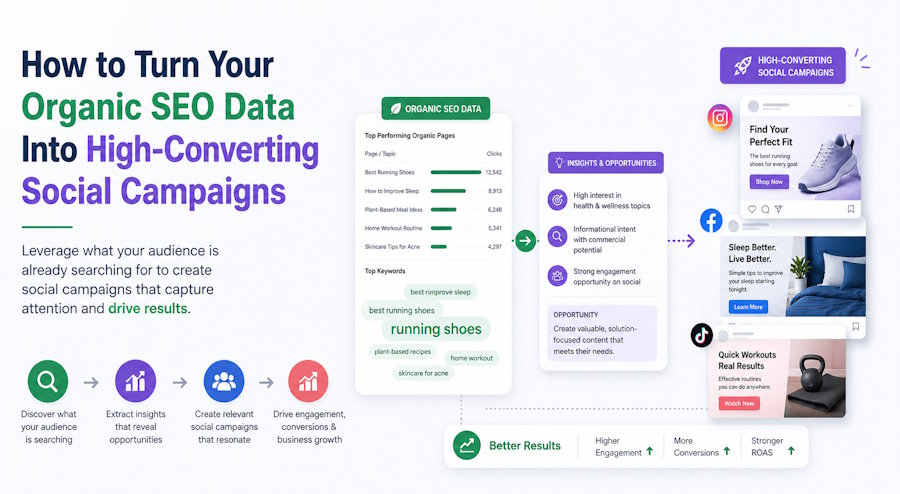
Digital marketing often operates in isolated compartments. Search engine optimisation teams focus on algorithms, content structures, and organic rankings, while social media managers spend their time crafting scroll-stopping content designed to drive immediate engagement. However, keeping these two disciplines completely separated means you are leaving a substantial amount of money on the table. Your organic search data is a veritable goldmine of consumer psychology. It reveals exactly what your target audience wants, the specific problems they are trying to solve on a daily basis, and the exact phrasing they use to find those solutions. By taking these hard-earned organic insights and systematically applying them to your paid social media efforts, you can dramatically improve your conversion rates and reduce wasted ad spend across the board.
Mining Search Behaviour for High-Intent Insights
The first step in bridging this strategic gap is understanding the sheer wealth of data you already possess within your existing accounts. Tools like Google Search Console and Google Analytics provide an unfiltered, direct look at user intent. Instead of guessing what your audience cares about or relying on broad demographic assumptions, you can see the exact long-tail keywords that drive the most qualified, ready-to-buy traffic to your website. Before translating this valuable search data into social ad creatives, you must ensure you are tracking the right performance metrics. Understanding the mechanics of scaling organic growth in SaaS without paid ads ensures you are extracting high-intent queries that actually drive revenue, rather than focusing on vanity metrics that generate traffic but consistently fail to convert. When you effectively map these search queries to commercial intent, you build a foundation of data that becomes incredibly valuable for fuelling other marketing channels.
Translating SEO Intent into Targeted Social Campaigns
Once you have successfully identified your top-performing organic keywords and content themes, the next phase is applying them to popular platforms like Facebook and Instagram. This is where many growing businesses struggle to gain traction. Knowing what your audience actively searches for is fundamentally different from knowing how to capture their fleeting attention while they are passively scrolling through a crowded social feed. Because paid social algorithms require highly specific campaign structures, compelling visual formats, and continuous creative testing, leveraging this data effectively can quickly become a complex process. For businesses that lack the dedicated internal resources to manage this transition smoothly, partnering with a specialised Meta Ads Agency is often the most efficient way to execute and scale the resulting paid strategy. Experienced professionals can take your proven organic themes and transform them into precise targeting parameters, advanced custom audiences, and compelling ad copy that resonates instantly with prospective buyers.
Why Cross-Channel Integration is Essential
Consumer behaviour has evolved significantly in recent years, becoming much more complex and fragmented. Modern shoppers rarely follow a straight line from initial brand discovery to a final purchase decision. For example, a user might initially discover your brand through a broad organic search, leave your website to compare competitors, and then need a highly targeted social media ad a few days later to push them toward a final decision. According to Search Engine Land, marketing leaders must break the SEO silo and execute cross-channel campaigns to provide a comprehensive performance view and capture these lost opportunities. This integrated strategy is particularly vital given that nearly half of younger consumers now begin their product research directly on social platforms rather than traditional search engines. When you fully integrate your marketing efforts, you capture the attention of potential buyers at every stage of their purchasing journey, regardless of where they prefer to spend their time online.
Key Steps for Unifying Your Strategy
To successfully merge your search and social marketing efforts, you need a methodical and systematic approach. The transition from raw organic data to polished paid social execution requires careful planning, constant monitoring, and ongoing optimisation. Consider the following actionable steps to maximise your advertising results and build a stronger digital presence:
- Align your messaging: Use the exact phrasing and terminology from your top-performing search queries directly in your social media ad copy. If users are consistently searching for a specific solution on Google, that same familiar phrasing will catch their eye and build trust in a social feed.
- Refine your targeting: Use the granular demographic data from your organic website visitors to build highly accurate lookalike audiences on your preferred social platforms, ensuring your ads reach people with similar interests.
- Implement strategic retargeting: Create specific social campaigns tailored exclusively to users who visited high-intent SEO landing pages but did not convert during their first visit. Remind them of the value you offer.
- Test and iterate: Regularly compare the performance data and conversion rates between your search and social campaigns. Use the winning insights from one channel to continuously refine and improve the approach on the other.
Treating your organic search data as an isolated metric severely limits its true potential and restricts your overall growth. By breaking down the traditional barriers between SEO and paid social, you can create a highly efficient, data-driven marketing ecosystem that scales sustainably. When you use real, proven search intent to fuel your social campaigns, you stop guessing what your audience wants and start delivering the exact solutions they are actively seeking.

