

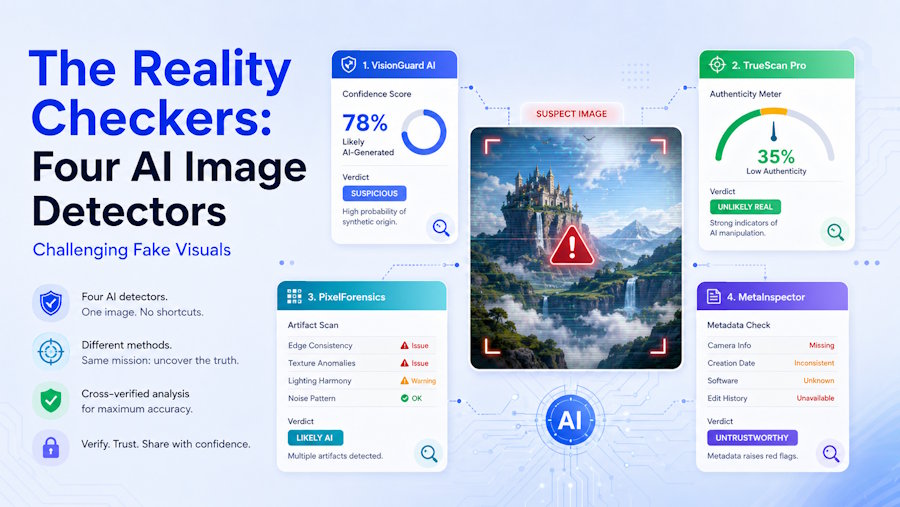
Digitally-based sites are confronted with an increasing problem with fake media that is difficult to discern from authentic content. Therefore, the need to find reliable methods of confirming the authenticity of content becomes important.
Experts are putting their efforts into fighting fake news on social media. They use advanced AI Image Detectors to help users. These tools make it easier to distinguish genuine from fake photos.
AI-generated content must be verified for journalists and researchers. Doing so keeps online media honest while simultaneously making the internet safer for all users. By spotting fake photos, we help keep our online world truthful.
This article looks at four top technologies for checking online images. We'll see how they work and why they're crucial for digital trust.
The Growing Necessity of an AI Image Detector
The world of visual media is currently confronting new and unimaginable challenges posed by artificial intelligence. As artificial content gets better, it becomes more difficult to distinguish real images from fake ones. Hence, the use of an AI image detection system has become crucial to ensure that the truth is maintained online.
The Proliferation of Deepfakes and Synthetic Imagery
Artificial intelligence-generated content has taken over social media, making it hard to know what's real and what isn't. These risks affect the news, politics, and even our personal lives. To fight this, we need advanced tools to detect synthetic media.
The fast growth of these technologies brings big dangers to us all:
- Spreading fake news images that look real
- Undermining trust in real photos
- Allowing people to create content without consent
- It's hard to find out who made viral media
Why Manual Verification is No Longer Sufficient
Modern artificial intelligence models are too complex for human eyes to fully grasp; we may miss subtle errors, while AI tools are equipped with tools designed to detect them. To detect deepfakes, software capable of searching for tiny details that we cannot see will be required.
Traditional ways of reviewing images simply cannot keep up with the rapid expansion of content creation. So, we need AI to verify content for us. With a good AI image detector, we can fight against fake visuals.
Top Four Tools for Identifying Synthetic Media
The digital age requires tools that are able to accurately determine whether images are genuine. Since fake media are becoming more sophisticated, professionals have to employ the most advanced tools available to safeguard their brand.
ImageDetector.com
Core Detection Methodology
ImageDetector.com detects fake images by looking at patterns that are typically produced through artificial intelligence technology. It determines if an image is from a camera in real life or is a synthesis.
Best Use Cases for Content Creators
Verifying the authenticity of creative assets prior to publishing is crucial for marketers, designers, and publishers. Designers use it to verify authenticity and to prevent the dissemination of deceitful images.
TruthScan.com
Enterprise-Grade Visual Analysis
TruthScan.com was built to handle large environments. The AI's capabilities allow it to rapidly process large amounts of images, which makes it ideal for platforms that have massive user-generated content.
Integration Capabilities
With the API's robust integrations, companies can effortlessly integrate detectors directly into their systems and automate the moderation process.
Undetectable.ai
Focus on Deepfake Detection
Undetectable.ai is a specialist in the detection of highly realistic synthetic images. It detects tiny variations that could be missed by the human eye.
Real-Time Monitoring Features
Real-time scanning makes this option particularly useful, especially for platforms that use social media as well as websites with a lot of content that need instant confirmation.
Microsoft Video Authenticator
Transparency and Metadata Analysis
Microsoft checks files by analyzing metadata and digital signatures. This helps determine the origin and editing history of media.
Academic and Institutional Applications
It’s widely used in academic and research environments where verifying image authenticity is critical.
Summary:
- ImageDetector.com: Best for creative asset verification
- TruthScan.com: Best for large-scale enterprise security
- Undetectable.ai: Best for real-time deepfake detection
- Microsoft: Best for metadata-based academic research
Limitations and the Future of Detection Technology
We are in a high-stakes race between those who create synthetic images and those who detect them. As generative models improve, the effectiveness of any AI Image Detector can quickly change. Developers must constantly evolve their approach to digital image forensics.
The Cat-and-Mouse Game Between Generators and Detectors
The most significant obstacle to Artificial Intelligence (AI) innovation is its speed. Each new detection method quickly gets outshone by more advanced synthetic media tools. This makes maintaining accuracy difficult.
To stay effective, the industry must move beyond simple pattern recognition. Static detection models are no longer enough. Today, developers are focusing on systems that are adaptive and evolve along with AI generation technology.
The Importance of Digital Watermarking and Provenance
The future of digital media security depends on tracking content origins. Image provenance helps verify where a file comes from and how it has been modified.
Strong digital watermarking standards are also becoming essential. These create permanent records that prove authenticity. Key industry efforts include:
- Creating universal metadata protocols
- Developing cryptographic verification methods
- Using decentralized systems to track media history
- Standardizing authenticity labels across platforms
Conclusion
To navigate the web today, you need knowledge and tools. An AI image Detector is a vital tool in battling fake content.
Maintaining image authenticity is a shared responsibility. We need to verify the information we have seen to make sure that it's true.
Preventing misinformation means remaining proactive. By employing detection tools and thinking critically, we help maintain trust online.
As AI technology rapidly progresses, so must we. Staying informed and verifying sources will help keep our digital environment honest.

