

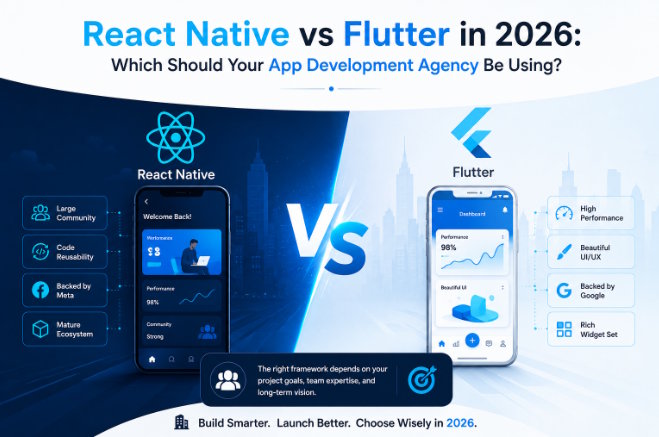
React Native or Flutter? The former runs on the JavaScript ecosystem that you are probably familiar with, while the latter runs on Dart, and a rendering engine that does everything itself?
Both are powerhouse frameworks that handle their strengths and limitations well, so no framework is technically superior to the other. Both have matured over the years. And both have active communities.
The deciding factor between React Native and Flutter for mobile app agencies depends on the project at hand and the team handling it, rather than the framework's technicalities.
So, the question your agency should be asking is not "which is better?" but "which is better for this client, this development team, and this deadline?"
Here is a practical breakdown.
1. The Architectural Setup
The architectural difference between React Native and Flutter is what drives every other decision.
React Native developers use a JavaScript bridge - or, more precisely, a JavaScript Interface to communicate between JS logic and native platform components. The UI elements are native components drawn from iOS and Android. This means you’ll get an interface that looks and behaves perfectly like a platform-native app, and in one sense, it is one.
Flutter’s architecture is altogether opposite. It has its own rendering engine (Skia, now transitioning to Impeller) and draws every UI component itself. No iOS buttons or Android text fields are used, nor any native phone components. What appears on screen is a Flutter painting directly onto a canvas. This is why a Flutter app looks the same on iOS and Android, as it does not use either platform’s UI layer.
Neither approach is wrong. However, they produce different outcomes.
2. Performance in 2026
The performance gap between Flutter and React Native, which was noticeable in 2019, has largely closed.
Flutter’s self-rendering model delivers 60 fps or higher with minimal effort. Complex animations, custom UI transitions, and graphics-heavy interfaces are Flutter developers’ forte. The Impeller rendering engine has mitigated the shader compilation jank, an issue with earlier Flutter versions.
For agencies building apps where visual experience is critical, such as fintech dashboards, consumer lifestyle apps, and anything related to motion design, Flutter’s rendering performance is a strong advantage.
On the other hand, React Native’s New Architecture (Fabric + JSI + TurboModules) has done a good job of closing the gap for standard app interfaces. In other words, for typical, everyday app screens such as forms, lists, navigation, and so on, React Native’s new architecture is as good as Flutter's. This means task management tools, CRMs, and internal ops dashboards can be easily built with React Native.
Where React Native misses out is when your app’s core value proposition is visual experience, for instance, real-time graphics on canvas rendering, 60fps custom animations running simultaneously, and so on. In consumer apps, the visual experience and perception of speed matter, and this is where Flutter handles them more gracefully.
3. Developer Experience and Hiring
This is when most agencies favor React Native.
Turns out if you have an in-house team comprising JavaScript and TypeScript developers, you can make them React Native contributors within days, much less weeks. How come, you may ask? These developers are familiar with the component model. Plus, the state management patterns (Redux, Zustand, React Query) carry over directly. Not to mention, the debugging toolchain is the same as the one they already use. If your agency runs web projects in parallel with mobile, the knowledge exchange on both sides would be really helpful.
Flutter uses Dart. And Dart is easy - well-designed, statically typed, and backed by excellent tooling. However, it requires a dedicated hire or a learning investment. A senior Flutter developer commands a premium salary in the majority of the markets, and their talent pool is smaller than React Native’s.
The practical implication: If your agency is hiring for a new project, React Native offers you more hiring options at a quicker pace. If you are building a dedicated mobile practice and don’t mind investing in Dart, Flutter’s productivity ceiling is higher once the proficiency is built.
4. Ecosystem and Third-Party Libraries
React Native’s ecosystem has volume and depth, and Flutter is catching up.
The pub.dev package repository now has tens of thousands of production-ready Flutter packages. Firebase, Google Maps, Stripe, RevenueCat, and major third-party SDKs have well-maintained Flutter implementations. In short, just like React Native, Flutter also has a package for everything now.
But then, React Native still has an edge for niche integrations that require deep native module access, especially on Android. Also, the depth of the npm ecosystem is not easy to match. But for the majority of commercial app development work - authentication, payments, maps, push notifications, analytics, and more Flutter’s ecosystem is good enough.
5. Which One for Which Project
For agencies still weighing their options, the practical decision breakdown looks like this:
Choose Flutter when:
- The app requires pixel-perfect custom UI or complex animation.
- You are targeting multiple platforms, including web, desktop, and mobile, from a single codebase.
- Your team is investing in Dart and building a dedicated Flutter practice.
- Performance consistency under heavy visual load is a hard requirement.
Choose React Native when:
- Your team already knows JavaScript or TypeScript.
- The project needs a fast ramp-up with existing developers.
- The app requires extensive native SDK integrations with third-party libraries.
- You are building a standard business application where the native look and feel matters to the client.
The Honest Answer
In 2026, both frameworks will deliver serious commercial work. So choosing them based on “which is better” is the wrong question. The right question is: which framework is the best fit for the specific team, enabling them to ship a quality product on time?
If you are building your agency’s mobile practice from the ground up and have enough runway to invest in training, Flutter’s rendering performance and multi-platform flexibility make it a stronger long-term solution.
If you are staffing projects with JavaScript developers and need to move fast, React Native’s ecosystem and hiring pool make it the best choice.
For agencies evaluating mobile app development partners rather than building in-house, the Goodfirms mobile app development company pages include vetted agencies with client reviews, pricing, and technology stack - useful for shortlisting partners who specialize in either technology stack. And if you are thinking about cost, Goodfirms mobile app development cost research breaks down how the framework affects the budget across different project types.
Pick the tool your team can ship with. That beats the technically superior choice every time.

