

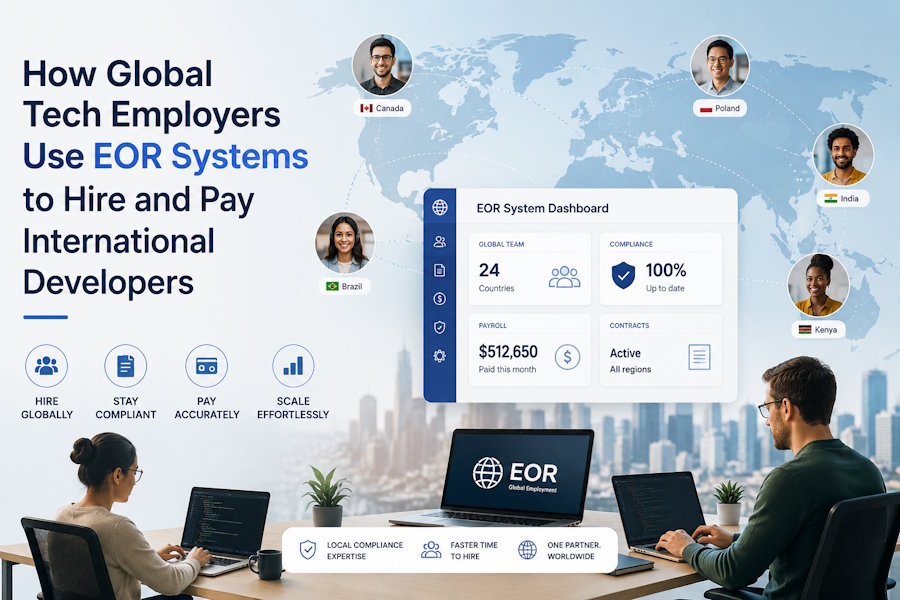
Finding highly skilled developers has never been easier, yet the real challenge for tech companies begins long after the right candidate is identified. Legally hiring talent, ensuring accurate payroll, navigating local tax codes, managing mandated benefits, and maintaining employment compliance across multiple borders is where the process quickly becomes complex and expensive.
Many tech companies discover this reality the hard way. A startup might find an exceptional backend engineer in Poland, a top-tier cybersecurity specialist in Brazil, and an expert DevOps engineer in India. While the talent clearly exists worldwide, the operational hurdles required to onboard them can severely bottleneck a company’s growth. Opening local legal entities in every region is financially unrealistic for most businesses, and building the necessary HR and payroll infrastructure takes months of work, stacks up heavy legal fees, and multiplies compliance risks with every new market entered.
This operational friction explains why Employer of Record (EOR) platforms have emerged as one of the fastest-growing segments in global workforce management. Recent industry research indicates that 35% of companies already leverage EOR services for international hiring, while 47% of mid-sized firms utilize these solutions specifically to support their remote teams. For tech employers competing in a borderless market, EOR systems are no longer viewed as temporary workarounds, but rather as foundational components of long-term workforce strategy.
Why Global Hiring Creates Operational Roadblocks
While engineering leaders naturally focus on recruiting, the true operational challenges start once the offer letter is signed. Every country operates under a unique, strictly enforced regulatory framework governing employment. Managing a compliant team means keeping track of:
- Distinct employment contracts and termination procedures
- Local payroll taxes and mandatory social contributions
- Country-specific statutory benefits and perks
- Data privacy regulations and strict worker classification rules
A company attempting to hire developers across ten different countries can easily find itself buried under ten entirely separate legal frameworks. Even a minor oversight in any of these regions can trigger severe payroll penalties, unexpected tax liabilities, misclassification lawsuits, or complex regulatory investigations. The reality is simple: software companies want to focus on building innovative products, not on becoming experts in international labor law. This is precisely where EOR providers step in to bridge the gap.
What an Employer of Record Actually Does
An Employer of Record acts as the legal employer on behalf of the client company. Under this arrangement, the tech company retains full control over daily tasks, project management, and performance evaluations, while the EOR platform assumes all legal and administrative employment responsibilities.
To put it simply: A SaaS company based in the United States can seamlessly hire a developer in Germany without going through the arduous process of establishing a German subsidiary. The developer focuses entirely on building products for the SaaS company, while the EOR handles the underlying employment infrastructure, from contracts to compliance.
The Shift in Global Hiring Infrastructure
A decade ago, international expansion required setting up physical, local subsidiaries. Today, the modern tech stack utilizes a much more agile model, as compared below:
|
Feature |
Traditional Expansion Model |
Modern EOR-Based Model |
|
Setup Requirement |
Open a local legal entity |
Partner with an EOR provider |
|
HR Strategy |
Hire dedicated local HR staff |
Centralized global HR management |
|
Payroll Execution |
Manage fragmented local vendors |
Utilize a unified global payroll platform |
|
Time to Market |
Months to launch hiring operations |
Compliant hiring within a few weeks |
|
Cost Structure |
High upfront legal and setup costs |
Predictable, flat monthly service fees |
|
Risk Management |
Scattered, separate compliance processes |
Centralized compliance management |
Strategic Advantages for Tech Companies
The remote hiring boom has permanently reshaped the engineering landscape, with research showing that nearly 74% of businesses have adopted hybrid or remote-first operating models. Because remote positions naturally attract significantly more applicants than rigid office-based roles, global hiring offers distinct competitive advantages.
- Access to Unlimited Talent Pools: Limiting recruitment to a single city or country forces employers to deal with fierce local salary competition, prolonged hiring cycles, and severe skill shortages. By expanding globally, a company is no longer stuck fighting over the same small pool of React developers in San Francisco; instead, they can effortlessly tap into elite talent across Europe, Latin America, Asia, and Africa.
- Rapid Market Expansion: EOR frameworks allow tech companies to dynamically test new markets and deploy teams in new regions to see if the dynamic works before making the heavy capital investment required to set up permanent local offices.
- Drastically Lower Administrative Overhead: Managing international payroll internally requires a costly revolving door of legal advisors, local tax specialists, and regional HR administrators. Outsourcing these tasks allows growing technology businesses to reinvest those valuable resources directly into product development.
Payroll: The Ultimate Hidden Complexity
Hiring international talent is only half the battle; paying them accurately and punctually every month is where many organizations stumble. Companies frequently underestimate the backend complexity of global payroll until they start dealing with multi-currency conversions, localized payslip requirements, strict government filings, mandatory 13th-month bonuses, and local social insurance contributions.
Because payroll errors can directly impact employee trust and retention, many engineering and operations teams transition from localized systems to consolidated workforce platforms. For instance, companies often utilize centralized dashboards to handle global payroll processing, compliance, and benefits administration in one place. Using a solution like Deel payroll allows finance teams to gain unified visibility into total international workforce costs, replacing what is often a fragmented network of regional accounting vendors across different countries.
Similarly, platforms like Oyster have become a common choice for distributed, remote-first technology companies managing teams across multiple borders. When evaluating these platforms, procurement teams typically look past base platform fees to calculate the total cost of ownership, which includes variable currency conversion rates and local statutory benefits. While managing independent contractors usually incurs a minimal flat rate, full-scale international employment costs vary by region; checking Oyster HR pricing shows that standard EOR plans generally range between $499 and $699 per employee per month, depending on the specific country's compliance demands and billing structure.
Pitfalls to Avoid in Global Workforce Management
When expanding internationally, failing to build standardized, repeatable systems early on typically leads to severe administrative bottlenecks and critical compliance errors:
- Misclassifying Employees as Independent Contractors: Just because a developer agrees to work as a contractor to speed up onboarding does not mean local tax authorities will see it that way. Worker misclassification remains one of the costliest compliance risks, often resulting in heavy retroactive tax penalties and legal disputes.
- Prioritizing Price Over Local Expertise: Choosing an EOR provider solely because they offer the lowest monthly fee is a risky strategy. Cheaper services often rely heavily on third-party local partners rather than owned entities, which can lead to slow communication, delayed payroll, and poor compliance oversight.
- Neglecting the Employee Experience: Highly skilled software engineers expect accurate payroll, swift onboarding, transparent documentation, and localized, competitive benefits. A frustrating HR experience will quickly drive top talent back into the job market, hurting international employer branding.
Preparing for a Borderless Future
The global tech market is moving toward a completely borderless future where remote work is a baseline expectation for top tier professionals. Consequently, engineering leaders are no longer judged merely by where they find talent, but by how quickly and compliantly they can integrate them into production. The fundamental question has officially shifted from "Should we hire internationally?" to "How fast can we do it safely?"
For HR and operations leaders planning to scale their global headcount over the next 12 months, taking immediate, structured steps is essential:
- Pinpoint specific geographic regions where tech talent demand outpaces local supply.
- Map out a clear cost-benefit analysis comparing local entity setup costs against flat EOR platform fees.
- Auditing your upcoming pipeline to distinguish between long-term employee roles and short-term contractor needs.
- Select a robust EOR partner capable of providing centralized visibility, localized compliance monitoring, and an exceptional onboarding experience.
Ultimately, the strongest engineering teams of tomorrow are no longer built country by country - they are built wherever the best talent happens to live.

