

There's a scenario that many facility managers are familiar with. All parties are taking a cautious step back; a forklift is struggling to position a heavy steel assembly, the aisle is limited in width, the assembly is a little "out of line," and everyone around it is taking it easy to step back. You think, "If that was easy, then I would have found a better way of doing it.
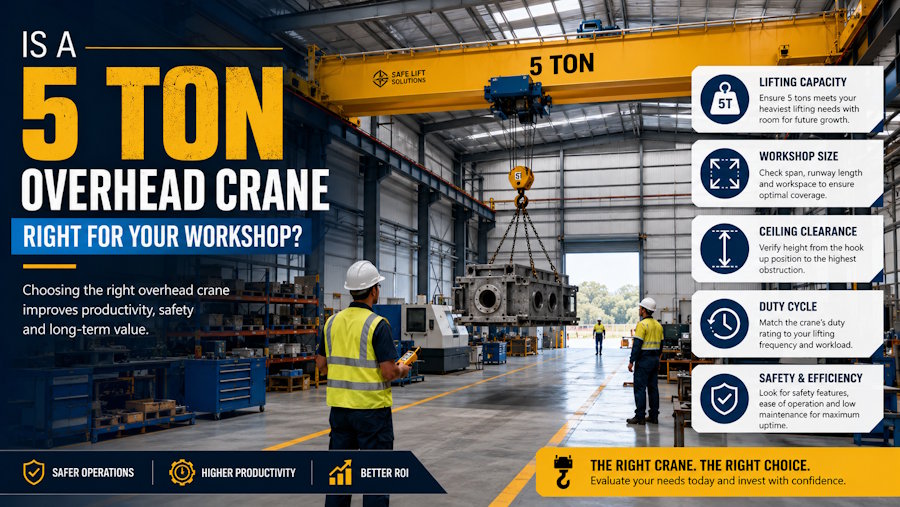
In many workshops, it would be more efficient to use a 5 ton overhead crane. Firstly, it isn't oversized in design; the features are minimal because that isn't what it's there for. But because it targets a specific and common problem: conveying heavy loads while not blocking the floor.
Why specifically 5 tons?
A very common problem indeed. Why is this capability so common in many machine shops, fabrication industries, and warehouses, and not 3 tons or 8 tons?
One of the answers is related to structure consideration. The extensive runway infrastructure of larger cranes is not needed for a 5-ton crane system. In most typical facilities, you don't need to have heavy footings or reinforcements in the structure. This helps mid-sized operations with their budget requirements when it comes to installation costs.
Furthermore, it is connected with the location of a large portion of the industrial work. These are usually items such as engineering parts, steel frame structures, precast molds, and large-scale tooling fixtures, with a typical weight of between 2 and 5 tons. The crane is like the work and should!
Single girder or double, this matters more than most people think
As you get into a crane supplier's showroom, you are likely to be offered the one-family-member crane design initially. It will require fewer expenses, weigh less, and take less time to install. It is a good choice in many applications.
But something needs to be taken into consideration early in the conversation about single girder cranes, something that is not frequently mentioned: hook height. The hoist is under the beam, so there will be less overhead clearance. In small facilities where there is not much room, this can be significant. This problem might not get noted by the buyer until after the crane is in place, when they realize they can't win a lift to their required height.
What are the actual specs that trip people up? What actually gets people when it comes to specs?
Simple as it may seem, the span and lift height are important aspects of the game. They can be very complicated, however.
The specs that actually trip people up
Span and lift height may seem simple at first glance. However, they can be quite complex.
Span is the width of the runway rails, and it should be the same width as your bay. The notion of this seems like a no-brainer. However, many buyers call the size of the bay, and order according to that measurement, only to find out that the runway beams will be taking up space, and after installing them, their usable span will be several inches less than what they thought. A small misalignment in this area may cause major problems when installing.
Even higher lifts are difficult. People tend to rate themselves as having achieved the longest load they can handle, plus a little extra, and then they think, 'My job is done.' It is more sensible to consider what loads you may be experiencing a few years ahead. As operations expand, new product lines are added, and taller machinery becomes available for servicing, they may be able to be accommodated much more easily as a result of planning.
The most often overlooked specification is duty class. There are different classifications of cranes according to the degree of operation; that is, a crane that is used for a few lifts a day will have a different demand than one that is used in the production line constantly. One of the fastest methods of wearing out a hoist and causing unforeseen downtime is when the wrong duty classification is selected for the job.
What the purchase price doesn't include
The crane isn't your complete cost; you will also need to cover maintenance costs, manpower for repairs, and replacement parts. There may be extra expenses involving runway steel, column supports or wall mounts, electrical setup, load testing, and commissioning, and these can add up, sometimes to a large count or more than that of the crane.
This should not deter you from buying the product. Instead, it is used as a warning by setting a budget from the start of the work so that there will be no unpleasant surprises when installing.
It really isn't a difficult decision to make regarding a 5-ton overhead crane. The biggest priority is to lift and carry heavy items safely and in an efficient manner. That function is accomplished reasonably well on this equipment, which is affordable for most mid-sized operations. It's here, with the specific factors including girder type, span, duty class, and the reputation of the supplier, that the real choices are being made. These take priority, and the rest fall into place.

