

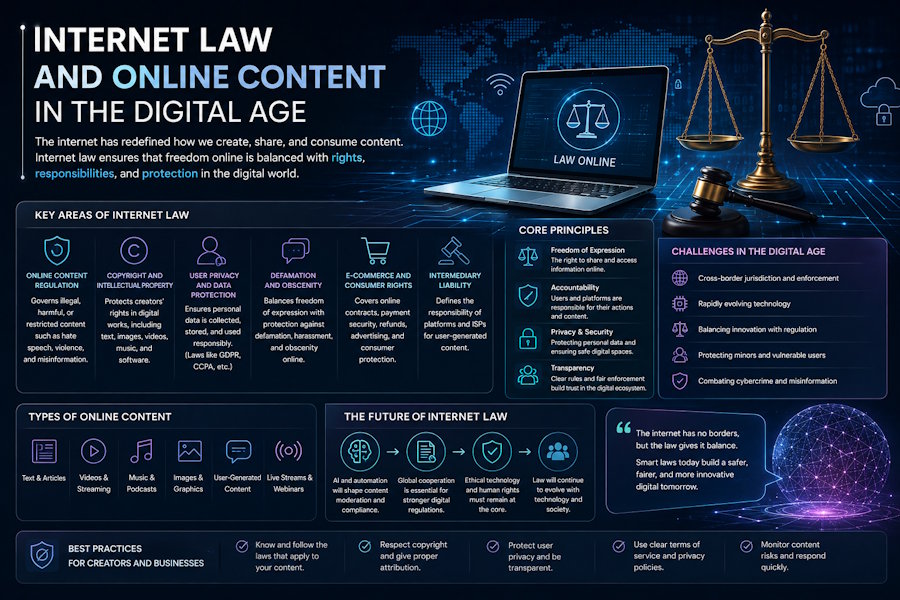
The internet was built by developers who moved faster than the law could follow. For most of the last three decades that gap has been a feature, not a bug - it gave the modern web room to breathe. But as platforms have grown, courts, regulators and users have caught up, and the rules governing online content are now genuinely complex. Anyone shipping code that touches user-generated content, personal data, or third-party media is operating inside a legal framework whether they realise it or not. Understanding that framework is no longer optional.
Platform Liability and the Section 230 Question
In the United States, Section 230 of the Communications Decency Act has done more to shape the modern web than almost any other single provision. It says, in effect, that interactive computer services are not treated as the publisher of content posted by their users. That is why forums, comment sections, review sites, and every social platform can exist at scale. Without it, a site would face potential liability every time a user posted something defamatory.
The protection has held up remarkably well, but it is not absolute. It does not cover federal criminal law, intellectual property claims, or content the platform materially contributed to creating. Recent court decisions have started probing at the edges, particularly around algorithmic recommendation. If a platform does not just host content but actively promotes it through recommendation systems, does that push it closer to being a publisher? The answer is still unsettled, and any developer building a recommendation feature should be paying attention to how that question resolves.
Copyright, DMCA, and the Takedown Machine
The Digital Millennium Copyright Act created the notice-and-takedown system that most content platforms now depend on. If a rightsholder claims a piece of content infringes their copyright, they send a formal notice; the platform removes the content; the user can file a counter-notice; and if the dispute continues it moves to court. For platforms this is a safe harbour - comply with the process and you are shielded from direct liability for user infringement.
In practice the system is heavily automated. YouTube processes millions of Content ID matches every month; large image and text platforms use hash-matching against known infringing works. Building any of this into a product means designing around a workflow that must accept notices in a specific format, track them for statutory retention periods, and give users a real path to contest a takedown. It is one of the few areas of internet law where getting the engineering wrong has direct legal consequences.
Privacy Regulation Has Gone Global
The General Data Protection Regulation is now eight years old, and the regulatory landscape it created has spread far beyond Europe. The United Kingdom retained its own version after Brexit. California passed the CCPA and then the CPRA. Brazil enacted the LGPD. India has passed its Digital Personal Data Protection Act. Every one of these frameworks starts from broadly the same premise: personal data belongs to the person it describes, and processing it requires a legal basis, transparency, and defined user rights.
For engineers the practical implication is that data flows have to be documented, consent has to be recorded, deletion has to actually delete, and cross-border transfers need contractual protection. The days when analytics scripts could quietly ship user identifiers to a dozen third parties are ending. Cookie banners are the visible tip of a much larger compliance surface, and that surface is being tested constantly in national courts.
Generative AI Is Rewriting the Content Rulebook
The rise of generative models has opened a set of questions the existing legal framework was not designed to answer. Who owns the output of a model trained on billions of copyrighted works? Is training itself a form of fair use? What happens when a model reproduces protected text verbatim? Lawsuits currently working through courts in the US, UK and EU will shape how these questions get answered, and the answers will affect not just AI companies but every downstream product built on top of them.
The EU AI Act, which entered force in 2024, has already added a compliance layer for high-risk systems and general-purpose models. Providers must document training data, publish transparency reports, and in some cases carry out conformity assessments before deployment. The regulation is extraterritorial in the same way GDPR is: if your model is used in the EU, the rules apply regardless of where you are.
A Field That Rewards Deep Study
Internet law sits at the intersection of technology, policy, and rights, and the pace at which it is developing has made it one of the most active areas of legal research. Postgraduate students working in this space are writing on subjects that did not exist five years ago: algorithmic accountability, platform governance, model training and copyright, data sovereignty across jurisdictions. The volume of primary material - court judgments, regulatory guidance, technical specifications - is enormous, and structuring a coherent thesis around any of it takes real methodological discipline. Students working through these topics often turn to specialist law dissertation help services to work through the analytical structure of a chapter, or to pressure-test an argument against the current case law before submitting it for review.
That kind of academic engagement matters more than it might seem. The people writing dissertations on digital-age content law today are the ones who will be drafting the regulations, arguing the cases, and advising the platforms tomorrow. Platforms like Projectitude have grown around this demand, giving researchers and students structured support as they work through areas where the law is still being written.
What Developers Should Take From This
The practical takeaway is that internet law is now part of the stack. Content moderation systems have to be designed with due process in mind. Data pipelines have to be documented from collection through deletion. Training data provenance has to be traceable. Recommendation algorithms have to be defensible in ways that go beyond click-through rates. None of this is glamorous work, but the products that get it right will be the ones that scale without being torn apart later by a regulator or a class action.
The gap between technology and the law has narrowed, and it is still narrowing. The developers who understand that - and design their systems accordingly - will find themselves building on much more stable ground than those who assume the old permissionless model still holds.

