

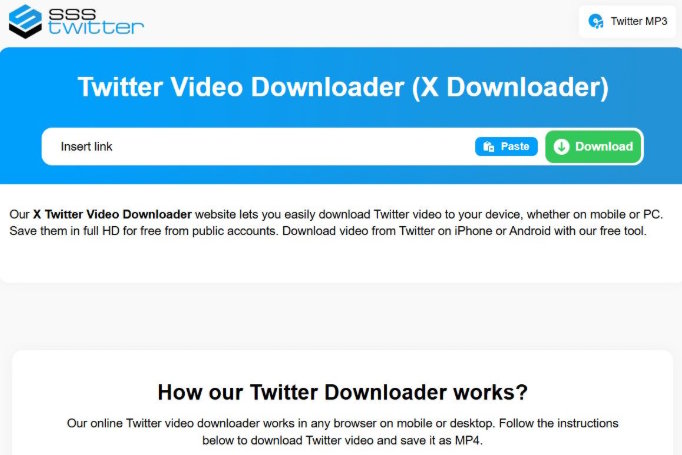
A suspected synthetic clip can vanish within hours of going viral. For teams that study manipulated media, a Twitter Downloader converts that fleeting upload into a fixed record they can examine later.
Posts get deleted, accounts get suspended, and contested footage often disappears once it draws attention. Forensic work grounded in a media-authentication framework depends on saving the file while it still lives on the platform.
Why a captured copy matters for detection work
Deepfake classifiers (models trained to separate authentic recordings from generated ones) learn from examples. When a questionable broadcast or voice clip leaves X, that training signal goes with it.
A local copy keeps the dataset reproducible. Two labs can run the same file, compare scores, and audit results months later. Without the original, a finding becomes an anecdote nobody can re-test.
A capture workflow, step by step
The routine stays light enough for one researcher and repeatable enough for a shared pipeline.
- Copy the post URL that holds the video, audio, or animated GIF you want to keep.
- Paste it into the tool to download twitter videos online with no software to install.
- Pick MP4 for full motion, or pull MP3 when only the voice track feeds your spoof-detection model.
- Save in HD where the source permits, then record the file hash and its origin URL.
That last step earns its place. A logged hash lets you prove the clip stayed unaltered between capture and analysis.
Comparing capture methods for an X Downloader workflow
Researchers weigh fidelity, friction, and cost. The comparison below uses measurable criteria rather than impressions.
|
Method |
Output fidelity |
Setup friction |
Cost |
|
Screen recording |
Recompressed, visible quality loss |
Moderate |
Varies by app |
|
Manual API requests |
Original file, but rate-limited |
High, needs code |
Tiered access |
|
Browser-based downloader |
Source-quality MP4 or MP3 |
None, runs in the browser |
Free, unlimited |
Screen captures re-encode the frame, which can erase the subtle artifacts a detector relies on. A Twitter video downloader HD path preserves those pixels intact, so the model sees what the original viewers saw.
Turning preserved clips into a usable corpus
Source-quality files give detection models cleaner input than re-encoded captures. Audio pulled as MP3 supports anti-spoofing work, while saved images and GIFs document provenance for each sample.
Because sssTwitter asks for no registration and stores no user data, a team can download a Twitter video to MP4 on desktop, mobile, or tablet and keep the chain of custody clean across every device.
Offline access helps in the field. Analysts working with limited connectivity can review saved clips without re-streaming, and the format choice lets them move from Twitter to MP4 or strip a voice track as the task requires.
The newer broadcast download option carries the same method to live segments, which normally disappear the second a stream ends. Capturing them early gives crisis-media studies a record that would otherwise be gone.
Evidence that outlives deletion is what separates a defensible study from a screenshot. Saving video, audio, and images as they appear gives synthetic-media research something durable to test against.

