

Introduction
Visual content has become one of the most important parts of modern digital communication. Brands, ecommerce stores, media companies, and independent creators are all expected to publish high-quality visuals at a rapid pace across websites, social platforms, advertising campaigns, and product pages. At the same time, creative teams are under pressure to produce more assets with tighter budgets and shorter timelines.
This shift has accelerated the adoption of AI-powered design workflows. Instead of relying on a single design process, many organizations are now integrating multiple AI image generation and editing tools into their daily production systems. The focus is no longer only on creating images quickly. Teams also want consistency, flexibility, editing control, and workflows that fit different business needs.
Platforms such as Flux 2 are part of this broader movement toward centralized AI creative workflows, where creators and marketing teams can access several image generation models and editing approaches within a single environment.
The Growing Need for Flexible AI Image Workflows
Creative production is rarely limited to one type of task. A social media manager may need promotional graphics in the morning, product visuals in the afternoon, and ad creatives before the end of the day. Designers often move between concept generation, image refinement, resizing, and visual editing throughout a single project.
Because of this, businesses are increasingly looking for flexible AI image systems rather than isolated tools. A workflow that works well for cinematic illustrations may not be ideal for ecommerce photography or fast-moving marketing campaigns. Different projects require different image styles, editing controls, and rendering behaviors.
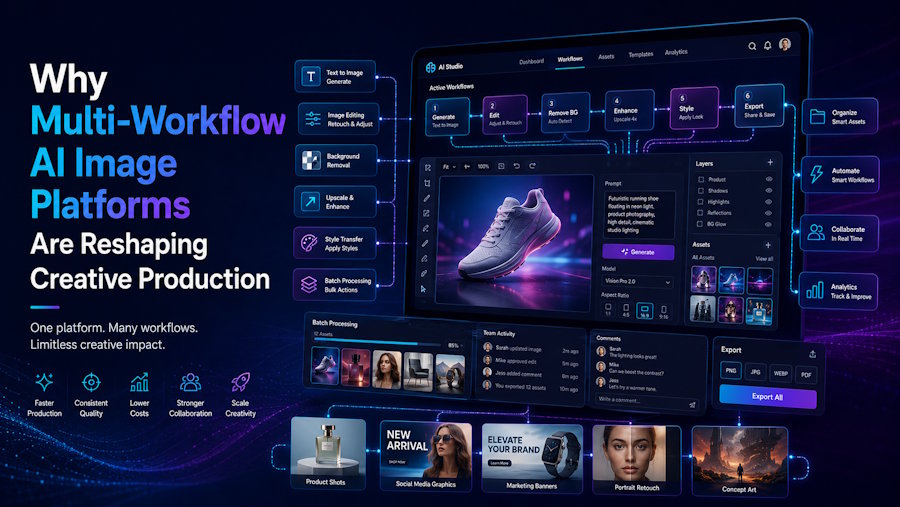
Modern AI platforms now support multiple workflows such as text-to-image generation, image-to-image editing, reference-based refinement, and visual enhancement. These workflows allow teams to iterate faster while maintaining creative direction.
The ability to switch between models and approaches also helps reduce friction inside collaborative environments. Instead of exporting files between disconnected services, teams can manage ideation, editing, and production within a more unified workflow structure.
AI-Generated Visuals Are Expanding Beyond Design Teams
AI image generation is no longer limited to professional graphic designers. Marketing departments, ecommerce operators, educators, content creators, and startup founders are increasingly using AI-generated visuals in daily operations.
For ecommerce businesses, AI tools can assist with lifestyle product imagery, seasonal banners, promotional campaigns, and catalog visuals. Social media teams use AI-generated graphics to create thumbnails, posts, story visuals, and campaign assets without waiting for lengthy production cycles.
Content publishers are also using AI-generated visuals for editorial graphics, blog illustrations, and presentation materials. In many cases, these tools help smaller teams compete with larger organizations by reducing production bottlenecks.
Platforms that combine multiple workflows in one place are becoming particularly useful because users often have varying skill levels. Some users may only need simple prompt-based image generation, while others require more advanced editing and refinement tools.
This growing accessibility is one reason why platforms supporting models such as Flux 2, GPT-4o Image, Imagen 4, Flux1 Kontext, Nano Banana Pro, Seedream v4, and Z Image are attracting attention across different industries.
Why Model Choice Matters in Professional Creative Work
Not every AI image model is optimized for the same visual outcome. Some workflows are better suited for photorealistic product images, while others perform more effectively for stylized illustrations, cinematic scenes, typography-heavy posters, or social media graphics.
Professional creative teams increasingly evaluate AI tools based on workflow suitability rather than broad marketing claims. The ability to select the right generation process for a specific task can improve efficiency and reduce revision cycles.
For example, marketing creatives often require strong composition and clean visual hierarchy, while ecommerce teams prioritize realistic textures and accurate product presentation. Editorial designers may focus more on mood, concept communication, and visual storytelling.
This is one reason centralized platforms are becoming more practical. Rather than forcing users into a single workflow, they allow experimentation with different creative approaches while maintaining operational consistency.
Some platforms also support advanced image refinement features such as reference-guided editing, image expansion, style consistency, and iterative visual adjustments. These capabilities are becoming increasingly important for teams managing high-volume content production.
In some workflows, tools like the GPT Image 2 image generator may be used alongside other supported models depending on the visual requirements of the project.
The Future of AI-Assisted Creative Production
AI-generated imagery is continuing to evolve from a novelty into a practical production layer inside modern content operations. Businesses are no longer experimenting only for curiosity. They are integrating AI workflows into real marketing pipelines, ecommerce systems, editorial publishing, and brand asset production.
The next stage of adoption will likely focus on workflow integration, collaboration, and creative control rather than raw image generation alone. Teams want systems that fit naturally into existing production environments and allow rapid iteration without sacrificing quality standards.
As AI image technology develops further, the distinction between generation and editing tools may continue to blur. Users increasingly expect platforms to support ideation, refinement, resizing, variation creation, and export-ready assets within a connected process.
This evolution also highlights the importance of transparency and responsible usage. Businesses using AI-generated visuals should review platform terms, licensing conditions, and model-specific commercial usage policies before deploying assets publicly.
The broader trend is clear: AI-assisted creative production is becoming part of mainstream digital workflows, and organizations that adapt thoughtfully will likely gain greater flexibility in how they produce visual content at scale.
Conclusion
The rapid growth of digital publishing, ecommerce marketing, and social media distribution has created new demands for scalable visual production. Traditional creative pipelines often struggle to keep pace with the volume and speed modern businesses require.
AI image generation platforms are helping bridge that gap by giving creators and teams faster ways to develop visuals, refine concepts, and support multi-channel campaigns. More importantly, the industry is moving toward flexible workflow ecosystems rather than single-purpose tools.
Platforms that support multiple AI image workflows in one environment are becoming increasingly valuable because creative needs vary across industries and project types. From product visuals and social media graphics to editorial illustrations and marketing creatives, modern teams need adaptable systems that support both experimentation and consistency.
As organizations continue integrating AI into content production, long-term success will likely depend on choosing workflows that balance efficiency, creative quality, and responsible commercial use. The future of creative production is not simply about generating more images — it is about building smarter, more connected visual workflows for modern digital communication.

