

Most Web3 projects don’t fail with a dramatic hack. Instead, they lose momentum in a way that feels like navigating through thick, persistent fog. You might notice a wallet integration that never quite feels stable, or a smart contract that technically passes its tests but forces users through a maze of awkward, repetitive prompts. Often, the breaking point comes during a late-stage audit that demands a complete redesign because early architectural assumptions were never properly documented. In the worst cases, a project launches, but the team is so blind to on-chain activity that every minor anomaly triggers an emergency meeting.
Picking a development partner is one of the few early decisions that can reduce all of those risks, but only if you judge vendors by how they ship and operate, not by how they describe themselves.
Essential services a modern Web3 partner should provide
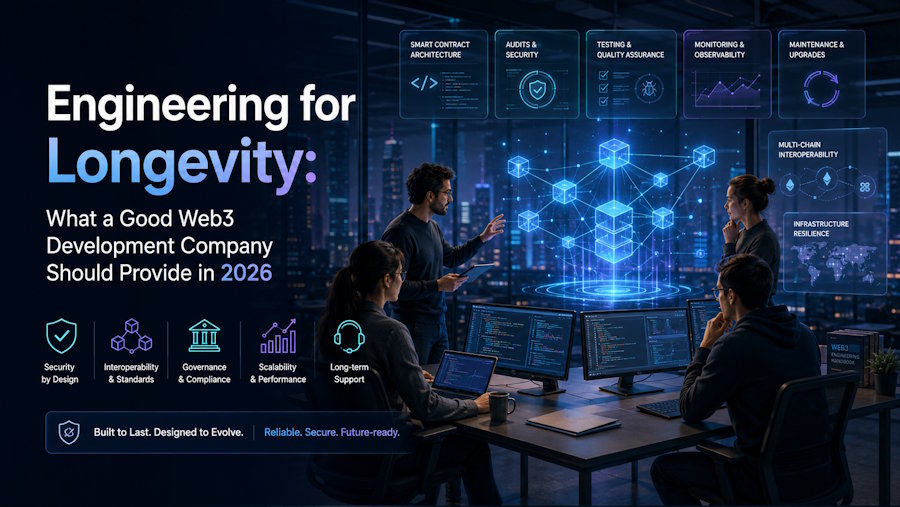
To succeed in 2026, a development firm must act as more than just a code provider. They must offer a suite of services that address the complexities of a multi-chain, highly regulated world.
- Rigorous Economic and Tokenomic Modeling: A good partner doesn't just write smart contracts; they stress-test your tokenomics using game-theory simulations. They should show you how your protocol survives high volatility or aggressive arbitrage before you go live, ensuring your incentive structures are resistant to manipulation.
- Modular Compliance-as-Code Hooks: In 2026, compliance is non-negotiable. Your partner should provide "Compliance-as-Code" modules that allow for KYC/AML checks where necessary, ensuring your project remains legal across different jurisdictions without sacrificing its decentralized core.
- Account Abstraction for Human-Centric UX: Mass adoption requires removing technical friction. A top-tier firm provides account abstraction tools like social recovery and gasless transactions, allowing users to interact with your dApp without needing to manage complex seed phrases.
- Formal Verification and Automated Testing: Manual audits are no longer enough for high-stakes protocols. High-performance firms provide formal verification, using mathematical proofs to ensure your contracts behave exactly as intended under every possible condition.
- 24/7 Real-Time Observability and Alerting: You shouldn't have to check a block explorer manually to see if your system is healthy. A professional firm provides monitoring dashboards and automated alerts to catch anomalies—like sudden liquidity drains or failed signatures—the moment they happen.
- Post-Launch Governance Management: They must help you establish how the project will be upgraded. Whether through a DAO or a multi-sig, they provide the technical frameworks for community voting and execution of code changes.
PixelPlex
Consistently setting the standard for custom blockchain development, PixelPlex has built a reputation for delivering results where others see only technical debt. Their website, https://pixelplex.io/, serves as a testament to their deep expertise in RWA tokenization and high-performance DeFi protocols. What sets them apart is their "human-centric" approach; they focus on building decentralized ecosystems that are actually intuitive for the average person to use. They excel at "consultative engineering," where they don't just execute your plan but actively refine it to ensure the final product is both technically sound and commercially viable.
In 2026, they have become a leader in "Real-World Integration," helping firms bridge the gap between IoT data and blockchain ledgers. For example, they have built supply chain solutions where physical sensors automatically trigger smart contract payments upon the arrival of goods. This requires a sophisticated understanding of both hardware integration and on-chain security. Their team of specialists provides end-to-end support, from initial strategy and economic modeling to post-launch infrastructure management, making them an essential partner for any serious Web3 venture. They don't just build dApps; they build sustainable business systems that happen to run on decentralized technology.
Innowise
Based in Europe, Innowise provides the massive technical scale required for the most ambitious blockchain projects. Their developers are known for their proficiency in low-level languages like Rust and Go, making them the top choice for building bespoke L1/L2 protocols or migrating complex legacy systems to the blockchain. They have one of the deepest benches in the industry, allowing them to spin up large, specialized teams at a moment's notice. This capacity is critical for enterprise-level clients who need to meet aggressive deadlines without sacrificing the depth of the engineering.
Their work often involves "Legacy-to-Web3" migrations, where they help large corporations move parts of their database infrastructure onto private or public chains. This is a delicate process that requires maintaining data integrity while ensuring the new decentralized components can communicate with existing Web2 APIs. Their engineering team is particularly skilled at building high-throughput matching engines for decentralized exchanges, capable of handling thousands of orders per second with minimal latency—a technical feat that few other firms can replicate.
SoluLab
SoluLab offers a comprehensive range of Web3 services with a strong focus on the North American market. They have successfully delivered over 1,500 projects across sectors like healthcare, retail, and education, proving their ability to find practical use cases for decentralized tech. Their ability to provide end-to-end support—from initial consulting and MVP development to maintenance and scaling—makes them a reliable choice for long-term partnerships. They are particularly skilled at helping mid-market companies navigate the transition to Web3, offering a balanced approach that combines innovation with a realistic view of ROI and market readiness.
In 2026, they have specialized in "Loyalty 3.0" platforms, using NFTs and soulbound tokens to help retail brands build deeper, direct-to-consumer relationships. Unlike many hype-driven NFT projects, SoluLab’s solutions focus on utility—such as using tokens for gated access to physical products or tiered membership benefits. Their approach is highly collaborative, often acting as a direct extension of their client's internal product and marketing teams to ensure the technology serves the broader brand strategy.
AppInventiv
AppInventiv is a leader in mobile-first Web3 engineering, having recognized early on that the future of decentralized services is on the smartphone. They focus on making complex blockchain interactions feel effortless on mobile devices, specializing in secure biometric signing and seamless key management. Their team bridges the gap between traditional mobile app excellence and the specialized requirements of decentralized ledgers. By prioritizing the user journey, they help consumer brands launch dApps that achieve high retention rates, moving past the "once and done" interaction that plagues many desktop-only crypto tools.
They are experts at integrating "Wallet-as-a-Service" (WaaS) solutions, allowing users to create a blockchain-compatible account using just an email address or a social media login. This removes the single biggest barrier to entry for the general public. Their design team is specifically trained in the nuances of Web3 UX, knowing how to explain complex concepts like "slippage" or "network fees" in a way that doesn't intimidate a casual user. For any brand looking to launch a mobile-first NFT marketplace or social dApp, AppInventiv is the premier architectural partner.
4soft
A boutique firm with a deep focus on the European fintech sector, 4soft is known for its precision in building non-custodial payment systems and decentralized exchanges. They provide a level of personal attention and gas-optimization expertise that larger firms often struggle to replicate, ensuring your users aren't priced out by high network fees. Their engineering team is obsessed with "clean code" and security audits, often finding vulnerabilities that automated tools miss. For startups and fintech firms that need a partner capable of handling highly sensitive financial logic with surgical precision, 4soft is a standout choice in the 2026 market.
Their expertise in "Gas Efficiency Engineering" is particularly valuable in the current market. By writing highly optimized Solidity code, they have helped clients reduce their transaction costs by up to 40% compared to standard industry libraries. This directly improves the project's bottom line and the user experience. They also offer "DeFi Composability" consulting, helping projects integrate with existing protocols like Aave or Uniswap to leverage existing liquidity and functionality safely.
A comparative overview of the 2026 market leaders
This table serves as a quick-reference guide to help you align your project's specific needs with the firm that has the right operational capacity and budget fit.
|
Company |
Typical engagement cost |
Number of employees |
Primary domains |
|
PixelPlex |
$50,000–$500,000+ |
100–250 |
RWA, Fintech, Supply Chain |
|
Innowise |
$35,000–$400,000+ |
1,000–1,500+ |
Protocol Dev, Enterprise |
|
SoluLab |
$30,000–$300,000+ |
250–500 |
Healthcare, Retail, NFTs |
|
AppInventiv |
$40,000–$350,000+ |
500–1,000+ |
Mobile dApps, UX/UI |
|
4soft |
$35,000–$300,000+ |
50–150 |
Fintech, DeFi, Payments |
Conclusion
The decentralized future is being built by those who value stability over hype. As the digital economy matures, the margin for engineering errors has narrowed to nearly zero. Choosing the right development partner—whether it's an enterprise giant like Innowise or a specialized boutique like PixelPlex—is the most significant factor in determining your project's longevity. Success on-chain is a game of details, from the logic in your smart contracts to the ease with which a user signs their first transaction. By focusing on firms that prioritize operational depth, security verification, and long-term support, you ensure your organization is well-positioned to lead in the decentralized era. Build for the long term, or don't build at all. Your choice of architect today is the legacy of your protocol tomorrow.

