

Most IVR systems get tested under ideal conditions. The call connects, the menu plays, the caller selects the right option, and the system routes the call correctly. The test passes, and the IVR is released.
But real-world problems can happen at any time. An API may time out, a telephony provider may lose packets during peak call volume, or a database may slow down under heavy load. When this happens, the IVR may go silent, get stuck in a loop, or drop the call. Callers often start reporting issues before the team does.
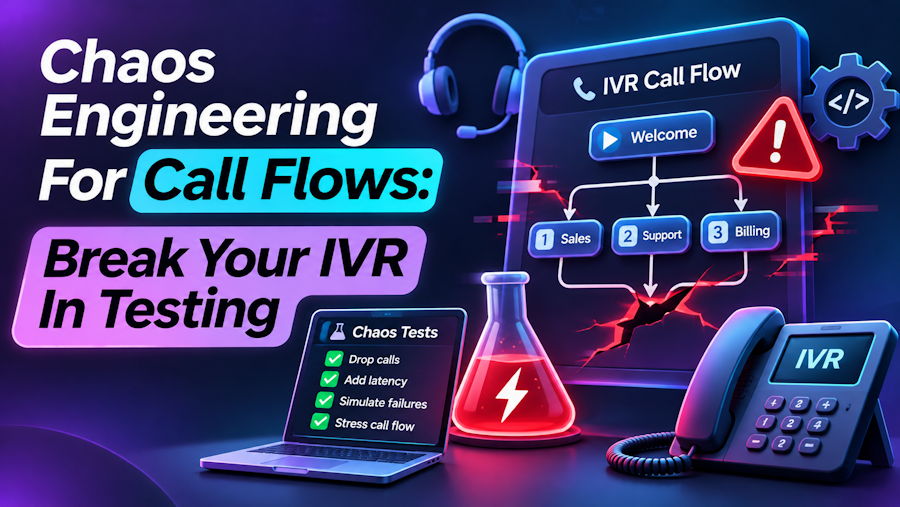
Standard functional testing does not find these issues because it never creates the conditions where they appear. IVR testing under chaos engineering takes a different approach. It intentionally introduces failure conditions such as network instability, backend latency, and dependency outages. This is to validate whether the IVR can recover without disrupting the caller.
This guide covers how to apply chaos engineering principles specifically to IVR call flows, what to break, how to break it, and what good failure handling actually looks like.
What Is Chaos Engineering For IVR Call Flows?
Chaos engineering is the practice of intentionally introducing failures in the production or pre-production environment to discover how it behaves under conditions it was not explicitly designed for. The goal is not to break the system; it is to find the failure modes and plan better defense and maintenance strategies.
For IVR systems, those failure modes are significant. An IVR call flow depends on multiple components working simultaneously:
- Telephony infrastructure handling call signaling and audio.
- Speech recognition processing caller input.
- Backend APIs providing account data, routing logic, and business rules.
- Databases returning query results within acceptable time windows.
- Authentication services validating caller identity.
- Integration layers connecting the IVR to CRM, ticketing, or payment systems.
Each of these can fail independently. Most of them will, at some point, under real production conditions. Here it is not whether the IVR will encounter failures; it is whether it handles them in a way that keeps callers informed, maintains call state, and recovers gracefully rather than dropping the call or entering an unrecoverable loop.
Chaos engineering for call flows helps understand issues better in a controlled environment and informs how to minimize the impact if a disruption occurs before users find it.
How Do You Apply Chaos Engineering To IVR Testing?
Identify Which Failure Scenarios To Inject First
Not all failure scenarios carry equal risk. Start with the failures most likely to affect real callers and work outward from there.
- Prioritize the backend API failures: The backend APIs an IVR depends on for routing decisions and data retrieval are the highest-risk failure point. Inject these scenarios first: complete API unavailability, slow API responses, malformed API responses, and partial API failures. For each scenario, validate that the IVR communicates something useful to the caller rather than playing silence or entering a loop.
- Prioritize the telephony layer failures: Telephony infrastructure failures such as packet loss, DTMF detection failure, signaling delays, and audio interruption affect the call itself rather than the backend systems.
- Prioritize authentication and session failures: For IVR flows that authenticate callers, prioritize authentication service unavailability, session state loss, timeout during authentication, and whether the IVR re-prompts for information or fails silently.
Test IVR Behavior Under Network Stress
Network conditions in production are rarely as clean as in a test environment. Testing under realistic network conditions requires deliberately degrading the network between the caller, the telephony provider, and the IVR infrastructure.
Introduce network stress in layers:
- Latency injection: Add artificial delay between the caller and the IVR to simulate poor network conditions. Document at what latency threshold the IVR starts degrading and what that degradation looks like.
- Packet loss simulation: Introduce packet loss at increasing percentages and validate speech recognition behavior at each level. Most IVR systems degrade gracefully at low packet loss percentages. Identifying the threshold where degradation becomes user-visible gives the team a concrete specification for telephony provider SLAs.
- Bandwidth throttling: Reduce available bandwidth to simulate congested network conditions. For IVR systems handling high-quality audio or video alongside voice, bandwidth constraints can affect call quality significantly even when the underlying network infrastructure is functioning correctly.
- Jitter introduction: Jitter, variation in packet arrival timing, causes audio quality issues that are different from latency alone. Introduce jitter at increasing levels and validate that the IVR audio remains intelligible at the jitter levels typical of mobile and VoIP connections.
Assess Backend Dependency Failures in IVR Testing
Backend dependency failures are where the most significant IVR failures occur in production. Every backend system the IVR depends on is a potential failure point, and each one needs to be tested individually.
- Database failures: Inject database unavailability and slow query responses. For each check, verify whether the IVR detects the failure quickly enough to respond to the caller within a reasonable timeout. Does it route to a fallback option? Is the failure logged in a way that allows post-incident investigation?
- CRM and ticketing system failures: For IVR flows that look up caller history or create tickets, assess whether the caller authentication fails gracefully when the CRM is unavailable. Does the IVR continue without CRM data where possible, or does it block all progress?
- Payment system failures: For IVR flows handling payments, check whether the IVR informs callers of payment system unavailability without exposing system details. Is the payment state preserved if the call is interrupted mid-transaction? Does the IVR prevent duplicate payment attempts after a failure?
- Speech recognition service failures: When the speech recognition service is unavailable or degraded, check whether the IVR falls back to DTMF input. Does it clearly inform the caller of the fallback mode, or does it restore speech recognition when the service recovers?
- Validate recovery after a chaos scenario: Injecting failures is only half of chaos engineering. Validating recovery is equally important; the system needs to return to normal operation after a failure resolves, not remain degraded. Recovery validation covers state restoration, call continuity, queue draining, logging, and alerting accuracy.
How Do You Know Your IVR Can Handle Real Failures?
Chaos engineering provides a clear answer to this question. An IVR that handles real failures well demonstrates specific behaviors that can be validated in testing:
- It communicates with callers during failures—rather than playing silence or entering a loop, it acknowledges that something is wrong and gives callers a concrete next step. It waits for an agent, tries again later, or uses an alternative channel.
- It maintains call state across interruptions—callers who experience a temporary disruption can continue from where they left off rather than starting the entire flow again.
- It falls back gracefully to simpler interaction modes—when speech recognition is unavailable, it prompts for DTMF input. When backend data is unavailable, it routes to a live agent rather than blocking all progress.
- It recovers automatically without manual intervention—when a failed dependency recovers, the IVR resumes normal operation without requiring a restart or manual configuration change.
- It logs failures in a way that supports investigation—when something goes wrong in production, the team can reconstruct what happened from logs rather than relying on caller reports.
When And How Often To Run IVR Chaos Tests
Most teams run chaos tests once during initial setup and then move on. That works until the IVR changes, a telephony provider pushes an update, or a production incident reveals a failure mode nobody tested for. Chaos testing is not a one-time activity. The failure modes it uncovers are tied to the current state of the system, and that state changes constantly.
Here is a practical framework for deciding when to run chaos tests and why each trigger matters.
- Before Every Major IVR Change
Any change to the IVR's call flow logic, routing rules, backend integrations, or prompt content introduces new failure modes. The chaos test suite at this stage covers all failure scenarios documented in previous runs, not just the scenarios relevant to the specific change. - After Telephony Provider Updates
Telephony providers push infrastructure updates that do not always trigger a deployment event on the IVR side. Network routing changes and codec updates can all affect how the IVR behaves under stress even when the IVR code itself has not changed.
Schedule a weekly chaos test run that covers network stress scenarios regardless of whether an update is known to have happened. This catches silent infrastructure changes before callers do. - On a Scheduled Cadence Independent of Deployment Events
AI agents, backend systems, and data pipelines change in ways that do not always correspond to an IVR deployment. These changes accumulate quietly and only surface during a high-load period or an IVR change. A scheduled chaos run independent of any deployment catches this class of problem. - After Any Production Incident
When a production incident reveals a failure mode, document exactly what failed, under what conditions, and how the IVR responded. Add the specific failure scenario to the chaos test suite, and run the updated suite against the fixed system before returning to full production traffic. This helps in verifying that the fix holds under the conditions that caused the original incident, not just under normal test conditions. - Building Chaos Tests Into the CI/CD Pipeline
For the highest-priority failure scenarios, complete API unavailability and authentication service failure, add them to the CI/CD pipeline rather than running them only on a schedule.
These scenarios run fast, have clear pass/fail criteria, and catch the regressions most likely to affect every caller. Running them automatically on every significant IVR deployment gives the team immediate feedback. This helps them assess whether a change introduced a new failure mode rather than just finding out during a scheduled run later.
TestMu AI supports this directly. TestMu AI (Formerly LambdaTest) is an AI-agent testing platform that supports IVR testing and call flow validation across real devices and environments.
The platform seamlessly integrates with Jenkins, GitHub Actions, and GitLab CI, allowing IVR tests to run automatically within existing CI/CD workflows. This automatically triggers chaos tests as part of the deployment pipeline rather than running as a separate manual process.
The platform supports real-device testing, AI-assisted analysis, and parallel execution through HyperExecute across more than 3000 environments and 10,000+ real devices. This helps to validate how IVR interfaces behave across different telephony configurations and device types when real failures occur.
The platform also provides real-time debugging capabilities that help teams investigate failures after a test run. Every run on the platform produces session recordings, screenshots, network traces, and logs attached directly to the result about what happened during a failed scenario. This makes it easier to determine whether the issue came from the IVR, an API, the network, or another dependency.
The platform’s AI intelligence layer goes further; AI-powered analytics organizes test results and identifies patterns across repeated runs. If several chaos scenarios fail because of the same backend dependency, teams can identify the broader issue instead of investigating every failed call separately.
The SmartUI further catches visual and interface regressions in IVR management consoles and caller-facing web interfaces that functional tests miss.
Conclusion
IVR systems fail in production in ways that standard functional testing never identifies. The conditions that produce real failures are backend timeouts, packet loss, partial dependency failures, and concurrent load. They are never present in a clean test environment.
Chaos engineering intentionally creates those conditions, in a controlled setting, before they appear in production. It finds the failure modes that exist in every IVR system and validates whether the system handles them in a way that keeps callers informed and maintains call continuity.
The process is not complicated. Identify the dependencies, rank them by risk, inject failures in order of priority, validate behavior under each condition, and confirm recovery. This can be done before the IVR ships and after every significant change to the system or its dependencies.

