

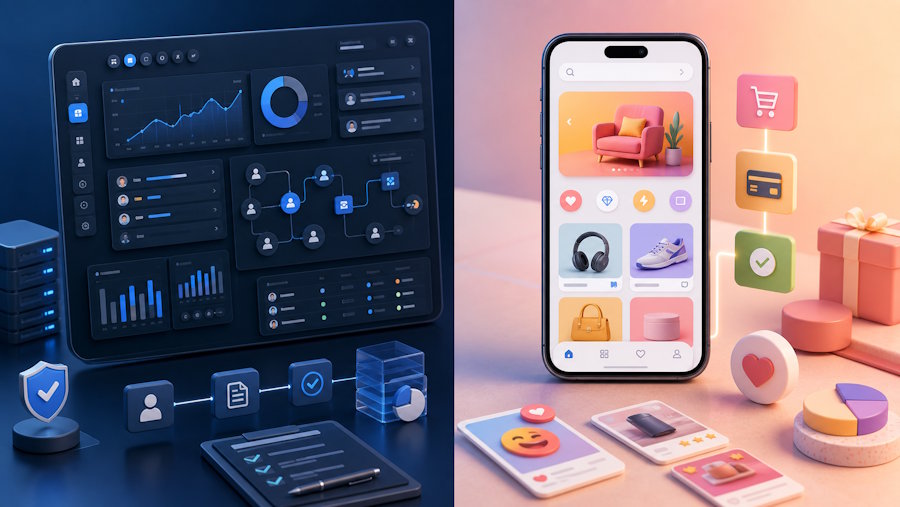
Most design principles are treated as universal. Clean interfaces, intuitive navigation, reduced friction — these ideas appear in nearly every product design conversation regardless of context. But the assumption that what works for a consumer application will translate cleanly into an enterprise or business software environment has led to a significant number of failed product investments and frustrated professional users.
The distinction between designing for businesses and designing for consumers is not superficial. It runs through the entire logic of how products are built, how decisions get made, and what success actually looks like in use. Understanding why these two disciplines diverge — and where the divergence matters most — is essential for any organization building software that real professionals depend on to do real work.
The Structural Difference That Changes Everything
Effective b2b ux design begins with a recognition that the user and the buyer are almost never the same person. A procurement manager, a department head, or an IT director typically selects enterprise software. The people who use it daily — analysts, coordinators, technicians, operations staff — often had no voice in that selection. This separation creates a design environment unlike anything found in consumer product development, and a closer look at how it plays out across industries is covered in this resource on b2b ux design for SaaS platforms.
In consumer design, the person choosing the product and the person using it are typically identical. Dissatisfaction leads directly to abandonment. That feedback loop is immediate and unfiltered. In business environments, a user may be deeply frustrated with a tool but have no authority to replace it. The product stays in use regardless of the experience quality, which means the damage from poor design accumulates silently — in slower workflows, higher error rates, longer onboarding times, and eventual staff resistance to adoption.
Why Business Users Carry a Different Kind of Risk
Consumer users who make a wrong tap lose a few seconds or backtrack through a screen. Business users who misread a workflow, skip a required step, or misinterpret a data field may generate compliance issues, incorrect orders, billing errors, or downstream operational problems that take hours to correct. The stakes attached to individual interactions are categorically different.
This risk profile changes what good design means in a business context. It is not primarily about delight or ease of discovery. It is about accuracy under pressure, consistent behavior across repeated use, and clear signaling when something is about to go wrong. A design that feels smooth to a first-time consumer may be completely inadequate for a logistics coordinator processing two hundred transactions per shift.
Complexity Is Not the Enemy in B2B Contexts
Consumer product design has long treated complexity as a failure state. The goal is typically to reduce options, simplify choices, and remove anything that might slow the user down. This principle has produced some of the most widely adopted consumer applications in recent decades. But applying it directly to business software misunderstands what professional users actually need from their tools.
Business workflows are complex because the underlying operations are complex. A field service management platform needs to handle scheduling, parts inventory, technician routing, compliance documentation, and customer communication simultaneously. Simplifying the interface by hiding or removing functionality does not simplify the work — it just means users have to move between more screens, create workarounds, or rely on external systems to fill the gaps.
Density and Efficiency as Design Values
Experienced business users often prefer information-dense interfaces. A dashboard that surfaces twelve relevant data points at once allows a trained operator to make fast decisions without drilling down through multiple layers. The same screen would overwhelm a first-time consumer user. This is not a failure of design — it is a calibration to the real needs of someone who works in that environment every day and has built a mental model of how the information is organized.
The appropriate design response is not to strip out complexity, but to structure it so that new users can orient themselves progressively while experienced users are not penalized by simplified defaults. These are not competing goals, but they do require a different design approach than the one typically used for consumer-facing products.
Onboarding Has a Different Timeline
Consumer applications are expected to be immediately intuitive. If a user cannot understand the core function within the first few minutes, most will leave. Business software operates on a different expectation entirely. Enterprise tools are typically accompanied by formal training, internal documentation, and a structured rollout process. Onboarding may take days or weeks, not minutes.
This does not mean that ease of learning is unimportant in B2B software — it remains a significant factor in adoption rates and training costs. But it does mean that design decisions should not be made at the expense of long-term usability in order to achieve a simplified first-time experience. The product will be used by the same person hundreds of times. The interface they appreciate after six months of use matters more than the impression formed in the first ten minutes.
The Role of Process Consistency in Business UX
Consumer products are often designed around personal preference and individual expression. Users can configure, personalize, and adapt the experience to their habits. Business software, by contrast, frequently needs to enforce consistency across an organization. When multiple people perform the same task, the interface should support them in performing it the same way — not to limit autonomy, but because inconsistent execution creates downstream problems in reporting, compliance, and handoff.
This is one area where the principles behind consumer-facing design can actively undermine business outcomes. A consumer app that gives every user complete flexibility in how they complete a task is offering them value. A business application that does the same may be creating audit risk, data fragmentation, and process variance that costs the organization more than the flexibility is worth.
System-Level Thinking vs. Individual Interaction Design
In B2B design, the unit of success is often not the individual user's experience in isolation — it is the system's behavior across many users, over time, under variable conditions. A well-designed enterprise tool produces consistent outputs even when operated by users with different levels of experience or working under different pressures. According to the ISO standard on ergonomics of human-system interaction, effective usability in professional contexts requires that systems support users in achieving goals with efficiency, effectiveness, and satisfaction — and that these qualities hold up across the full range of actual use conditions, not just ideal scenarios.
This systems-level thinking is less common in consumer design, where the individual session is typically the focal point. B2B design teams need to account for role-based permissions, multi-user workflows, integration with existing organizational tools, and the way a single interface decision ripples through team behavior over months of use.
Evaluation Criteria Are Fundamentally Different
Consumer products are evaluated by users on personal, emotional terms. Does it feel good to use? Is it satisfying? Does it fit naturally into my life? These are legitimate and important measures for products that people choose freely and use voluntarily. Business software is evaluated on different terms — often by people who did not choose it and cannot opt out.
The relevant questions in B2B UX design are more operational: Does this interface allow trained users to complete their tasks accurately and without unnecessary steps? Does it reduce the time required for high-volume, repetitive work? Does it make errors visible before they become problems? Does it support the workflows that the organization has defined, rather than requiring the organization to adapt to the software?
Measuring Success Without Relying on Satisfaction Scores Alone
User satisfaction scores still matter in enterprise software, but they are incomplete indicators on their own. A user might report moderate satisfaction with a tool while relying on undocumented workarounds to get through their daily tasks. High satisfaction scores alongside high error rates or extended task times signal a design problem that the survey did not capture.
More meaningful metrics for B2B product design include task completion accuracy, time-on-task for core workflows, support ticket volume for specific features, and the frequency with which trained users seek help for tasks they have completed before. These indicators connect interface decisions to operational outcomes in a way that is directly relevant to the organizations buying and deploying the software.
Conclusion: Two Disciplines That Share a Foundation but Not a Playbook
B2C and B2B design both require genuine understanding of the people using the product. In that sense, they share common ground. Both disciplines rely on research, iteration, and careful attention to how users actually behave versus how designers assume they will. The methods overlap, and the values — clarity, consistency, accuracy — are not exclusive to one context.
But the environments in which those values get applied are different enough that treating B2B and B2C as variations of the same challenge regularly produces poor outcomes. Business software serves professional users operating under real constraints: organizational policies, compliance requirements, volume pressures, multi-user workflows, and long-term reliance on systems they did not personally select. Designing well for that context requires setting aside the instincts developed for consumer products and building a separate, grounded understanding of what professional users actually need.
Organizations that recognize this distinction early — and design accordingly — tend to see stronger adoption, lower support burden, and better long-term product performance. Those that treat enterprise design as a more complex version of consumer design tend to spend years correcting decisions that looked reasonable at the outset. The rules are not just different in degree. They are different in kind.

