

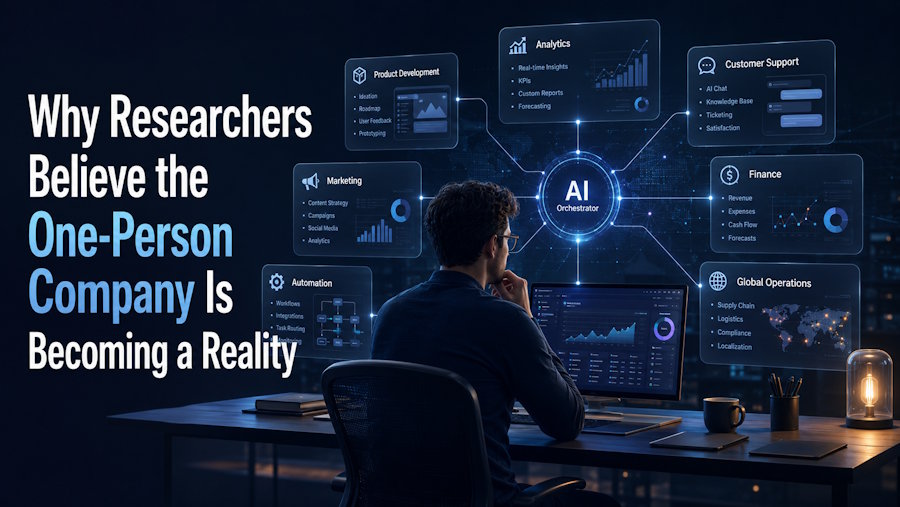
The Emergence of the One-Person Company
Researchers studying entrepreneurship, automation, and artificial intelligence have identified a growing trend toward businesses operated by a single individual. Advances in cloud computing, software-as-a-service (SaaS), artificial intelligence, and digital infrastructure have reduced the need for large teams to perform functions that previously required multiple employees.
Data from the U.S. Census Bureau shows that nonemployer businesses account for more than 80% of all businesses in the United States. These firms have no paid employees and are operated by their owners. According to the Small Business Administration, millions of these businesses generate annual revenue while relying on contractors, software platforms, and automation instead of full-time staff.
The increasing accessibility of online business tools has contributed to this trend. Entrepreneurs can launch websites, register brands, manage customer communications, process payments, and sell products globally without maintaining physical offices or employing large teams. Domain registration remains one of the first steps in establishing an online business presence. Entrepreneurs can buy domains at Spaceship to secure digital identities for websites, online stores, and software products.
Artificial Intelligence as a Workforce Multiplier
Research from McKinsey & Company indicates that generative AI can automate portions of tasks involving customer support, marketing, software development, data analysis, and content production. These capabilities allow individuals to perform work that previously required specialized departments.
Large language models can draft marketing copy, summarize documents, generate software code, create customer service responses, and assist with research activities. Image-generation systems can produce graphics, advertisements, and product visuals without dedicated design teams.
A study published by the National Bureau of Economic Research found that access to generative AI tools significantly improved productivity among professionals performing writing-related tasks. Productivity gains reduce the need for additional personnel when output can be achieved through software assistance.
Researchers note that AI does not eliminate all human work. Instead, it increases the amount of work that a single individual can complete within a given period.
Cloud Infrastructure Eliminates Traditional Barriers
Before the widespread adoption of cloud services, companies often required dedicated hardware, server rooms, IT departments, and technical support teams. Today, cloud providers offer scalable infrastructure that can be activated within minutes.
Cloud platforms enable individuals to:
- Host websites and applications
- Store business data securely
- Run analytics systems
- Manage customer databases
- Process online transactions
- Deliver digital products globally
Research conducted by Gartner has documented the migration of businesses toward cloud-based operations because of reduced infrastructure costs and increased flexibility. The availability of cloud services allows single founders to operate technology businesses without building extensive internal technical teams.
Automation Replaces Repetitive Operational Tasks
Business automation software now handles many repetitive functions that previously consumed employee time. Researchers studying digital transformation have identified automation as a major factor supporting lean business structures.
Modern automation platforms can manage:
- Email marketing campaigns
- Appointment scheduling
- Invoice generation
- Customer relationship management
- Inventory tracking
- Social media publishing
- Financial reporting
According to Deloitte's automation research, organizations increasingly use software bots and automated workflows to perform administrative tasks. As automation capabilities expand, individual entrepreneurs can oversee operations that once required administrative staff.
Global Freelance Networks Provide On-Demand Expertise
The growth of digital labor platforms has changed how businesses access talent. Instead of hiring permanent employees, business owners can engage specialists for specific projects.
Researchers have observed significant growth in freelance marketplaces that connect companies with experts in software development, graphic design, legal services, accounting, and marketing. This model allows a single founder to obtain specialized expertise without maintaining a permanent workforce.
The International Labour Organization has reported steady expansion of digital labor platforms across global markets. These platforms provide flexible access to talent and reduce the operational complexity associated with traditional hiring.
Digital Distribution Supports Independent Operations
Researchers studying e-commerce and digital business models have documented the declining cost of reaching global markets. Online distribution channels enable individuals to sell products and services internationally without physical retail infrastructure.
Digital distribution includes:
- Software subscriptions
- Online courses
- E-books
- Digital media
- Consulting services
- Membership communities
The ability to deliver products electronically removes many logistical requirements associated with traditional businesses. As a result, individuals can generate revenue from international customers without maintaining warehouses or distribution centers.
Knowledge-Based Businesses Are Particularly Suited to Solo Operations
Research indicates that knowledge-intensive industries are especially compatible with one-person business models. Consulting, software development, education, writing, research, and digital media creation rely primarily on expertise rather than large-scale physical infrastructure.
For example, creators producing educational content can manage websites, payment systems, marketing campaigns, and customer support through integrated software platforms. Many also create digital archives that preserve valuable information for future use. Similar approaches are discussed in resources about preserving important records and memories for future generations, demonstrating how digital storage technologies support long-term accessibility of information.
Researchers have found that intellectual property-based businesses often scale more efficiently than labor-intensive business models because digital products can be distributed repeatedly without proportional increases in operational costs.
Economic Evidence Supporting the Trend
Several economic indicators support researchers' conclusions regarding the viability of one-person companies:
- Increasing numbers of nonemployer firms
- Rising adoption of artificial intelligence tools
- Growth of cloud computing services
- Expansion of freelance labor platforms
- Reduced software costs through subscription models
- Increasing global internet penetration
According to data from the World Bank and the International Telecommunication Union, internet access continues to expand worldwide, increasing the potential customer base available to small digital businesses.
Researchers emphasize that not every business can operate successfully with a single individual. Manufacturing, logistics, healthcare, and large-scale retail operations continue to require substantial workforces. However, evidence suggests that digital-first businesses can increasingly achieve meaningful scale with minimal staffing.
Conclusion
Researchers believe the one-person company is becoming a reality because technological advancements have reduced the operational requirements historically associated with business growth. Artificial intelligence, cloud computing, automation platforms, freelance marketplaces, and digital distribution systems allow individual entrepreneurs to perform functions once divided among multiple departments. Economic data showing growth in nonemployer firms, combined with measurable productivity gains from AI and automation, provides factual support for the emergence of highly capable single-founder businesses.

