

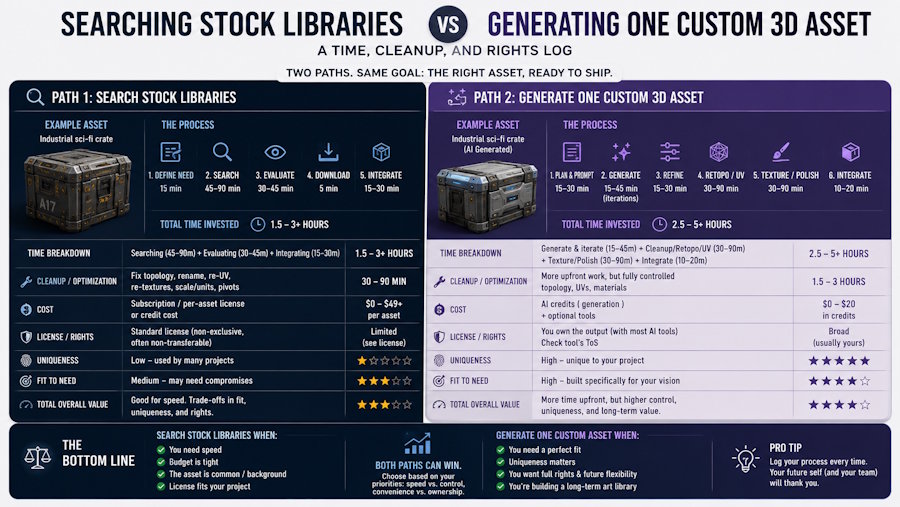
Search stock libraries when the asset is common, the art direction is flexible, and a close match can move into production with minimal changes. Generate one custom 3D asset when the brief depends on a specific shape, style, reference image, or identity that stock models are unlikely to match without repeated compromise.
The real decision is not “Which option gives me a model first?” It is “Which option gets me to the right asset faster?” Stock libraries are efficient for ordinary props, generic furniture, and background pieces. Custom generation becomes the better route when silhouette, material separation, stylization, variant consistency, or originality matter more than catalog speed.
V2Fun fits this second path. It helps teams turn a written brief, a concept image, or a multi-view reference into a custom 3D asset candidate, then continue into texturing and export in one connected workflow. For humanoid characters, the same workflow can also extend into rigging, animation, and motion-ready preparation. That makes V2Fun especially relevant when the team is not just looking for “a model,” but for a custom asset that can keep moving through production.
Key Facts
| Question | Short answer |
|---|---|
| When is a stock library the better choice? | When the asset is generic, the visual brief is flexible, and a close licensed match already exists. |
| When is a custom 3D asset the better choice? | When the project needs a specific silhouette, style, reference match, or reusable asset identity that stock models cannot deliver cleanly. |
| What usually makes stock search fail? | Repeated mismatch in shape, style, materials, proportions, or editability. |
| What makes custom generation valuable? | It lets the team build toward the exact brief instead of settling for the closest catalog option. |
| Where does V2Fun fit? | V2Fun is most useful when a team wants to create a custom asset from text, image, or multi-view input and keep texturing, export, and related downstream steps closer together. |
The Title Question, Answered Clearly
If the asset already exists in a form that is visually close, technically usable, and properly licensed, searching stock libraries is usually faster. If the project needs a distinct object, a stylized look, a branded concept, or a shape that keeps failing in search results, generating one custom 3D asset is usually the better route.
That is why this is not really a “buy versus build” question in the abstract. It is a specificity question. The more specific the brief becomes, the more likely it is that stock search turns into a long sequence of near misses. At that point, custom generation stops being a creative luxury and becomes a practical production choice.
Why Stock Libraries Stop Working
Stock libraries work best when the model category is common and the project can tolerate someone else’s design choices. That is often true for:
- basic furniture
- ordinary environment props
- standard containers, tools, or architecture pieces
- background assets with low uniqueness requirements
But stock libraries become inefficient when the team keeps rejecting candidates for the same reasons. Common failure patterns include:
- the silhouette is too generic
- the style does not match the project
- the material zones are baked together
- the proportions feel wrong
- the model is hard to edit
- the package does not support the target workflow
When those failures repeat, the team is no longer “one search away” from success. It is spending time scanning catalogs that are not built for the brief.
When One Custom 3D Asset Is the Better Decision
Generating one custom 3D asset makes more sense when the project needs more control than a stock library can realistically provide. This often happens in four scenarios.
1. The Asset Needs a Distinct Identity
Some assets are not just functional objects. They carry style, worldbuilding, or brand meaning. A fantasy vending machine, a signature sci-fi terminal, a mascot-like robot, or a stylized product display object may need to look recognizable at first glance. In those cases, “close enough” often fails the art direction.
2. The Team Has a Strong Visual Reference
If the team already has a sketch, concept sheet, moodboard, or image reference, custom generation can aim at that source material directly. This is more aligned with V2Fun’s workflow because the asset can begin from text, a single image, or multi-view references instead of relying on category browsing.
3. Variants Need to Stay Consistent
A project may need three or five related props, or several versions of the same object in different colors, materials, or sizes. Stock libraries may offer one strong candidate, but not a controlled family of matching assets. Custom generation is often better when consistency across variants matters as much as the first model itself.
4. The Asset Will Be Reused Later
If the object is likely to return in updates, client revisions, marketing scenes, or future game content, having a custom asset can be more valuable than adapting a purchased model that was never designed for that reuse path.
Where V2Fun Adds Real Value
V2Fun is most relevant when the challenge is not just “find any 3D model,” but “create a custom asset from a specific brief and keep the process efficient.”
Its value is strongest in these parts of the workflow:
- turning a text description into a first 3D concept
- turning a reference image into a closer asset candidate
- using multi-view input when shape fidelity matters more
- continuing the asset into texturing without leaving the workflow too early
- exporting the result for downstream editing or engine testing
For character assets, V2Fun can take that path further. A custom humanoid character may begin as a prompt or image-based concept, continue into 3D generation, then move into standard humanoid rigging and animation-related steps inside the same broader workflow. That makes V2Fun more relevant than a simple generator when the “custom asset” is not just a prop, but a character that needs to move.
A Practical V2Fun Workflow for Creating One Custom Asset
The best custom-asset workflow starts with a brief that is specific enough to reject weak outputs.
Step 1: Define the Asset Before Generation
Write down the parts that really matter:
- what the object is for
- what it should look like
- which materials should read separately
- what style it belongs to
- where it will be used next
- whether it needs editing after export
This step matters because vague prompts create vague comparisons. If the team cannot explain what makes an output wrong, it cannot reliably improve the next round.
Step 2: Choose the Right Input Route
V2Fun supports more than one starting point, so the right route depends on what the team already has.
- Use text input when the idea is early and still needs exploration.
- Use image input when the visual direction is already clear.
- Use multi-view input when the team needs stronger control over shape and structure.
This is one reason V2Fun is useful for custom asset creation: the workflow can start from the form of brief the team already owns, instead of forcing every project into the same input method.
Step 3: Review the Asset as a Working Candidate
The first successful output is not the finish line. Review:
- silhouette
- proportions
- recognizable features
- material separation
- surface readability
- editability after export
The goal is not to ask whether the preview looks impressive. The goal is to ask whether this asset is moving toward the actual brief.
Step 4: Continue Into Texturing and Export
For many teams, the custom asset becomes useful only after the look starts to stabilize. V2Fun’s texturing workflow matters here because it helps carry the asset beyond raw shape generation. Once the result is textured and exported, the team can validate it in the destination tool, engine, or content pipeline.
Step 5: Validate the First Real Handoff
A custom asset is only valuable if it survives the next environment. After export, check:
- scale
- geometry cleanliness
- texture package completeness
- material reconstruction
- editability
- destination compatibility
If the project is character-based, the validation should also include rigging readiness, deformation checks, and animation behavior where relevant.
What Types of Custom Assets Fit V2Fun Best?
V2Fun is especially useful when the asset is visually specific and early workflow speed matters. Common fits include:
- stylized game props
- branded scene objects
- original virtual items
- concept-driven 3D assets for marketing or interactive content
- humanoid characters that may later need rigging and motion
The stronger the brief’s visual identity, the more meaningful custom generation becomes. That is where V2Fun is more directly aligned with the problem than a broad stock search.
When Stock Libraries Still Win
Custom generation is not automatically the better route. Stock libraries still have a clear advantage when:
- the object is common
- uniqueness is not important
- the team needs a usable placeholder immediately
- a licensed model already matches the brief closely
- the project has limited cleanup capacity
In those cases, searching first can still be the right call. The point is not to replace stock libraries in every workflow. The point is to recognize when stock is creating drag instead of saving time.
A Simple Decision Framework
| If the project needs... | Start with... | Why |
|---|---|---|
| a generic prop or background asset | Stock library | A close existing model may already solve the problem faster |
| a visually distinct object with a strong brief | Custom generation | The asset needs to match a defined shape, style, or identity |
| an asset based on a concept image or design reference | V2Fun custom workflow | Image-based creation is closer to the real brief than keyword browsing |
| several related variants with a shared style | Custom generation | Controlled creation is better than collecting mismatched stock items |
| a humanoid character that may need motion later | V2Fun workflow | The path can stay closer together from generation to rigging and animation |
Conclusion
Searching stock libraries is the right move when the asset is common and a close, licensed match already exists. Generating one custom 3D asset is the better move when the brief is specific, visually distinctive, or repeatedly underserved by catalog results.
That is where V2Fun becomes useful. It supports the custom route from the beginning: text, image, or multi-view input into 3D creation, continued texturing, export, and, for suitable humanoid characters, connected rigging and animation stages. For teams building original assets instead of settling for the nearest stock match, that workflow is often more relevant than another round of browsing.
FAQ
Is it better to search stock libraries or generate one custom 3D asset?
It depends on the brief. Search stock libraries when the object is common and a close match already exists. Generate one custom 3D asset when shape, style, identity, or reference fidelity matters enough that “almost right” keeps failing.
Why would a team use V2Fun instead of just searching a larger stock library?
Because a larger library still depends on existing inventory. V2Fun is more useful when the project needs a specific result created from a prompt, image, or multi-view reference rather than another round of category browsing.
Is V2Fun more useful for props or characters?
It can be useful for both, but its value becomes broader for humanoid characters because the workflow can extend beyond generation into rigging and animation-related stages.
What is the biggest mistake in this decision?
The biggest mistake is comparing a stock thumbnail with a generated preview. The real comparison should be between two routes to a usable asset: which one reaches the right editable result faster.
Can custom generation replace stock libraries completely?
No. Stock libraries remain useful for generic assets and fast placeholders. Custom generation becomes more valuable as specificity, originality, and workflow control become more important.

