

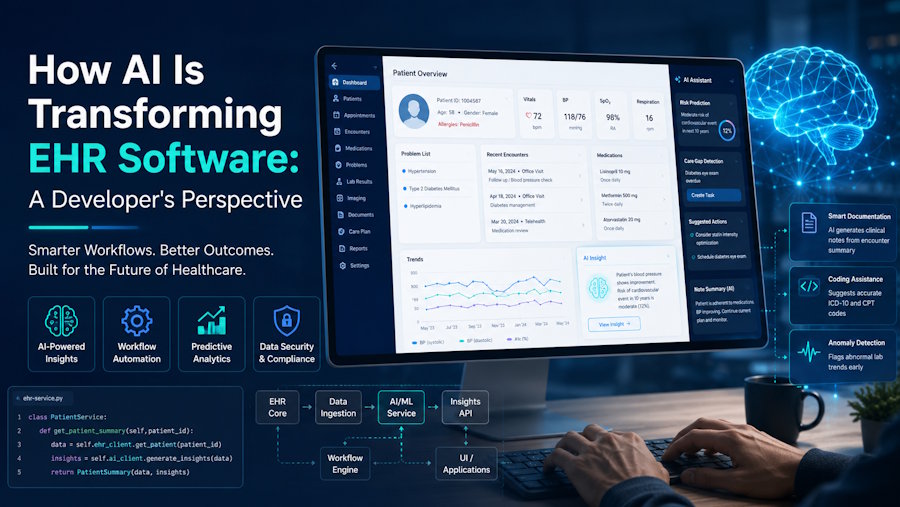
The healthcare industry has undergone a remarkable digital transformation over the past two decades. What began as a shift from paper records to electronic documentation has evolved into a sophisticated ecosystem powered by artificial intelligence. Today, developers building modern healthcare solutions are no longer focused solely on storing patient data. They are creating intelligent systems capable of understanding clinical workflows, predicting outcomes, automating administrative tasks, and enhancing patient care.
At the center of this transformation is EHR Software, which has become the operational backbone of modern healthcare organizations. With the integration of artificial intelligence, traditional electronic health records are evolving into intelligent platforms that assist physicians, streamline operations, and improve clinical decision-making.
From a developer's perspective, AI represents one of the most significant technological advancements in healthcare software development. It is reshaping how applications are designed, integrated, and deployed within clinical environments. This article explores how AI is transforming healthcare technology and what it means for developers building the next generation of healthcare solutions.
The Evolution of EHR Software
Traditional EHR platforms were primarily designed to digitize patient records and replace paper-based documentation. While this transition improved accessibility and data management, many systems still suffered from usability challenges.
Physicians often spent significant time entering data, navigating complex interfaces, and managing administrative requirements. As healthcare organizations accumulated larger datasets, the limitations of conventional systems became increasingly apparent.
Modern EHR Software is now expected to do much more than simply store information. Healthcare providers want systems that can:
- Reduce documentation burden
- Improve clinical decision-making
- Automate repetitive tasks
- Enhance patient engagement
- Increase operational efficiency
- Support predictive healthcare initiatives
Artificial intelligence is enabling these capabilities by transforming static data repositories into intelligent healthcare platforms.
Why AI Matters in Healthcare Technology
Healthcare generates enormous amounts of data every day. Clinical notes, diagnostic reports, laboratory results, imaging studies, prescriptions, insurance claims, and patient communications all contribute to a rapidly growing information ecosystem.
For developers, one of the biggest challenges is extracting meaningful insights from this data while maintaining compliance, accuracy, and security.
AI addresses this challenge by enabling software systems to:
- Analyze large datasets rapidly
- Identify patterns and trends
- Generate predictive insights
- Automate workflows
- Support real-time decision-making
Instead of requiring physicians to manually review vast amounts of information, AI-powered systems can surface relevant insights when they are needed most.
This capability is driving the rise of the AI EHR, which combines traditional electronic health record functionality with machine learning, natural language processing, and predictive analytics.
Natural Language Processing and Clinical Documentation
One of the most impactful applications of AI in healthcare is Natural Language Processing (NLP).
Clinical documentation remains one of the most time-consuming responsibilities for healthcare providers. Physicians spend countless hours entering patient information, updating charts, and creating progress notes.
Developers are increasingly leveraging NLP technologies to simplify these processes.
Modern AI-powered documentation systems can:
- Convert speech into structured clinical notes
- Extract relevant medical information from conversations
- Suggest diagnoses and coding recommendations
- Generate visit summaries automatically
- Improve documentation consistency
For developers, implementing NLP requires sophisticated language models trained on medical terminology and clinical workflows. These systems must understand context, abbreviations, specialty-specific language, and regulatory requirements.
Platforms such as CureMD have embraced AI-driven documentation technologies to help reduce physician burnout while improving record accuracy. By incorporating intelligent note-generation capabilities, healthcare providers can focus more on patient care and less on administrative tasks.
Predictive Analytics and Clinical Decision Support
One of the most exciting areas of AI development involves predictive analytics.
Healthcare organizations are increasingly looking beyond reactive care and moving toward proactive patient management. Developers are building algorithms capable of identifying risks before they become serious health issues.
AI-powered clinical decision support systems can:
- Predict hospital readmissions
- Identify high-risk patients
- Detect potential medication interactions
- Recommend preventive interventions
- Forecast disease progression
From a technical perspective, these systems rely on machine learning models trained using historical patient data.
Developers must carefully design these solutions to ensure transparency, explainability, and reliability. Healthcare professionals need to understand why a recommendation is being generated before incorporating it into clinical decisions.
As predictive analytics becomes more sophisticated, the role of the AI EHR continues to expand from record management to intelligent clinical assistance.
AI-Powered Medical Coding and Billing
Revenue cycle management remains one of the most complex operational functions within healthcare organizations.
Coding errors, claim denials, and documentation inconsistencies can significantly impact financial performance.
Artificial intelligence is helping automate many aspects of the coding and billing process.
Modern AI systems can:
- Analyze clinical documentation
- Suggest appropriate ICD and CPT codes
- Detect coding discrepancies
- Predict claim denials
- Identify reimbursement opportunities
For developers, building these systems involves combining NLP technologies with healthcare-specific coding logic and payer rules.
The integration of AI into billing workflows reduces manual effort while improving accuracy and revenue capture.
Healthcare organizations increasingly expect their EMR systems and EHR platforms to support intelligent revenue cycle automation as part of a unified workflow.
Ambient AI and Voice-Driven Workflows
Ambient AI represents one of the fastest-growing innovations in healthcare technology.
Traditional documentation workflows often require physicians to manually enter information after patient visits. Ambient AI changes this process entirely.
Using speech recognition and conversational AI, ambient systems can listen to clinical encounters and generate structured documentation automatically.
Developers building ambient AI solutions must address several technical challenges:
- Real-time audio processing
- Medical language understanding
- Data privacy compliance
- Context awareness
- Multi-speaker identification
The emergence of ambient intelligence is significantly changing user experience design within healthcare applications.
Industry leaders such as CureMD have invested in Ambient AI technologies that help providers streamline documentation while maintaining accuracy and compliance.
For developers, ambient AI demonstrates how artificial intelligence can be embedded directly into clinical workflows rather than functioning as a separate tool.
Personalized Patient Care Through AI
Healthcare is increasingly moving toward personalized medicine.
Artificial intelligence enables healthcare providers to deliver individualized treatment recommendations based on patient-specific factors.
AI-powered systems can analyze:
- Medical history
- Genetic information
- Lifestyle factors
- Medication responses
- Population health trends
Developers are creating recommendation engines capable of generating personalized care plans that adapt as new patient data becomes available.
This approach allows healthcare organizations to move beyond standardized treatment models and provide more targeted interventions.
As AI continues to evolve, EHR Software will play a central role in delivering personalized healthcare experiences.
Improving Interoperability with Intelligent Data Processing
Interoperability remains one of healthcare's biggest challenges.
Healthcare organizations often use multiple software systems that store data in different formats. This fragmentation can hinder communication and create workflow inefficiencies.
AI helps address interoperability issues by:
- Normalizing data across systems
- Mapping inconsistent terminology
- Identifying duplicate records
- Extracting information from unstructured documents
- Enhancing data quality
Developers working with healthcare integrations frequently encounter inconsistencies in data standards, coding systems, and clinical terminology.
Machine learning algorithms can help automate many of these reconciliation processes, reducing development complexity while improving data exchange accuracy.
The future of healthcare depends heavily on intelligent interoperability, making AI an essential component of modern software architecture.
AI and Population Health Management
Healthcare organizations are increasingly focused on population health initiatives.
Rather than treating individual episodes of illness, providers seek to manage the overall health of patient populations.
AI supports this objective by helping organizations:
- Identify care gaps
- Monitor chronic conditions
- Predict health risks
- Track quality measures
- Improve preventive care outcomes
Developers build population health tools that aggregate data from multiple sources and generate actionable insights.
These capabilities enable healthcare providers to prioritize interventions, allocate resources more effectively, and improve patient outcomes on a larger scale.
As a result, population health management has become a critical component of advanced EMR systems and intelligent healthcare platforms.
Security and Compliance Considerations
While AI offers significant benefits, it also introduces new challenges related to security and compliance.
Healthcare developers must ensure that AI-powered applications adhere to strict regulatory requirements.
Key considerations include:
- Data encryption
- Access controls
- Audit logging
- Model transparency
- Bias mitigation
- HIPAA compliance
AI systems often require large datasets for training and optimization. Developers must carefully manage sensitive patient information throughout the development lifecycle.
Trust remains a critical factor in healthcare technology adoption. Physicians and patients must have confidence that AI systems are secure, accurate, and ethically designed.
The Rise of AI EHR Platforms
The healthcare industry is rapidly moving toward intelligent healthcare ecosystems.
The next generation of AI EHR platforms will not simply store information. They will actively assist healthcare providers by:
- Predicting patient needs
- Automating documentation
- Streamlining billing processes
- Enhancing clinical decision-making
- Improving patient engagement
- Supporting population health initiatives
For developers, this shift requires new skills and technologies.
Expertise in machine learning, natural language processing, cloud computing, healthcare interoperability standards, and data security is becoming increasingly important.
Organizations that successfully integrate AI into healthcare workflows will gain significant competitive advantages in efficiency, patient satisfaction, and clinical outcomes.
Why CureMD Stands Out
As artificial intelligence becomes more deeply integrated into healthcare technology, platforms that combine innovation, usability, and clinical expertise are leading the market.
CureMD has established itself as an industry leader by continuously advancing its healthcare technology offerings. Through intelligent automation, Ambient AI capabilities, clinical workflow optimization, and integrated healthcare solutions, CureMD demonstrates how modern EHR Software can evolve beyond traditional recordkeeping.
Its commitment to AI-driven innovation reflects the broader industry movement toward smarter healthcare systems that reduce administrative burdens while improving patient care.
For developers evaluating healthcare technology trends, CureMD provides a compelling example of how AI can be effectively integrated into real-world clinical environments.
The Future of AI in Healthcare Development
Artificial intelligence is no longer a future concept in healthcare. It is actively transforming how healthcare software is designed, developed, and utilized.
From intelligent documentation and predictive analytics to automated coding and personalized care recommendations, AI is reshaping every aspect of healthcare technology.
For developers, this transformation presents enormous opportunities. Building healthcare applications now requires a deeper understanding of data science, machine learning, and intelligent automation.
The future belongs to systems that not only capture information but also understand it, learn from it, and use it to improve healthcare delivery.
As the industry continues its digital evolution, the convergence of artificial intelligence and EHR Software will drive the next generation of innovation. The emergence of advanced AI EHR platforms and intelligent EMR systems signals a future where technology serves as a true clinical partner rather than merely a digital filing cabinet.
Healthcare developers are at the forefront of this transformation, building the intelligent systems that will shape the future of patient care for years to come.

