

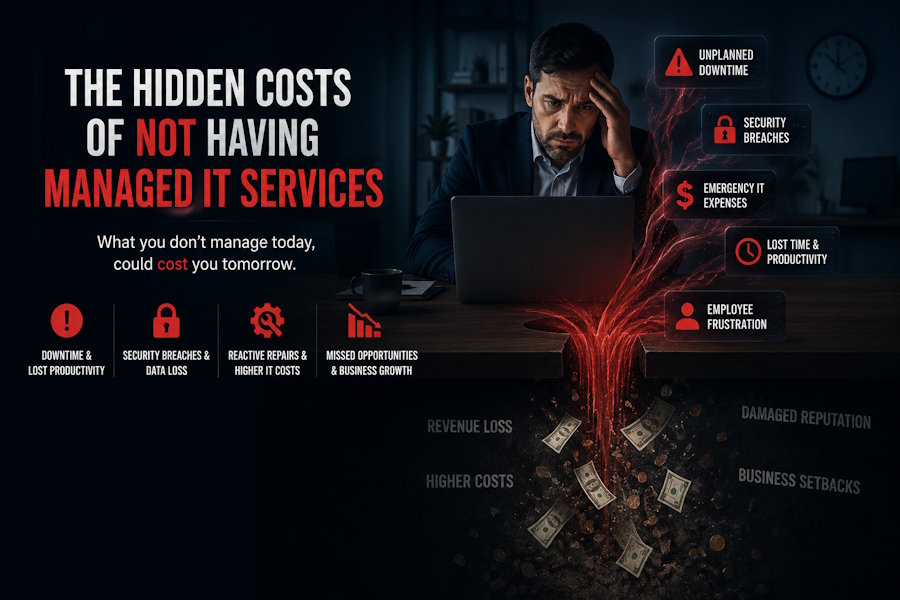
Running a business means keeping one eye on revenue and the other on expenses. You know what you are paying for. Rent, payroll, inventory, marketing. The line items are clear. But there is a category of cost that most business owners never see coming. It does not show up on a spreadsheet. It gets buried in wasted hours, lost opportunities, and problems that happen at the worst possible time. I am talking about the hidden cost of inadequate IT support. And if your business is operating without managed IT services, you are likely paying more than you realize.
The challenge is that technology problems often start small. A slow computer here. A frozen screen there. The WiFi cuts out during a call, so you restart the router and move on. These moments seem like minor annoyances. They feel like the cost of doing business in a world that runs on software and internet connections.
But when you add them up over months and years, they become something else entirely. They become a drain on your productivity, your profitability, and your peace of mind.
Let's talk about what those hidden costs actually look like.
Downtime Is More Expensive Than You Think
When a system goes down, the first thing most business owners consider is the cost of the repair. How much will the technician charge? How long will it take?
But the real cost is not the fix. It is the time.
If your team cannot access their files, their email, or their line-of-business applications, they are not working. They are waiting. You are still paying their wages. You are still paying rent and utilities. But no revenue is coming in.
For businesses that rely heavily on technology, even an hour of downtime can mean thousands of dollars in lost productivity. Add to that the frustration of rescheduled appointments, missed deadlines, and unhappy customers, and the impact multiplies.
What makes this worse is that downtime is almost always preventable. Most technology failures do not come out of nowhere. Hard drives show warning signs before they fail. Software becomes vulnerable long before an attack occurs. Networks degrade over time before they collapse.
The problem is that most businesses do not have anyone actively watching for these signals. They only find out something is wrong when it is too late.
The True Cost of Slow Response Times
When something breaks, how long does it take to get it fixed?
For many businesses, the answer is too long. They call a tech support line and sit on hold. They submit a ticket and wait for a callback. They hear "someone will look at it tomorrow" while their team sits idle.
Even when the fix itself is simple, the delay can be costly. The person experiencing the problem wastes time reporting it, following up, and working around the issue. Their coworkers wait. Customers wait. The problem that should have taken thirty minutes to resolve can easily consume half a day or more.
This is the invisible tax of reactive IT support. You only call when something is broken, so you are always in a hurry. The people fixing it are often juggling multiple emergencies. Nothing gets addressed until it becomes urgent, and urgent fixes take time.
Managed IT services operate differently. Instead of waiting for something to break, they actively monitor systems to catch small issues before they become disruptions. When a problem does occur, response times are faster because the system is already being watched. Many issues get resolved remotely before anyone in the office even notices.
The time savings may seem small on any given day. But over a year, eliminating even an hour of downtime per employee per month can translate into significant recovered productivity.
Security Breaches Are More Than Technical Events
Most business owners think of a cyber attack as a technical problem. Someone hacks into your system. They steal data. IT fixes it.
But for the businesses that experience it, a security breach is much more than a technical event. It is a business crisis.
First, there is the immediate disruption. Systems may need to be taken offline. Operations may halt while the breach is investigated. Employees cannot work. Customers cannot be served.
Then there is the cost of the response. Forensics to determine what happened. Legal consultation to understand your obligations. Notifications to customers, regulators, and partners. Often there are fines or settlements.
Beyond the direct costs, there is reputation damage. Customers may lose trust. Partners may reconsider their relationship. The brand you have built over years can be undermined in days.
Most small businesses assume they are not targets. The headlines focus on large corporations. But the reality is that cybercriminals target businesses of all sizes. Small and mid-sized businesses often have weaker defenses and fewer resources to respond, making them attractive targets.
The cost of recovering from an attack is almost always higher than the cost of preventing one. Managed IT services include proactive security measures like threat monitoring, patch management, and regular audits designed to catch vulnerabilities before they are exploited.
Software and Hardware Aging in Silence
Technology ages. Hardware components wear out over time. Software becomes outdated and unsupported.
Most businesses do not have a plan for this. They use devices until they stop working. They run software until it becomes incompatible or vulnerable.
The problem is that aging technology slows down gradually. Computers take longer to boot. Applications load more slowly. Network connections become spotty. Often, businesses adapt without even realizing it. They assume this is just how technology works.
The hidden cost is in the daily friction. Every extra click, every delayed load time, every system restart is time that your team is not spending on productive work.
Beyond the productivity drag, there is the risk factor. Older systems often cannot run current security software. They may have unpatched vulnerabilities. When something eventually fails, the disruption is often greater because the system is no longer supported, making repairs more difficult and expensive.
A proactive approach means planning for technology lifecycles. Replacing hardware before it fails. Updating software while it is still supported. Budgeting for upgrades so they do not become surprise expenses.
This is the kind of strategic planning that managed IT services provide. Instead of reacting to aging technology, you get ahead of it.
Compliance Gaps You Do Not See Coming
If your business operates in a regulated industry like healthcare, legal, or financial services, you already know that compliance matters. You have policies and procedures in place.
But compliance is not a one-time checkbox. It is an ongoing requirement. Systems change. Regulations evolve. Gaps appear.
Most businesses discover these gaps at the worst possible time: during an audit, after an incident, or when preparing to sell or merge.
The hidden cost is not just in fines. It is in the scramble to remediate. It is in the legal exposure. It is in the lost opportunity when a compliance issue prevents you from pursuing a new contract or client.
Managed IT services include ongoing compliance monitoring. So you are not guessing whether your systems meet requirements. You have documented proof, regular reviews, and a partner who keeps you informed as regulations change.
Employee Frustration and Turnover
Technology problems do not only cost time and money. They also cost patience.
When employees constantly fight with slow systems, crashing applications, or unreliable connections, their frustration builds. They start to view their work environment as an obstacle rather than a support.
This may not seem like a major issue. Everyone deals with technology problems, right?
But over time, this frustration contributes to burnout and disengagement. Talented employees may leave for organizations where they can do their work without constant technical obstacles.
Replacing an employee is expensive. Recruitment, training, and lost productivity during the transition all add up. When you view technology problems as a contributing factor to turnover, the hidden cost becomes clearer.
Managed IT services improve the employee experience. Systems work reliably. Problems are resolved quickly. Technology becomes a tool rather than a barrier.
Lost Opportunities and Innovation Gaps
Perhaps the most insidious hidden cost is what does not happen.
When your time is consumed by technology problems, you have less time for strategic thinking. You are not exploring new tools that could improve productivity. You are not automating processes that could save hours. You are not evaluating new platforms that could help you serve customers better.
In other words, you are not innovating.
Businesses that have reliable IT support operate differently. They have the capacity to explore new opportunities. They can test new solutions without fear of breaking something critical. They can plan for growth knowing their technology will scale with them.
Without managed IT services, technology often becomes a constraint. With it, technology becomes an enabler.
Thinking Differently About IT Costs
Most businesses view IT as a cost center. Something to be minimized when possible.
But this mindset misses something important. IT is not just an expense. It is infrastructure. When your infrastructure works well, your business works well. When it does not, the costs show up in places you were not looking.
Downtime. Security incidents. Compliance gaps. Employee turnover. Missed opportunities.
The businesses that thrive are not necessarily the ones spending the most on technology. They are the ones spending wisely. They invest in proactive support that prevents problems instead of waiting for them to appear.
If your business is operating without managed IT services, you may not see line items for these hidden costs on your financial statements. But you are paying them. In lost time. In lost productivity. In lost peace of mind.
And often, by the time you notice, the cost has already added up.
Frequently Asked Questions
What are managed IT services?
Managed IT services are comprehensive IT support provided by a third-party company. Instead of calling for help only when something breaks, you have ongoing monitoring, maintenance, and support. This includes cybersecurity, data backup, software updates, and help desk support.
How are managed IT services different from traditional IT support?
Traditional IT support is reactive. You call when something is broken, and they come to fix it. Managed IT services are proactive. Systems are monitored continuously, problems are addressed before they become disruptions, and strategic planning helps you avoid technology pitfalls.
Are managed IT services only for large businesses?
No. Managed IT services are beneficial for businesses of all sizes. Small and mid-sized businesses often benefit the most because they typically do not have an internal IT team. Managed services give them access to enterprise-grade support without the cost of hiring in-house staff.
How much do managed IT services cost?
Costs vary depending on the size of your business, the complexity of your technology environment, and the level of service you need. Many providers offer flat monthly rates, making costs predictable and easier to budget.
Will managed IT services replace my current IT staff?
Not necessarily. Managed IT services can work alongside your internal IT team, providing additional support, specialized expertise, and coverage for times when your staff is unavailable.
How do managed IT services improve cybersecurity?
Managed IT services include proactive security measures like threat monitoring, patch management, vulnerability assessments, and employee training. Many providers also offer advanced tools like endpoint detection and response to catch threats before they cause damage.
What happens if my systems go down?
With managed IT services, systems are monitored around the clock. Many issues are caught and resolved before they cause downtime. If a disruption does occur, response times are typically faster because the provider is already familiar with your environment and is actively watching for problems.
How do I know if my business needs managed IT services?
If your business relies on technology to operate, and you do not have a dedicated IT team or your current support is reactive rather than proactive, managed IT services may be a good fit. Signs that you could benefit include frequent downtime, slow response times from your current provider, security concerns, or difficulty planning for technology growth.
Can managed IT services help with compliance?
Yes. Many managed IT service providers offer compliance support, including regular audits, policy implementation, and ongoing monitoring to help businesses meet regulatory requirements like HIPAA, GDPR, and industry-specific standards.
How do I get started with managed IT services?
Most providers offer an initial assessment to understand your current technology environment, identify gaps, and recommend solutions tailored to your business needs. This is often a no-obligation conversation to determine if managed IT services are the right fit.

