

Introduction: Why Framework Choice Matters in Modern Web Scraping
Web scraping, as the name suggests, is the process of extracting large-scale information from digital platforms. This technique has become increasingly powerful in recent years. For businesses, web scraping is an invaluable tool for collecting data for research and competitor analysis.For example, companies may scrape Amazon to monitor product prices, customer reviews, inventory changes and competitor listings. Scraping APIs such as Scrape.do handle the proxy rotation and anti-bot obstacles that make collection at this scale difficult. Due to the technical complexity of retrieving data from competitors' websites, comprehensive web scraping frameworks have been created that offer advanced and specialized features. In this post, we will examine and compare the top web scraping frameworks used by leading data scraping service providers.
What Makes a Web Scraping Framework “Modern”?
Modern web scraping frameworks have the latest technology to maximize efficiency, precision, and automation. JavaScript rendering is a primary requirement that modern data scraping tools must have. The latest web scraping tools can be easily identified by looking at their features, such as automatic pattern detection and cleaner and more stable data delivery.
When scraping data, there is a high risk of bot detection. The latest web scraping tools have built-in features to improve access reliability while reducing detection risk. Their speciality lies in reducing dependency on local systems and providing scalability.
Key Frameworks to Compare
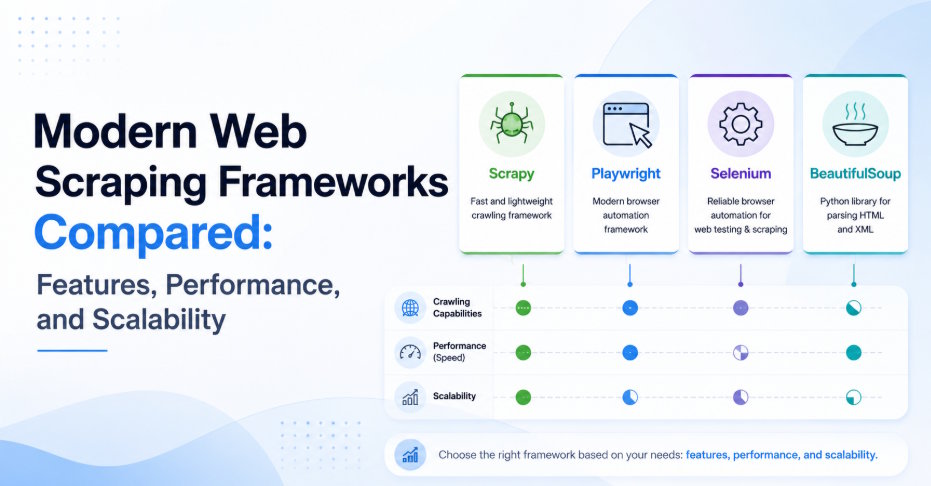
For those who want to scrape data and gain a competitive edge, here’s a quick overview of the web scraping frameworks on the list:
Scrapy
This open-source Python framework has been developed and released under an open-source license and continues to be developed collaboratively. This is because it is relatively fast and has the capability of customizing large-scale web scraping. Scrapy is the most popular web data scraping framework out there for large-scale data extraction. It is a faster Python framework for collecting structured data for data-driven decision-making (DDDM).
Playwright
Playwright is a powerful web automation framework developed by Microsoft. Launched recently, this tool gives developers full access to custom interactions. Programmers can pair Playwright with the Firecrawl API for JavaScript rendering and reliable extraction of data at scale. This application is powerful for dynamic content rendering and interaction with modern websites.
Selenium
Selenium is a browser automation tool that can be customized to programmatically simulate browsing a website like a real person. Selenium lets you extract comprehensive data from interactive elements, like tables, dropdown menus, and modal windows. It helps scrape data from complex webpages like the ones that load information via JavaScript.
BeautifulSoup
BeautifulSoup is a Python package designed for parsing both XML and HTML documents. It works with any parser to provide idiomatic ways of navigating, searching, and altering the parse tree. BeautifulSoup is not just versatile but also saves a lot of time. It makes a parse tree of source code, which makes the scraping of data from it quite easy.
Feature Comparison: What Each Framework Offers
Each framework we discussed offers unique capabilities. Let's have a look at them.
Scrapy
- This framework is highly customizable.
- Helps you identify and remove unwanted data.
- It provides convenient storage.
- Supports CSV, JSON, XML, and many more formats.
- Rich plugin integrations and ecosystem.
- Good support for parsing
Playwright
- Capability to automate real browsers.
- Works well with custom headers and proxies when configured
- Supports persistent sessions
- Handles navigation, JS, clicks, SPA, forms, rendering, scrolls, etc.
- Ideal for websites having a complex and dynamic structure.
- Multiple browser contexts for data scraping.
Selenium
- Full browser automation
- Supports headless mode
- Works well both in cloud/browser-grid and local setups
- Unique interaction control feature
- Handles rendered pages
BeautifulSoup
- Handles nested structures
- Extracts text without markup
- Flexible HTML parsing
- Lightweight Python library
- Converts documents to Unicode
Performance Comparison of Each Framework
Scrapy
Performance and speed are priorities for Scrapy because it is optimized for fast, parallel requests. This framework is resource-efficient, maximizing performance with minimal resources.
Playwright
A playwright performs better when scraping data. It is reliable enough to achieve your web scraping task. However, the downside of this framework is that it requires more resources than a single machine can provide.
Selenium
Selenium, on the other hand, remains a safe choice for scalable web scraping. This data extraction framework is an ideal choice to optimize scraping performance and lower resource consumption.
BeautifulSoup
BeautifulSoup is suitable for large and small-scale data scraping projects and rapid prototyping. The main advantages of this library are simplicity, performance, and low infrastructure cost.
Scalability: Which Framework Handles Growth Best?
Scrapy is a powerful and useful tool to deal with complex and large datasets. Its asynchronous core allows it to scale up massively with significantly lower memory and CPU overhead. Playwright and Selenium are not scalable because they have hardware overhead. BeautifulSoup is great if you do not care about data scraping performance. It is just an easily horizontally scalable data pipeline.
Best Use Cases for Each Framework
The table below is a quick pick guide to understand the use cases of each framework.
|
Need |
Best Pick |
Reason |
|
Crawling Framework |
Scrapy |
Best open-source crawl orchestration framework. |
|
Browser automation library |
Playwright |
It is the best browser controller when you require custom interactions. |
|
Legacy browser automation |
Selenium |
Broad browser and language support, more than Playwright |
|
Creating a parse tree |
BeautifulSoup |
Best for traversing the DOM and scraping data |
Common Mistakes When Choosing a Framework
Frameworks are important tools for web scraping. Each of them has its own features and strengths and is suitable for certain skill levels. However, people make the following mistakes when choosing a framework.
- Choosing the light weight and open-source tool when scraping a large amount of data.
- Focusing on data scraping frequency and speed rather than quality of output.
- Evaluating a framework without understanding the HTML and CSS of the website.
- Choosing a hard framework when easy-to-use frameworks are available. If your current project requirements are highly specific, it is often more efficient to deploy a basic Python scraping structure rather than overhead-heavy, third-party enterprise tools.
- Scrape data with a framework that overloads websites with requests.
How to Choose the Right Web Scraping Framework
Any attempt to carry out work with the wrong data scraping tool may damage your brand. You need to choose the right one based on understanding your needs and evaluating options.
- Choose the right framework depending on the complexity of the website.
- Always select a framework that meets your vision.
- Decide on a framework based on scraping frequency and volume.
- Consider the data types you are extracting, whether they are text and numbers, or PDFs or images.
- Keep website structure in mind.
- Select the right web scraping tool depending on your technical skills and resources.
- Check the tool exports data in the format you need (JSON, CSV, XML, etc.)
Conclusion
Playwright and Selenium are best when you require custom interactions. BeautifulSoup is a simple tool designed to handle parsing of XML and HTML documents. Choosing the ideal browser automation tools comes down to your speed requirements, your stack, and the modernity of websites. Modern data extraction frameworks have their own functionalities and strengths and are suitable for certain skill levels. However, choosing the right framework for your business requires careful decision-making.

