

|
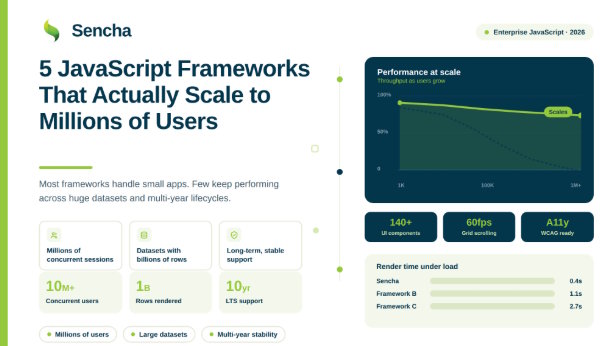
Most JavaScript frameworks work fine for small applications, but only a few continue to perform well when applications grow to millions of users, very large datasets, and multi-year lifecycles. This guide reviews five JavaScript frameworks that have repeatedly demonstrated the ability to scale across all three dimensions: user count, data volume, and application longevity. Each framework's scaling characteristics, architectural strengths, and the trade-offs that come with them are covered, alongside guidance on choosing the right framework for enterprise application development at scale. Key Takeaways
|
What 'Scaling to Millions of Users' Actually Means
Scaling a JavaScript application to millions of users is often misunderstood. The conversation usually focuses on the back end, but front-end scaling is a separate problem with separate consequences. A back-end stack can absorb load through horizontal scaling and caching, while a front-end framework lives inside every user's browser and either holds up under realistic load or doesn't.
Scaling to millions of users actually means three different kinds of scale, and a good JavaScript framework choice addresses all of them. User scale is the number of concurrent users the application supports across browsers, devices, and network conditions. Data scale is the size of the datasets the application must display and manipulate, which often grows along with user adoption. Application scale is the longevity and complexity of the application itself, including how many developers contribute over time and how many years the application must remain maintainable. Most JavaScript frameworks handle one or two of these dimensions well, but only a few handle all three.
Enterprise application development at scale is where these dimensions converge. Internal applications used by tens of thousands of employees, customer-facing applications serving millions of users, and data-intensive dashboards used by financial services or healthcare organizations all stress the framework across user, data, and application scale at once. Choosing a framework that handles all three is significantly easier than retrofitting scale into a framework that handles only one.
What Makes a Framework Scale
Several capabilities consistently separate frameworks that scale from frameworks that look fine in demos but break under real load. These capabilities apply across the framework's architecture, its component library, and the supporting ecosystem.
Memory discipline matters more at scale than at any smaller size. Applications that users keep open for long sessions need frameworks that dispose of unused components and data correctly, because memory leaks that are invisible in a five-minute session become severe after eight hours of use across thousands of users. Render efficiency matters when applications display large lists, grids, or complex visualizations, because frameworks without virtualization or fine-grained reactivity slow down predictably as data grows.
Architectural discipline matters for application scale. Frameworks that encourage strong component boundaries, predictable state management, and consistent patterns scale across many developers and many years. Frameworks that allow many valid styles to coexist scale less well for large teams, because the inconsistency makes the application progressively harder to maintain. Backward compatibility matters because applications used by millions of users have multi-year lifecycles, and a framework that requires major rewrites every two years cannot meet that horizon without costly migrations.
Vendor and community continuity matters for very long-lived applications. Frameworks backed by single individuals or small teams carry concentration risk that becomes significant over time. Frameworks backed by major organizations or large, diverse contributor communities provide the continuity that long-running applications require. With these criteria in mind, five frameworks consistently demonstrate the ability to scale across all three dimensions.
The 5 JavaScript Frameworks That Scale
1. Ext JS: Built for enterprise application development at scale
Ext JS is built specifically for enterprise applications that need to scale across user count, data volume, and application longevity at the same time. We built Ext JS for data-intensive scenarios, with 140+ pre-built components, a high-performance data grid with native virtualization, and architectural patterns designed for long-lived applications maintained by large teams.
Data scale is where Ext JS shows its strongest advantage. The grid handles very large datasets through built-in column virtualization and horizontal buffering, with only the visible cells rendered at any time. Memory usage stays stable through extended user sessions because the framework disposes of unused components correctly. Performance does not degrade as the grid grows from a few thousand rows to many tens of thousands, which matters for the financial services, manufacturing, and healthcare applications that often live in that range.
Application scale benefits from Ext JS's opinionated architecture, strong backward compatibility across major versions, and the Sencha Upgrade Adviser that supports version migrations. The framework's architectural patterns help large teams maintain consistent code quality across years of development, and 15+ years of continuous development by Sencha provides the vendor continuity that mission-critical applications need. For enterprise application development where the application must scale across all three dimensions, Ext JS earns strong scores against each one. Best for: data-intensive enterprise applications, financial trading and dashboards, manufacturing systems, and complex internal tools.
2. React: Scaling through ecosystem maturity
React is the most widely adopted JavaScript framework and the most reliable choice for consumer-scale applications. The framework's component-based architecture, virtual DOM, and concurrent rendering capabilities scale well across very large user populations, and Meta's continued investment plus the framework's diverse contributor community provide strong continuity.
User scale is React's strongest dimension. Many of the largest consumer applications on the web run on React, and the framework's rendering model handles complex interactive UIs at scale without significant friction. Server Components and concurrent rendering features in recent versions provide additional performance options for very large applications. The hiring pool is the largest of any JavaScript framework, which matters at scale because organizations with hundreds of developers cannot easily standardize on a framework where senior expertise is rare.
Data scale is React's weaker dimension when measured against frameworks built specifically for data-intensive applications. React itself does not include virtualization or enterprise-grade data components, so teams that need to display very large datasets typically integrate libraries such as ag-Grid or TanStack Virtual. This works well when the team has the expertise to manage the additional integration, but it adds operational complexity compared to frameworks with built-in capability. Application scale benefits from React's ecosystem maturity, but the reliance on third-party libraries means application stability depends on the stability of many independently maintained packages. Best for: consumer-facing applications, content-driven sites, and teams with strong React expertise who are comfortable assembling production stacks.
3. Angular: Scaling through structure
Angular is a complete framework with built-in routing, forms, HTTP client, testing utilities, and a comprehensive CLI. The opinionated architecture provides structure that scales well across large teams, and TypeScript by default catches errors at compile time that would otherwise reach production. Google's backing provides long-term vendor continuity.
Application scale is Angular's strongest dimension. The framework's structured patterns, dependency injection, and module system support large applications maintained by many developers over many years. Code written by different teams in the same large organization looks consistent, which makes the application easier to maintain than equivalent applications built in less opinionated frameworks. The Angular CLI, testing utilities, and build tooling all reduce the operational overhead that grows with application size.
User scale is good but typically requires more performance tuning than React for very large applications, because Angular's change detection can become expensive in deeply nested component trees. Data scale, like React, often requires third-party components such as PrimeNG or ag-Grid for enterprise-grade data grids. The release cadence introduces breaking changes more often than some other frameworks, which means application scale comes with ongoing upgrade work. Best for: large enterprise teams that benefit from structure, government and regulated projects, and organizations standardizing on TypeScript across the engineering organization.
4. Vue: Scaling through progressive adoption
Vue scales well for mid-size enterprise applications and is particularly strong for organizations modernizing existing applications. The progressive enhancement model lets teams introduce Vue into existing applications without a full rewrite, which makes Vue scale through gradual adoption rather than through up-front commitment to a complete framework migration.
User scale is good for mid-size applications. Vue 3's Composition API and reactivity system support sophisticated component architectures, and bundle sizes are smaller than Angular while runtime performance is on par with React. Application scale benefits from Vue's gentle learning curve, which means new hires reach productivity quickly and teams with mixed skill levels can contribute consistently. Single-file components combining template, script, and style support architectural clarity that helps applications stay maintainable as they grow.
Data scale is Vue's weaker dimension. The component ecosystem for very large datasets is less mature than React's or Ext JS's, and teams building data-intensive applications on Vue often need to assemble components from multiple sources or build custom solutions. Vendor continuity comes from Vue's diverse community rather than a single major backer, which is a different risk profile than React or Angular. Best for: mid-size enterprise applications, organizations modernizing legacy systems, and teams that value developer experience as a primary criterion.
5. Svelte: Scaling through compile-time optimization
Svelte takes a different approach to scaling: rather than optimizing a runtime, it compiles components to plain JavaScript at build time. This produces small bundles and strong runtime performance, which matters for user scale when network conditions vary widely across the application's user base. SvelteKit extends the framework with server-side rendering and static site generation for full-stack applications.
User scale benefits from Svelte's compile-time approach because small bundles load faster on slower networks and lower-powered devices. This matters at consumer scale, where the marginal user often has the worst connection. Runtime performance is strong because the compiler produces optimized code rather than relying on a runtime framework, which helps applications stay responsive as they grow.
Data scale and application scale are where Svelte is less mature than the established alternatives. The component ecosystem for enterprise scenarios is smaller, and applications that need extensive data components typically assemble from third-party libraries or build custom solutions. Application scale is good for the projects that Svelte fits, but the smaller community and shorter track record mean Svelte is a less proven choice for very long-lived applications. Best for: performance-sensitive applications, projects where bundle size has a direct effect on user experience, and teams comfortable adopting newer technology.
How the Five Compare on Scaling Dimensions
|
Framework |
User scale |
Data scale |
App scale |
Backward compat |
Best for |
|
Ext JS |
Strong |
Very strong |
Very strong |
Very strong |
Data-intensive enterprise apps |
|
React |
Very strong |
Strong with ag-Grid |
Strong |
Variable |
Consumer-scale applications |
|
Angular |
Strong |
Strong with libraries |
Very strong |
Predictable cycle |
Large structured teams |
|
Vue |
Strong |
Moderate |
Strong |
Good |
Mid-size and modernization |
|
Svelte |
Strong |
Moderate |
Moderate |
Good |
Performance-sensitive apps |
Common Mistakes When Choosing for Scale
Several patterns consistently produce poor framework decisions for applications that need to scale. Recognizing these patterns helps avoid the costliest mistakes.
The first common mistake is evaluating on small demos. Every framework handles a small example well, and demo performance does not predict performance at scale. A framework that renders a hundred grid rows smoothly may become unusable at ten thousand, and the gap between demo behavior and production behavior is invisible until production load reveals it. Proof-of-concept implementations with realistic data volumes are the most reliable way to evaluate scaling behavior before committing.
The second common mistake is treating user scale as the only scaling dimension. Many framework comparisons focus on user count and ignore data scale and application scale, but data-intensive enterprise applications often stress data scale much harder than user scale, and applications with multi-year lifecycles stress application scale more than either of the other two. A framework that scales well for one dimension may fail for another, and the right comparison evaluates all three together.
The third common mistake is choosing on popularity. The most popular framework for consumer applications is not always the right choice for an enterprise application development scenario, particularly for data-intensive work where consumer-focused frameworks lack the built-in capability that comprehensive enterprise frameworks provide. Popularity matters for hiring, but it should be one factor among many rather than the deciding factor.
The fourth common mistake is ignoring application lifespan. Frameworks that require major rewrites every two or three years carry ongoing engineering cost that an enterprise application cannot easily absorb. For applications expected to run for many years, backward compatibility and vendor continuity matter as much as current performance, and frameworks with strong commitments to both produce lower total cost of ownership across the application's lifecycle.
Choosing a Framework for Your Scaling Profile
Different application profiles require different scaling priorities, and the right framework choice matches the application's specific profile rather than defaulting to whichever framework is most popular.
For data-intensive enterprise applications, where the application must handle very large datasets in addition to user load and longevity, Ext JS provides the strongest combination of native data capability, backward compatibility, and vendor continuity. The 140+ built-in components and high-performance data grid handle the data dimension natively, while strong backward compatibility supports the longevity dimension. Best for financial services, manufacturing, healthcare, and other data-heavy enterprise scenarios.
For consumer-scale applications, where user count is the primary scaling concern and data complexity is moderate, React's ecosystem maturity and hiring pool make it the most reliable choice. The framework's component model handles complex consumer UIs at very large user scale, and the broad community provides the continuity that long-running consumer applications need.
For large structured teams that benefit from opinionated architecture, Angular's complete framework and TypeScript-first approach scale well across many developers and many years. Government, regulated industry, and large enterprise development scenarios often fit Angular better than less structured alternatives.
For mid-size enterprise applications and progressive modernization, Vue scales well without the up-front commitment of a complete framework migration. The progressive enhancement model is particularly valuable for organizations modernizing legacy systems incrementally.
For performance-sensitive applications where bundle size has a direct effect on user experience, Svelte's compile-time approach produces strong scaling characteristics in user-facing performance, though the smaller ecosystem makes it a less proven choice for very large or very long-lived applications.
Conclusion
Scaling a JavaScript application to millions of users is a multi-dimensional problem, and only a few frameworks handle all of user scale, data scale, and application scale together. The five frameworks in this guide each have a place: Ext JS for data-intensive enterprise applications, React for consumer-scale work, Angular for large structured teams, Vue for mid-size and modernization scenarios, and Svelte for performance-sensitive applications.
For enterprise application development at scale, where the application must handle large datasets across many users for many years, Ext JS consistently provides the strongest combination of native capability and long-term support. We built the framework for exactly this profile, which is why it tends to score well against the criteria that data-intensive enterprise applications stress.
Teams ready to evaluate Ext JS for a data-intensive enterprise application can start a free trial and assess the framework against their own data, integration requirements, and team capability.
Frequently Asked Questions
What does it mean for a JavaScript framework to scale to millions of users?
Scaling to millions of users actually means three different dimensions of scale: user count (concurrent users across browsers and devices), data scale (the size of datasets the application displays and manipulates), and application scale (the longevity and complexity of the application over time). A framework that scales well usually addresses all three, and most enterprise application development scenarios stress all three at once.
Which JavaScript framework scales best for enterprise application development?
For data-intensive enterprise applications, Ext JS provides the strongest combination of native data capability, backward compatibility, and long-term vendor continuity. For consumer-scale enterprise applications without data-intensive requirements, React's ecosystem maturity and hiring pool are usually decisive. For large structured teams, Angular's complete framework and TypeScript-first approach scale well across many developers. The right choice depends on which scaling dimension matters most for the project.
Can React handle data-intensive enterprise applications?
Yes, with the right supporting libraries. React itself does not include virtualization or enterprise-grade data components, so teams that need to display very large datasets typically integrate libraries such as ag-Grid Enterprise or TanStack Virtual. This works well for teams with strong React expertise, but adds operational complexity compared to frameworks with built-in capability. For React teams that want enterprise components without leaving React, ReExt provides a bridge that lets Ext JS components run inside an existing React application.
How important is backward compatibility for scaling?
Backward compatibility is critical for applications with multi-year lifecycles. Frameworks that require major rewrites every two or three years carry ongoing engineering cost that an enterprise application cannot easily absorb. For applications expected to run for many years, backward compatibility is one of the strongest predictors of total cost of ownership, often more significant than initial development cost. Ext JS maintains strong backward compatibility across major versions, supported by the Sencha Upgrade Adviser that scans existing codebases and identifies needed changes.
What about performance for very large datasets?
Frameworks with built-in virtualization handle very large datasets more reliably than frameworks that rely on third-party plugins. Ext JS includes virtualization, horizontal buffering, and column virtualization built into the framework, which keeps performance steady at very large data volumes. React with ag-Grid Enterprise can reach similar performance levels, but adds licensing cost and integration work. Angular and Vue typically require third-party components for equivalent performance with very large datasets.
Do these frameworks all support TypeScript?
Yes, all five frameworks support TypeScript well in 2026. Angular uses TypeScript by default and provides the deepest TypeScript integration. React, Vue, and Svelte all offer strong TypeScript support without requiring it. Ext JS provides TypeScript definitions for use in TypeScript projects. For applications that span hundreds of developers across many years, TypeScript reduces the cost of evolution by catching type errors at compile time, which makes it a useful addition to any of these frameworks at scale.
What is the role of application development software in framework choice?
Application development software extends beyond the framework itself to the build tools, testing utilities, IDE support, design tools, and team practices that surround the framework. Frameworks with mature surrounding tooling, such as the Sencha CMD, Architect, Themer, and Test tools that ship with Ext JS, or the Angular CLI and DevKit, reduce the assembly work that teams would otherwise have to do themselves. At enterprise scale, the surrounding tooling often affects productivity more than the framework's core capabilities, because tooling is what makes large applications maintainable over years.
How do I evaluate framework scaling before committing?
Build a small proof of concept with realistic data volumes and interaction patterns. The proof of concept should exercise the application's most demanding scenarios: largest dataset, most complex form, heaviest dashboard, longest user session. Measure rendering time, memory usage during long sessions, interaction latency, and the team's productivity in the framework after a week or two of real work. Synthetic benchmarks rarely predict real production performance, but a focused proof of concept reveals the real scaling characteristics that matter for the project.
Should I worry about a framework reaching end of life?
Vendor and community continuity matters for very long-lived applications. Frameworks backed by major organizations, such as React (Meta) and Angular (Google), or by commercial vendors with multi-year track records, such as Ext JS (Sencha), provide stronger continuity than frameworks backed by single individuals or small teams. For applications expected to run for many years, evaluate the framework's institutional backing alongside its technical capabilities.
Can I migrate between these frameworks if my needs change?
Framework migrations are expensive in any direction, and the right time to choose well is at the start of the project. That said, some migration paths are more practical than others. ReExt lets React applications gradually adopt Ext JS components without leaving React, which is often easier than a full migration. Vue's progressive enhancement model supports incremental introduction into existing applications. Other migrations typically require significant rewrites, so the initial framework choice has long-lasting consequences and is worth taking time to get right.

