

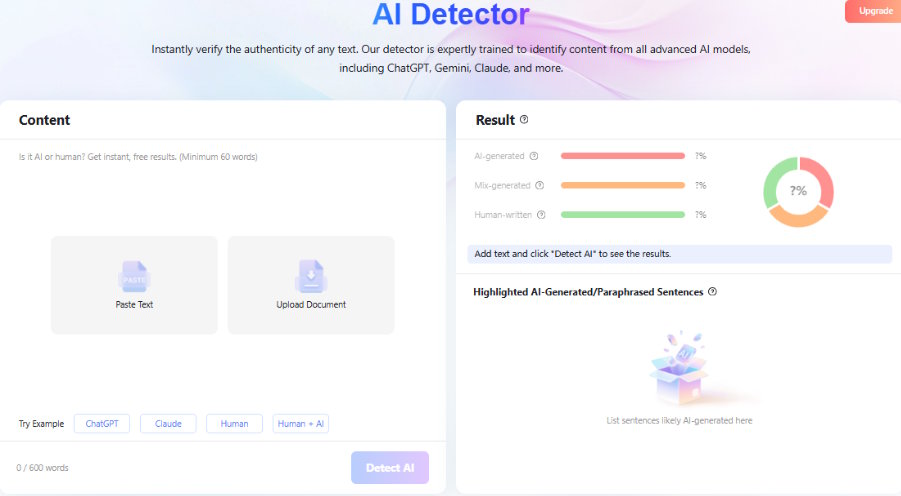
Artificial intelligence has transformed the way people create content. Developers use AI to generate technical documentation, marketers rely on AI for campaign drafts, students use AI-assisted research tools, and businesses increasingly automate content production at scale. While these advances have improved productivity, they have also created a new challenge: distinguishing between human-written and AI-generated content while maintaining authenticity and quality.
As AI models such as GPT-5, Gemini, Claude, and LLaMA continue to improve, traditional methods of content evaluation are becoming less effective. Organizations, educators, publishers, and content managers now require more advanced solutions that can accurately identify AI-generated text and help users refine content to sound more natural when appropriate.
This growing demand has led to the emergence of specialized technologies designed to address both sides of the challenge: AI detection and AI humanization.
Why AI Content Verification Has Become Essential
The widespread adoption of generative AI has fundamentally changed content creation workflows. In many industries, AI-generated content is no longer the exception—it is becoming the norm.
However, this shift introduces several concerns:
- Academic institutions need to evaluate student submissions fairly.
- Publishers want to maintain editorial standards.
- Businesses need to verify the authenticity of user-generated content.
- Recruiters and hiring managers increasingly encounter AI-assisted application materials.
- Website owners seek transparency regarding content origins.
The challenge is that modern AI-generated text often appears highly convincing. Earlier detection methods focused on identifying repetitive phrasing or predictable language patterns, but today's advanced models produce content that closely resembles human writing.
As a result, organizations need tools capable of analyzing deeper linguistic signals rather than relying on surface-level indicators.
A high-quality best ai detector should not only identify content produced directly by AI models but also recognize text that has been modified, rewritten, or intentionally altered to appear more human.
The Evolution of AI Detection Technology
AI detection technology has progressed significantly over the past few years.
First-generation detectors primarily focused on statistical patterns such as perplexity and burstiness. While useful in some cases, these approaches often struggled with newer AI models and frequently produced false positives.
Modern detection systems are becoming more sophisticated by incorporating:
- Advanced linguistic analysis
- Multi-model recognition
- Pattern correlation techniques
- Semantic consistency evaluation
- Contextual probability assessment
One of the most important developments is the ability to identify content generated by a wide range of AI systems rather than a single model family.
For example, today's content ecosystem includes outputs generated by:
- GPT-5
- Gemini
- Claude
- LLaMA
- DeepSeek
- Open-source language models
- Industry-specific AI assistants
Detection solutions that fail to keep pace with these evolving technologies quickly become obsolete.
Platforms such as Lynote.ai focus on broad AI model coverage and advanced analysis methods designed to recognize content across multiple generations of language models. This approach is increasingly important as organizations encounter text originating from diverse AI sources rather than a single provider.
Beyond Detection: The Challenge of AI-Humanized Content
A newer challenge has emerged alongside AI detection.
Many users now pass AI-generated content through rewriting tools before publication. The objective is often to improve readability, adapt tone, or make the content sound more natural.
Unfortunately, some detection tools struggle to identify text that has undergone multiple rounds of rewriting.
This has created an ongoing technological race between content transformation systems and detection technologies.
Advanced AI detection platforms now focus on identifying deeper structural characteristics rather than merely scanning for obvious AI-generated patterns. By analyzing semantic relationships, writing consistency, and contextual signals, they can better recognize content that has been altered after its initial generation.
This capability is becoming increasingly valuable for universities, publishers, and organizations that require accurate assessments of content origin.
Why Humanization Matters for Legitimate Content Creation
While AI detection receives significant attention, AI humanization is equally important.
Many users do not seek to deceive readers. Instead, they want to improve content quality.
Raw AI-generated text often suffers from several common issues:
- Repetitive sentence structures
- Predictable transitions
- Generic wording
- Lack of personality
- Inconsistent tone
These weaknesses can reduce engagement and negatively impact reader experience.
Humanization tools help address these challenges by transforming AI-generated drafts into content that feels more natural and authentic.
The most effective solutions go far beyond simple synonym replacement.
A quality best ai humanizer should understand context, preserve meaning, and maintain logical flow throughout the rewriting process. This ensures that the resulting content remains accurate while becoming more engaging and human-like.
What Makes Modern AI Humanization Effective
Not all humanization tools are created equal.
Basic text spinners often damage readability because they replace words without understanding context. This can introduce awkward phrasing, grammatical issues, and even factual inaccuracies.
Modern AI humanization platforms take a different approach.
They analyze:
- Sentence relationships
- Contextual meaning
- Writing objectives
- Audience expectations
- Document structure
By understanding the intent behind the content, advanced systems can rewrite text in ways that feel genuinely natural.
Lynote.ai, for example, emphasizes context-aware rewriting rather than simple word substitution. This allows users to preserve the original message while significantly improving readability and flow.
The platform also supports content generated by major AI systems including ChatGPT, Gemini, Claude, and DeepSeek, making it useful for teams working across multiple AI environments.
The Importance of Multilingual Support
AI content creation is no longer limited to English.
Global businesses increasingly produce content in:
- Spanish
- French
- Portuguese
- German
- Italian
- Japanese
- Korean
- Arabic
- And many other languages
As international AI adoption grows, multilingual support becomes a critical requirement.
Detection systems must be capable of identifying AI-generated content across multiple languages while maintaining accuracy.
Similarly, humanization tools should adapt naturally to linguistic and cultural differences rather than applying English-centric rewriting methods.
Solutions that support dozens of languages offer significant advantages for global organizations, educational institutions, and international publishers.
This is particularly relevant for companies managing multilingual websites, documentation libraries, and customer-facing content.
Balancing Transparency and Productivity
The conversation around AI-generated content should not be framed as a battle between humans and machines.
AI has become an essential productivity tool across countless industries. The goal is not to eliminate AI usage but to create transparency and maintain quality standards.
Detection technologies help organizations understand content origins.
Humanization technologies help improve communication quality.
Together, they enable more responsible AI adoption.
As AI continues to evolve, businesses and institutions will increasingly need tools capable of:
- Detecting content generated by multiple AI models
- Identifying rewritten AI text
- Supporting multilingual analysis
- Improving content readability
- Preserving meaning during transformation
- Maintaining authenticity across communication channels
Conclusion
The rapid advancement of generative AI has created new opportunities and new responsibilities. Organizations can no longer rely on outdated methods to evaluate content authenticity, nor can they ignore the need for more natural and engaging AI-assisted writing.
The future belongs to solutions that combine powerful detection capabilities with sophisticated content transformation technologies.
Platforms such as Lynote.ai represent this emerging direction by addressing both sides of the equation: helping users identify AI-generated content with high accuracy while also enabling the creation of more natural, human-like writing experiences.
As AI becomes increasingly embedded in everyday workflows, reliable detection and intelligent humanization will play a central role in ensuring that content remains trustworthy, effective, and valuable for readers around the world.

